Your China & Yunnan Travel Experts

 Ask a Question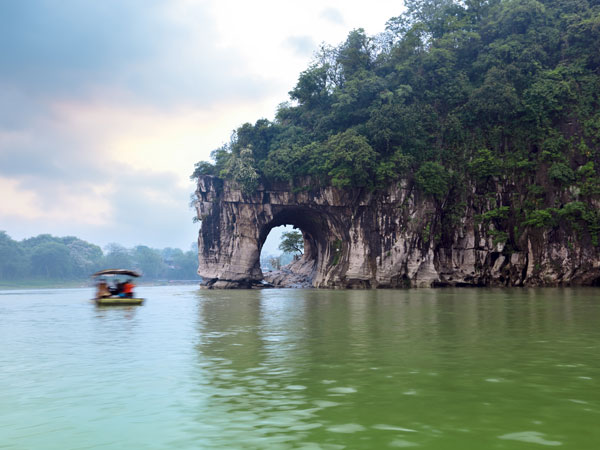
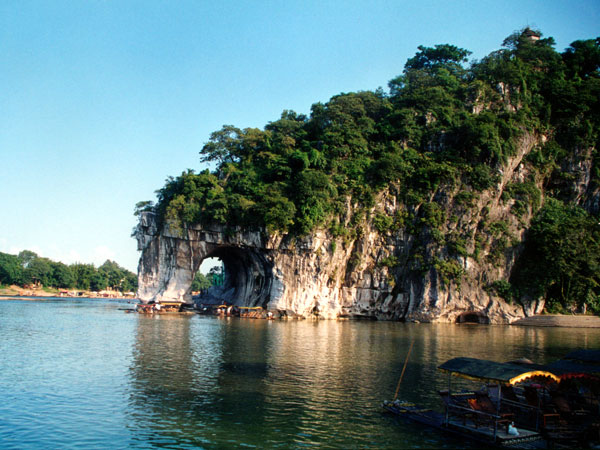
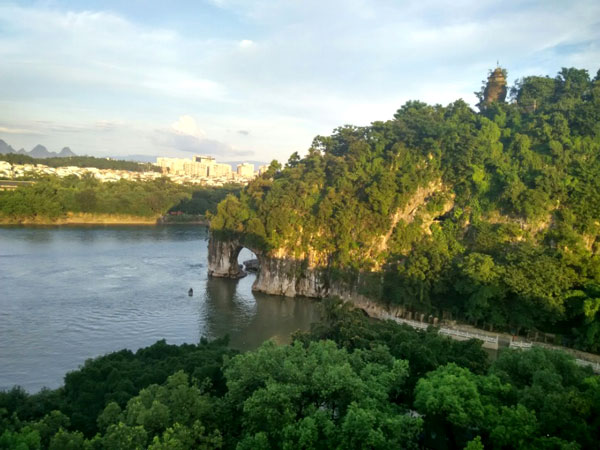
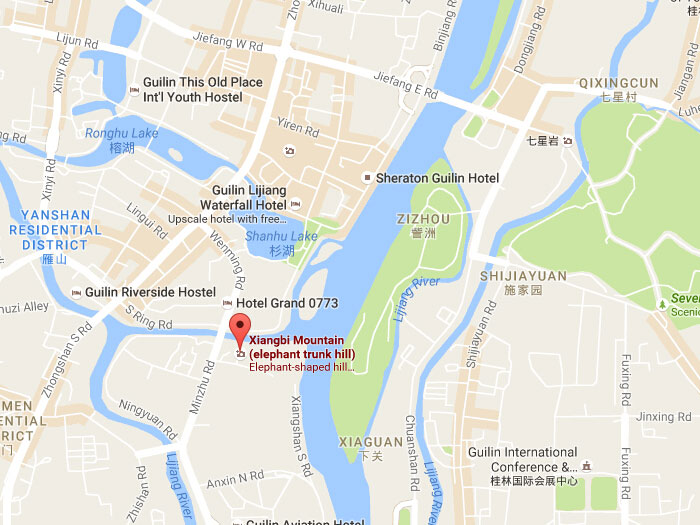
Infall of Peach Blossom River and Li River, Guilin, Guangxi, China
Landmark of Guilin City
On the top of the hill stands a pagoda – Puxian Pagoda. Built in Ming Dynasty, it has a long history. At the foot of the hill is Yunfeng Temple, inside which is now the exhibition of The Revolution of the Taiping Heavenly Kindom in Guilin.
One legent tells that how Elephant Trunk Tree came about, In ancient time there is an elephant, which belonged to the Emperor of Heaven, came down to earth to help the people in their work. This angered the Emperor of Heaven, who stabbed the elephant while it was drinking at the river's edge and turned it to stone. The cave between the body and the trunk of this elephant figure is of a particularly interesting shape and has inspired poets and other writers, old and new, to engrave verses on its walls. The poems of Lo You, Fan Chengda, and other poets from different dynasties are of inestimable literary and archaeological value. On the top of the hill stands the Puxian Pagoda, erected during the Ming Dynasty (1368-1644) and shaped as the handle of the dagger with which the elephant was killed.
Another legent tells that in ancient time, once 7 fairies came down from the heaven palace to appreciate the beautiful sceneries in the world. The youngest fairy saw that people living along the Li River often bothered by the flood, and the masses were living on the edge of starvation. She took pity on them. So she came down again with the god elephant of the Jade Emperor to help people here. When the Jade Emperor found the truth, he was very angry. He ordered his celestial general to take the fairy back. The elephant became the elephant hill with a sword on its back and it would never go back to the heaven palace. One day, Samantabhadra Bodhisattva passed here and saw the god elephant was suppressed by a sword on its back. Samantabhadra Bodhisattva was moved by what the elephant did. He pulled out the sword on the back of the elephant. But the elephant still violated the rules of the Heaven Palace; Samantabhadra Bodhisattva had to put his magic vase on the back of the elephant to keep it here. Later the vase became the Samantabhadra Pagoda. Time flied by, later, Samantabhadra Bodhisattva passed here again and he wanted to free the god elephant but found it already become the hill and could never come back to the Heaven Palace again. When Samantabhadra Bodhisattvadecided to come back, he found no one live here as the god elephant dredged the channel and disturbed the water in the river, and the water was so dirty that no people or animal could drink it. And he found it was because there were no stones at the bottom of the river which made the soil in the river could not deposit. Samantabhadra Bodhisattva changed his white elephant into a golden stone into the river, the water the river instantaneously become crystal clear. After that, many people came back to the bank of the Li River and lived here. People were moved by the god elephant. For memorizing the elephant, people named it the Elephant Hill or Elephant Trunk Hill.
Moon-Over-Water Cave
The best time to visit Elephant Trunk Hill in Guilin will depend on your preference. The Elephant Trunk Hill is more suitable for photographing at sunny days. It is recommended to visit Elephant Truck Hill during the autumn months of September to November. During this period, the weather is generally sunny and dry, providing comfortable temperatures and clear skies ideal for sightseeing and photography. Autumn also offers vibrant natural scenery, enhancing the beauty of the karst landscapes and the Li River. If you do not mind the hot weather and crowds in summer in Guilin, you can choose to visit Guilin in summer, which is also beautiful.
Sun and Moon Pagodas
The Sun and Moon Pagodas(also known as the Sun and Moon Twin Towers) are iconic landmarks located in Shanhu Lake, right in the heart of Guilin. The Sun Pagoda(日塔) is about 41 meters (9 stories), which is made entirely of bronze. It's the tallest bronze pagoda in the world. Illuminated with golden lights at night, symbolizing the sun. The Moon Pagoda(月塔) is about 35 meters tall(7 stories), which is built with glazed tile and wood. Lit up with silver lights in the evening, representing the moon. These two towers are connected by an underwater tunnel — pretty cool to walk through!
You can go up both pagodas for panoramic views of Guilin, especially magical at sunset or when the city lights up. The twin pagodas represent yin and yang, a symbol of balance in Chinese culture.
The best time to visit Sun and Moon Pagodas is at night. The reflections on the lake and the lighting on the towers are stunning. It's one of Guilin's most picturesque scenes.
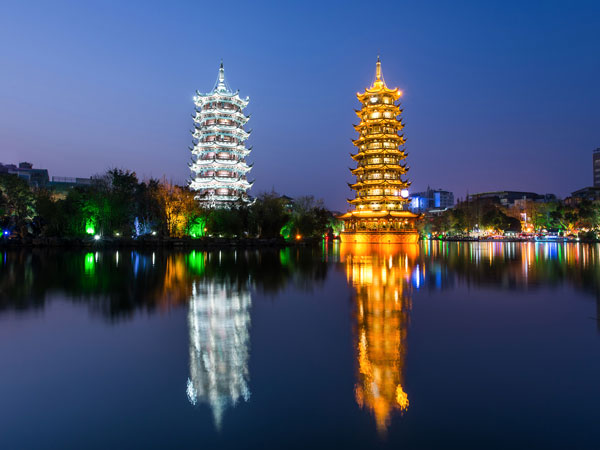
Sun and Moon Pagodas Guilin
Xiaoyao Tower
The Xiaoyao Tower(逍遥楼) is a historic landmark in Guilin, located between Jiefang Bridge and Fubo Mountain along Binjiang Road. The Xiaoyao Tower was constructed in 621 AD during the Tang Dynasty by General Li Jing. The Xiaoya Tower has been damaged and rebuilt multiple times throughout history, and it was destroyed during the War of Resistance against Japanese Aggression. The Xiaoyao Tower we see now was rebuilt in 2015.
Climb up the Xiaoyao Tower, you can have a panoramic view of Li River and the surrounding mountains. And the night view of Xiaoyap Tower is worth seeing. You can see the night view of Xiaoyao Tower at night at the Jiefang Bridge(Liberation Bridge) on the Binjiang Road.
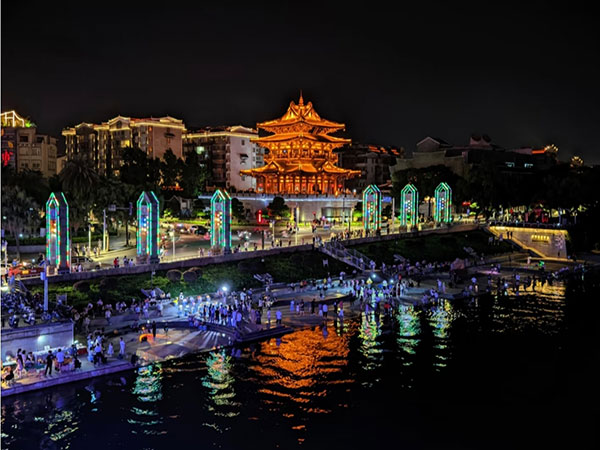
Xiaoyao Tower
Hot
From $ 245
Hot
From on request