Your China & Yunnan Travel Experts

 Ask a Question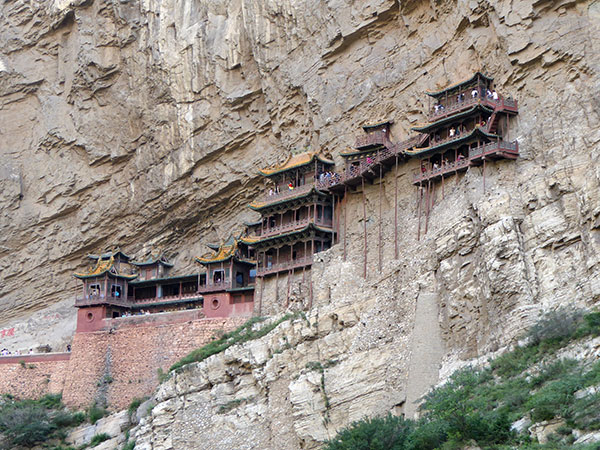
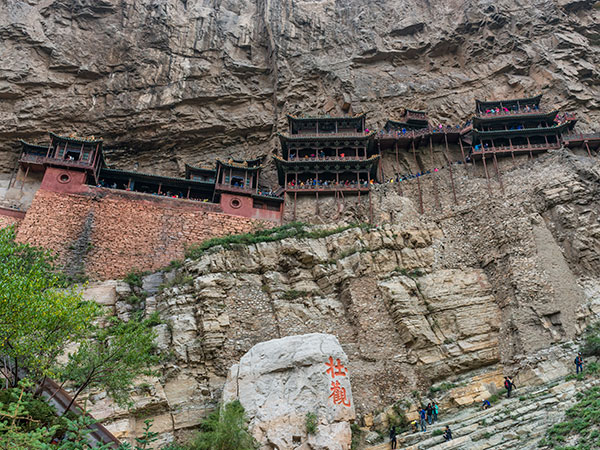
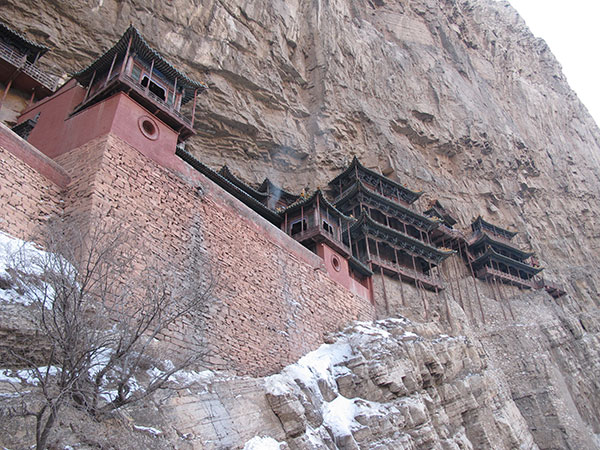
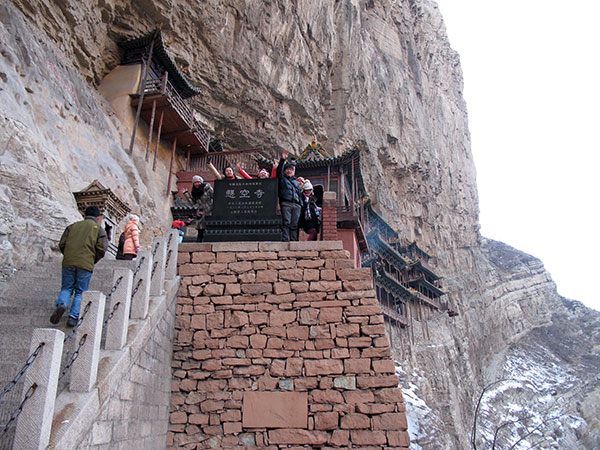
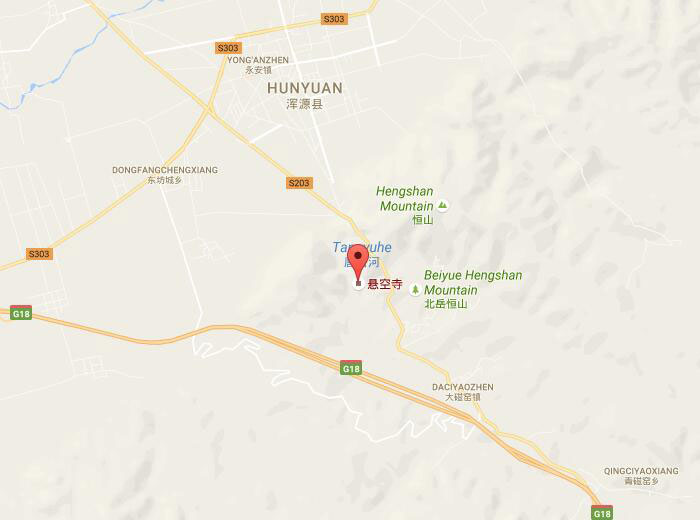
Mt. Hengshan in Hunyuan County, Datong City, Shanxi province, China.
The only remaining integrated temple of Confucianism, Buddhism and Taoism.
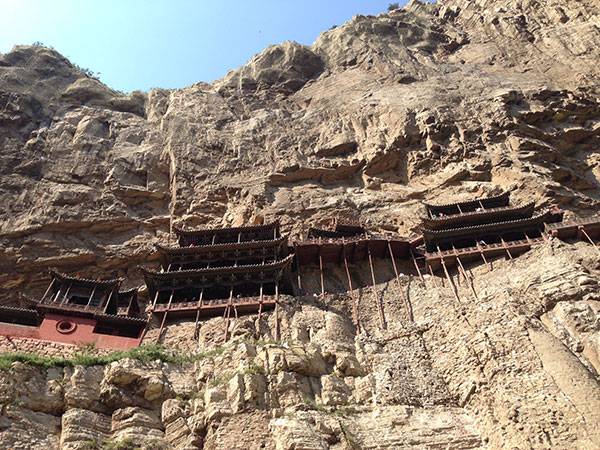
Hanging Temple was built into a cliff (75 meter or 246 feet above the ground) of Mt. Hengshan in Hunyuan County, Datong City, Shanxi province, China. It is also the most famous scenic spot in Mt. Hengshan area. Originally constructed in Northern Wei Dynasty (386-557) by only one man, a monk named Liao Ran, Hanging Temple has been standing right at the foot of Mt. Hengshan for over one thousand years. After many times of repairs, the Hanging Temple had a large scale, and became a rare high altitude building on cliff in China. Leaning on the precipitous mountain face and facing a deep valley, the temple was constructed in a unique way, which is the buildings are supported by sturdy wooden pillars inserted in holes cut in the mountain body. Seeing it from the distance you could find it hanging in the mid air miraculously, hence the name “Hanging Temple”.
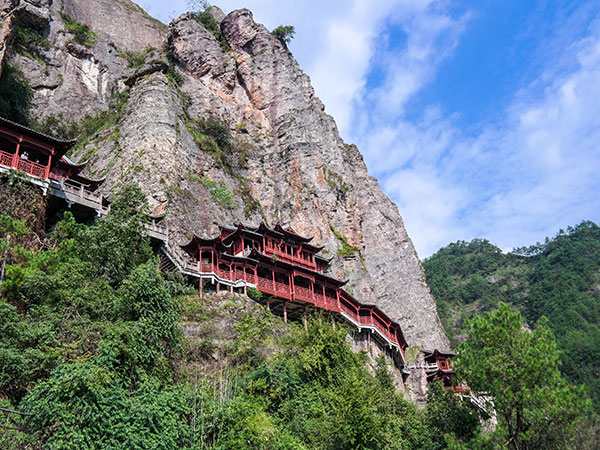
Tourists can walk upwards along the steep stone pathway to visit some 40 exquisite and unique halls in the temple. This is the special monastery in which you could find not only the elements of Buddhism but also Taoism and Confucianism. There are about 40 halls with 80 sculptures which are vividly carved from copper, iron, terracotta and stone in this temple. The caves and halls are connected by winding corridors and bridges. A visit to the Hanging Temple will be a happy adventure at the same time. This building is a perfect combination of religion and culture of Chinese feudal society.
The Hanging Temple was designed skillfully and constructed audaciously. The method is to chisel a horizontal hole in the cliff, and then put a beam through the hole out of the cliff, at last put board and pillars on the beam to build various beam frames and roofs. Balusters are set around all the buildings outside the cliff. Looking from the top of the mountain, visitors can see some impending wooden poles under the buildings that are far from the cliff. These wooden poles are set to protect the buildings. The temple was arranged in random from north to south, with a bluff inside and devious plank roads built along the face of the cliff. Beam frames are harmonious up and down, and balusters are connected to each other, with appropriate density, like one integrated mass. Seen from the buildings, it looks as if facing an abyss; seen from the bottom of the valley, the cliff is lofty like a rainbow; seen from the opposite side over the valley, it looks like a young flying phoenix on the cliff. It is just like what the inscription on the cliff of plank roads reads, People are more creative than nature.
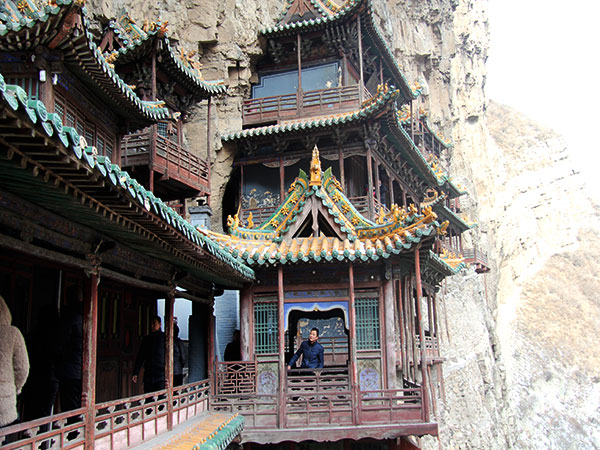
On December 2010, it was listed in “The Time” magazine as the world's top ten most odd dangerous buildings.
【Chinese name】: 悬空寺
【Address】: Mt. Hengshan in Hunyuan County, Datong City, Shanxi province, China.
【How to get to Hanging Temple from Datong】: Hanging Temple is just about an hour outside of the city. Bus tickets can be purchased at the long-distance bus station or at one of its kiosks located around the city (there is one outside the train station, in the parking lot of Feitian Hotel). The buses depart about every hour, starting at 7:30. If you should choose to take the bus, it will drop you off on the side of the road, where a cab will be waiting to take you to the Hanging Temple. You can bargain on the price.
South Pavilion
Recommended visiting time: about 1 hour
The South Pavilion is three stories high, around 8 meters long and 4 meters wide, and includes several main halls — the Chunyang Palace, San'guan Hall, Sanjiao Hall, and Leiyin Hall.
Chunyang Palace, also called Lvzu Temple, is dedicated to Lv Dongbin, one of the Eight Immortals in Taoism.
The San'guan Hall is the largest hall within the Hanging Temple, featuring precious clay sculptures from the Ming Dynasty. The “Three Officials” (San'guan) represent the deities who bless, pardon, and protect the people — the Heaven Official grants happiness, the Earth Official pardons sins, and the Water Official relieves disasters. The central clay statue, about 2 meters tall, is the largest sculpture in the temple, flanked by attendants, generals, and ministers including Marshal Tianpeng and the turtle-snake warriors.
The Leiyin Hall, located at the highest level of the South Pavilion, is a Buddhist sanctuary. “Leiyin” literally means “Thunder Sound,” symbolizing the mighty and resonant voice of Buddha Shakyamuni spreading the Dharma across the world.
North Pavilion
Recommended visiting time: about 1 hour
The North Pavilion is also three stories high, about 7 meters long and 4 meters wide, consisting of the Five Buddhas Hall, Guanyin Hall, and Sanjiao Hall.
The Five Buddhas Hall, located on the lower level, enshrines five Buddhas representing the five directions.
The Guanyin Hall, on the middle floor, is devoted to the Bodhisattva of Compassion, Guanyin, who listens to the cries of the world.
At the top level sits the Sanjiao Hall, a rare architectural marvel symbolizing the unity of the three major Chinese philosophies — Buddhism, Taoism, and Confucianism. Inside the hall, the three sages share the same altar: Buddha Shakyamuni in the center, Confucius on the left, and Laozi on the right. Such a layout is extraordinarily rare in Chinese temple architecture, representing the ideal of harmony and inclusiveness within Chinese civilization — the spiritual concept of “Great Unity under Heaven.”
Changxian Bridge
Recommended visiting time: about 30 minutes
Connecting the South and North Pavilions is the Changxian Bridge, which is about 10 meters long. A small building is constructed upon the bridge, within which sits a Buddhist shrine. The bridge integrates temples, halls, and towers into one complex, forming a spectacular combination of “marvel, peril, and ingenuity.” Walking across this narrow bridge suspended over the cliff gives visitors an unforgettable thrill and panoramic view of the surrounding mountains.
The Hanging Temple Scenic Area adopts a two-ticket system, including the entrance ticket and the temple access ticket (for the core area):
Entrance Ticket: ¥15 per person — allows visitors to explore the lower garden area, the Xu Xiake Monument, and surrounding viewpoints.
Temple Access Ticket: ¥100 per person — grants entry to the main Hanging Temple complex (limited to 3,260 visitors per day; advance reservation required).
Height Caution: The temple is built high on a sheer cliff. Stairways are narrow and only allow one person to pass at a time. Those with acrophobia should consider carefully before entering.
Peak Season Crowds: During holidays and high season, waiting time to enter may exceed two hours. It's best to arrive before 8:00 a.m. to avoid long lines and enjoy a quieter visit.
Sun Protection: The site is largely exposed, with little shade. Bring a sun hat, sunglasses, and sunscreen.
Body Size Limitation: Some corridors are only 40 cm wide, making it difficult for larger visitors to pass through. Be prepared mentally and physically.
Clothing & Gear: Wear non-slip sneakers, bring sun protection and rain gear, and avoid carrying bulky luggage. Storage services are available at the scenic area.
Best Vantage Point: The shuttle bus drop-off area offers the best angle for photographing the temple's full view against the cliff.
Photography Rules: Taking photos inside the temple is not allowed, but the platform outside provides excellent shots of the structure.
Drone Use: Drones are permitted only with prior approval from the scenic area administration. Unauthorized drone use is prohibited.
Yingxian Wooden Pagoda: Located nearby, this thousand-year-old wooden pagoda — also known as the Sakyamuni Pagoda — is one of China's greatest architectural masterpieces.
Mount Hengshan: As one of China's Five Sacred Mountains, Mount Hengshan offers stunning natural landscapes and sacred Taoist sites.
Local Cuisine: Don't miss Hunyuan Cold Jelly (Hunyuan Liangfen) — a refreshing local delicacy with a tangy and spicy flavor.
Accommodation Recommendation: Staying in Datong Ancient City is highly recommended. The area provides convenient access, traditional architecture, and great dining options. You can also enjoy an evening walk along the ancient city walls for a memorable night experience.
From $ 531
From $ 644