Your China & Yunnan Travel Experts

 Ask a Question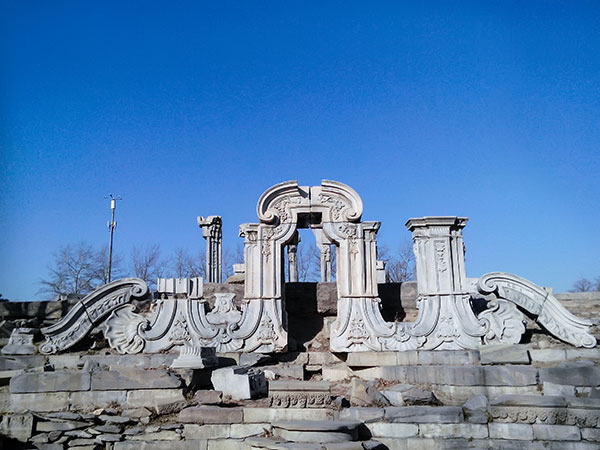
Qinghuan West Road, Haidian District, Beijing, China
Historical site; An destroyed imperial garden
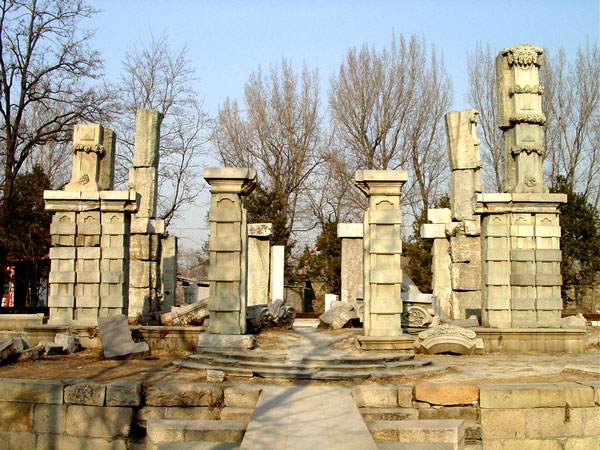
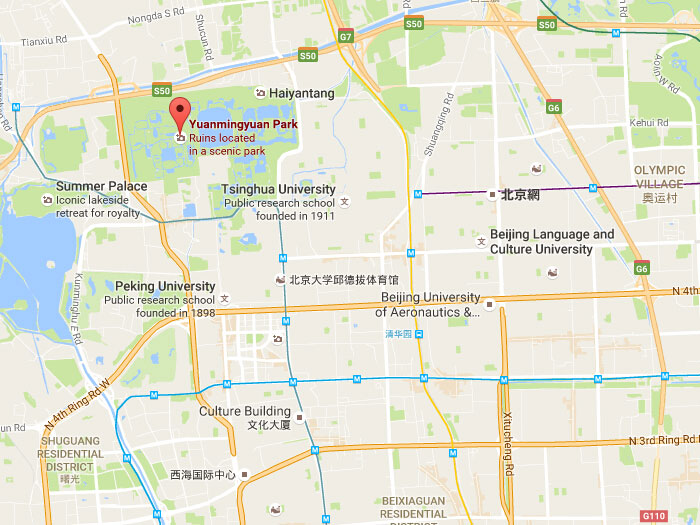
The Old Summer Palace which is also known as the Ruins is the Yuanmingyuan – the Garden of Perfection and Light. It is located in the northwest of Beijing and to the east of the present-day Summer Palace. The Garden was first constructed in the year of 1709 during the reign of the Emperor Kangxi of the Qing Dynasty. Over the next 150 years of the Qing Dynasty, this Garden was expanded to be a large-scale Chinese emperors' private pleasure garden, covering a total area of 350 hectares.
In a word, the Old Summer Palace consists of three parts – Yuanmingyuan, Wanchunyuan which is the Garden of Blossoming Spring and Changchunyuan which is the Garden of Eternal Spring. These three gardens are often referred to as a common name: Yuanmingyuan. Hundreds of scenic spots in the Garden are made up of exquisitely constructed halls, pavilions, chambers, kiosks, earth and rock hills, rivers and ponds, and exotic flowers and grasses from different parts of the country. Indeed, it contains the representative of Chinese ancient landscape gardening.
The Old Summer Palace's construction and horticulture of Yuanmingyuan is a harmonious blend of typical Chinese scenery and western architecture. The most famous scenic spots include, for example, the Grand Waterworks, the Throne for viewing the Waterworks and the Labyrinth. No wonder, Yuanmingyuan was also called the ‘garden of gardens' or the ‘Versailles of the East' in Europe during that time. What' more, Yuanmingyuan was also an imperial museum that collected a large number of books, treasures and cultural artifacts.
Destruction and Plunder
However, a large number of these collections were plundered by the Anglo-French Allied Forces in 1860, at the same time as the Garden was burnt down. Now, most of these historical curiosities are displayed in the other countries' museums, including the British Museum, Bibliotheque Nationale de France, Metropolitan Museum of Art, New York City, USA, Oslo Museum of Applied Art and so on.
Current Status and Preservation
The most majority of the remaining scenic spots were destroyed in the 1980's, but under the due protection of the ruins of Yuanmingyuan, a park has been established on the ruin site. So visitors can imagine the former grandeur of the Old Summer Palace from the crumbling walls and ruins. What's more, there is also an opportunity for visitors to view the complete picture of Yuanmingyuan in its ‘heyday' in the exhibition hall. The reconstruction of some of the original structures and scenic spots provides people with a lovely place to relax.
A partial copy of the palace, the “New Yuan Ming Palace”, was built in 1997 in the southern city of Zhuhai, in Guangdong province, as an amusement park of 1.39 km², including an 80,000 m² lake.
To this day many relics which were taken from the gardens remain in foreign museums and private collections. Although the Chinese government has tried to recover them, only a few statuettes from The Eternal Spring garden of the Yongzheng Emperor have actually been returned; these are displayed in the Beijing National Museum.
Main Gate
• June–August: 6:00–21:00 (ticket sales end at 19:00)
• April–May & September–October: 6:00–20:00 (ticket sales end at 18:00)
• November–March: 6:30–19:30 (ticket sales end at 17:30)
Yuanmingyuan Museum (Zhengjue Temple): 8:00–16:30, closed on Mondays (except holidays)
European Palaces (Western-Style Palaces) Area:
• April–October: 7:00–19:00
• November–March: 7:30–18:30
Panoramic Model Exhibition:
• April–October: 7:00–17:30
• November–March: 7:30–17:00
By Public Transport
• South Gate: Metro Line 4, Yuanmingyuan Station, Exit B; or buses 424/432
• East Gate: Buses 331, 305, 320, 375, 424
In-Park Transportation
• Electric Shuttle: East sightseeing line (Three-Garden Junction → Western-Style Palaces), RMB 20 per ride
• Bicycle Rental: Available at Three-Garden Junction, Zaoyuan Gate, and Western-Style Palaces
• Boat Route: South Gate Pier → Western-Style Palaces West Pier (with a transfer); RMB 40 total
1. Zhengjue Temple & the Remnant Stone Bridge
Zhengjue Temple
Located on the west side of Qichun Garden, Zhengjue Temple is the only surviving Qing-dynasty architectural complex inside Yuanmingyuan. Structures such as the Hall of Heavenly Kings, Manjushri Pavilion, and the gatehouse blend Han, Manchu, Tibetan, and Mongolian elements.
Highlights:
Bronze Horse Head: The temple houses the famous “Horse Head”—a returned bronze zodiac statue displayed in the exhibition “Returning Home: The Journey of the Horse Head.” Photos, documents, and multimedia installations recount its century-long odyssey. Exhibition runs until 2025.
Architectural Heritage: The gate plaque bears Qianlong Emperor's calligraphy; murals and statues inside remain remarkably preserved, offering a glimpse into imperial temple artistry.
The Remnant Bridge
Located north of Jianbi Pavilion, this single-arch stone bridge once connected the Tianxin waterscape and Fuchun Hall. Today, only the base and fragments of the arch survive, making it the sole remaining bridge among nearly 200 formerly in the garden.
Experience
• The weathered stonework contrasts with peaceful lotus ponds, evoking the brilliant scenes of old.
• Early morning or sunset provides the best lighting for photography, with the broken arch reflected on the still water.
• The bridge is accessible via a pleasant 15-minute walk from Zhengjue Temple.
2. Western-Style Palaces Ruins Area
This is perhaps the most iconic zone within the Old Summer Palace, representing the encounter between Qing imperial taste and Western architectural innovation.
• Grand Waterworks (Dashuifa): The monumental fountain complex designed with Baroque elements.
• Haiyantang: Former site of the zodiac water-clock fountain, now marked by its remaining stone bases. Visitors can use AR to visualize the original water-spraying sequence.
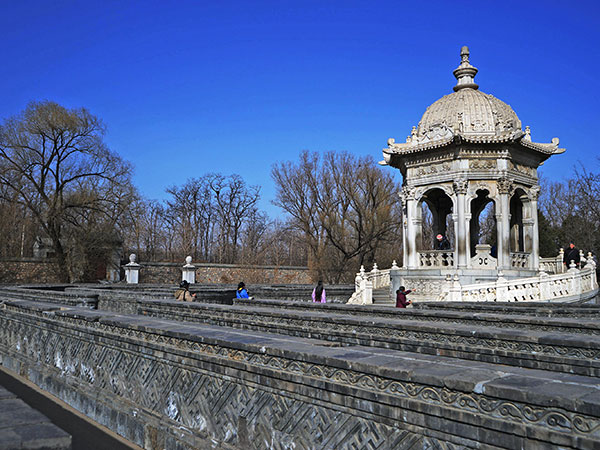
• The Maze (Huanghua Zhen): An 18th-century European-style labyrinth where the central pavilion once offered commanding views of the garden.
• Xieqiqu: The earliest Western-style building in Yuanmingyuan and the original location of the famous tail-flicking stone fish sculpture (now housed at Peking University).
Route 1 — From South Gate
Begin with Jianbi Pavilion and the Remaining Bridge, then continue to Tianxin Water Surface, Hanqiuguan, and the Three-Arch Bridge. Explore the lakeside pavilions such as Quyuan Fenghe and Pengdao Yaotai, before reaching Pinghu Qiuyue and finally the European Palaces.
Route 2 — From East Gate
Visit the Longspring Garden and Wanchun Garden, see sites like Yulinglong Hall and the Lion Grove, then explore the panoramic model hall to understand the full layout before heading to the Western ruins area.
Tip: At the Grand Waterworks, AR scanning reveals vivid recreations of the original architecture—especially spectacular during evening summer light shows.
1. Cultural Experiences
• AR Guides: Available at the Western Ruins area for RMB 30/hour.
• Cultural Stores: Specialty souvenirs such as bookmarks and fridge magnets available near San-Kong Bridge and Dashuifa.
• Black Swan Sightings: A unique feature of Yuanmingyuan, with swans residing across the lakes since 2008.
2. Practical Advice
• Clothing: October temperatures fluctuate significantly; light jackets and comfortable shoes are recommended.
• Safety: Ruins contain uneven steps; caution is advised.
• Reservations: Make ticket reservations 1–3 days in advance via the official account.
3. Food & Rest Areas
Simple meals such as noodles, burgers, and snacks can be found near San-Kong Bridge and Dashuifa. Visitors may also bring picnic food to enjoy by Fuhai Lake or Gingko Avenue.
4. Nearby Attractions
• Summer Palace: Famous for Kunming Lake, the Long Corridor, and Longevity Hill.
• Tsinghua University: Known for its classical architecture and serene campus.
• Peking University: Home to Weiming Lake and the Boya Pagoda.
• Fragrant Hills Park: Popular autumn foliage destination with historic temples.
From on request
From $ 306
From on request