Your China & Yunnan Travel Experts

 Ask a Question
Cloisonné is copper-bodied enamelware made by shaping a metal body, fixing thin metal strips into a design, filling the resulting cells with enamel, firing, polishing and finishing the exposed metal. The craft is called jingtailan in Chinese and is especially associated with Beijing. This page explains the process, the limits of historical claims and a practical way to compare pieces.
Reviewed August 28, 2026. Begin with the Beijing travel guide if you want to combine a workshop or museum visit with shopping. Beijing's official cultural information describes cloisonné as a national intangible-cultural-heritage craft, but that status applies to the tradition and its transmission—not automatically to every enamel object sold to visitors. Copper-bodied enamel differs from painted porcelain and from carved lacquer because the visible pattern is divided by metal wires or strips and the coloured areas are fired enamel. Use construction, finish and documentation as your evidence.
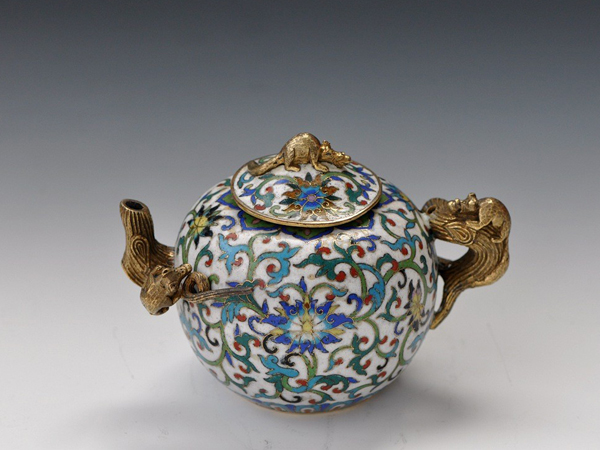
Beijing cloisonné vase with visible wire cells and enamel
The technique developed in China through exchange with earlier enamel traditions and was adapted by Chinese metalworkers over several centuries. Surviving objects and court records are more reliable than a shop's exact founding legend. The Chinese name jingtailan
literally connects the craft with “Jingtai blue,” and later historical writing associated it with the Ming Jingtai reign. However, production existed before and after that period, and blue is not the only traditional colour. Ming and Qing workshops expanded forms, motifs and technical control. Court use helped establish prestige,
while later commercial workshops made the craft available beyond the palace. Twentieth-century institutions supported training and continued production. In 2006, the craft entered China's first national list of intangible cultural heritage. That designation protects knowledge and practice, not a retail guarantee. A modern piece may be excellent without being an antique, and an old-looking surface may be deliberately distressed.
Do not assign a dynasty from colour, motif or sales language alone. Independent specialist assessment is appropriate for a high-value object. Keep the seller's written description, maker information and receipt. Export controls can apply to genuine cultural relics, so an ordinary receipt does not by itself authorize export.
A traditional piece normally uses a shaped copper body. Thin copper strips are bent into outlines and fixed to the surface, creating cells that hold enamel. Examine whether curves meet cleanly, the wire is secure, the enamel fills the cells evenly and the base sits without rocking. Handwork can contain small variations; rough solder, sharp edges, widespread pits or unstable cracks are faults rather than proof of authenticity. Compare a complex curve with a simple border: both should show intentional spacing rather than loose wire hidden by heavy colour.
Mineral-based enamel mixtures are applied and fired repeatedly because enamel settles during firing. The surface is then polished so the metal lines and enamel read as one controlled plane, and exposed metal may be gilded. Ask whether the object is hand-wired, molded or transfer-decorated, what the body metal is and where it was made. Look inside the mouth and under the foot where construction is easier to read. An unfinished interior can be normal for some decorative forms, but flaking residue, corrosion that lifts the enamel or a body distorted by impact deserves caution. Handles and lids should align without force.
Dragons, lotus, clouds, flowers and geometric borders are common, but motif does not establish date. Compare the clarity of wirework, colour transitions, symmetry where intended and finish on the underside. For a useful construction comparison, read the Beijing carved-lacquer guide.
Official Beijing craft descriptions identify a long sequence of specialized operations; one city account summarizes 108 processes across the workflow. That number describes a detailed production system, not a stopwatch for every product. Time varies with scale, complexity, firing and workshop organization, so avoid fixed claims that all pieces take six months.
Choose a workshop showroom, museum shop or established retailer that can explain material and process. Opening hours, demonstrations and factory access change, so confirm directly before travelling across the city. A credible seller should allow calm inspection and give an itemized receipt.
Workshop or factory showroom: This can be valuable when a demonstration is actually operating. Ask which stages are performed on site, whether the displayed item is the one you will receive and who made or supervised it. Do not assume that a factory name makes every souvenir handmade.
Established craft or museum shop: Selection may be smaller, but labels and after-sales contacts are often clearer. Compare materials and dimensions, and ask whether packaging is suitable for air travel. Price alone is not evidence of technique.
Panjiayuan and mixed-vendor markets: These are useful for comparison and browsing, but modern reproductions, decorative enamel and genuinely old objects can sit side by side. Never treat a stall label as authentication. For smaller collectible objects, compare the questions in the snuff-bottle buying guide.
Before paying, photograph the piece with permission and record dimensions, weight, body material, technique, maker or workshop, condition, included stand, price and return terms. Inspect the rim, foot, handles and joins; request protective wrapping that prevents metal-on-enamel contact. If the seller claims age or a named master, ask for evidence you can verify independently. For pairs, compare height, colour and motif in the same light rather than assuming they match. Confirm whether a wooden stand is included and whether it is stable. Air travelers should measure the finished package and avoid putting pressure on projecting handles or finials.
At home, support the object from its body rather than a delicate handle. Dust with a soft dry cloth; avoid abrasive polish, household acids, hard brushes and immersion unless a conservator or maker gives specific instructions. Keep it stable, away from impacts and extreme temperature changes. Display heavy vessels on a level surface with room around them, and do not use decorative enamelware for food unless the maker explicitly confirms that use. Last reviewed August 28, 2026; prices, stock and access are intentionally not fixed here.

From on request

From $ 306

From on request