Your China & Yunnan Travel Experts
 Ask a Question
Peking opera, or Jingju, is a highly codified theatre form combining singing, recitation, acting and martial movement. Its stories draw on history, literature and social life, while a compact set of stage objects can suggest palaces, roads, boats or battlefields. “Peking” is an older romanization of Beijing; both English names refer to the same genre.
UNESCO inscribed Peking opera on the Representative List of the Intangible Cultural Heritage of Humanity in 2010. The inscription recognizes a living performance tradition centered especially in Beijing, Tianjin and Shanghai; it should not be misdated to 2001 or treated as a claim that every production is identical.
Development
Peking opera took shape in Beijing around the turn of the nineteenth century through interaction among regional troupes and musical traditions. The arrival of Anhui troupes for Qianlong-era celebrations in 1790 is an important part of the accepted narrative, but the genre was not created in a single court performance. Artists, audiences and theatres continued to reshape it over subsequent decades.
Hubei performers and vocal systems contributed to the developing form alongside Anhui traditions. Kunqu and other genres also influenced repertoire, movement and stage practice. It is more accurate to describe adaptation and synthesis than to say one opera simply replaced another.
As the genre spread, performance schools, star actors, recordings and urban theatres extended its reach. Singing, speech, gesture, dance, combat and percussion remained interdependent. For planning rather than history, the Peking opera activity page helps explain how a show can fit into an evening itinerary.
Peking opera performance
Main Types of Performers
The four broad role categories are sheng, dan, jing and chou, each with subdivisions defined by age, status, temperament and vocal or martial demands. Sheng covers principal male roles such as older laosheng, young xiaosheng and martial wusheng. Dan covers female roles including dignified qingyi, lively huadan and martial daomadan. Historically, casting reflected changing restrictions and theatre practice; today, role type is not determined by the performer's gender.
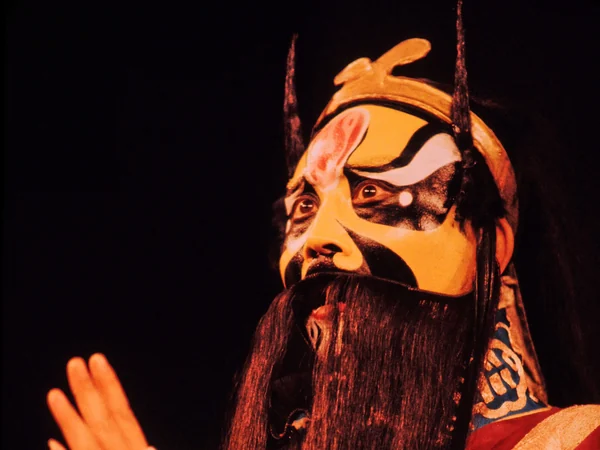
Jing roles use striking painted-face designs and forceful vocal or physical styles. Wenjing roles emphasize singing and characterization, while wujing roles emphasize combat and movement, though productions can blur these distinctions. Face patterns identify a stage role, not the actor's real personality, and the design must be read with costume, story and performance school.
Chou roles are recognized by a patch of white makeup around the nose and often provide wit, social commentary or comic contrast. “Clown” is only a partial translation: chou performers require precise speech, rhythm and movement, and their characters can be servants, officials, soldiers or townspeople.
Peking opera role types
Facial Make-Up and Costumes
Makeup and costume communicate role type, rank, age and temperament before every word is understood. Designs are conventional but not a simple universal color dictionary. The same color can gain meaning from line pattern and dramatic context; spectators should use the synopsis rather than assuming that red always means one trait and white another.
Red commonly appears in loyal or courageous character designs, black in forthright or forceful ones, and white in some calculating figures. Blue, green, gold and silver can suggest distinctive temperaments, rebels, spirits or supernatural beings. These are tendencies within a visual system, not fixed psychological labels for Chinese culture.
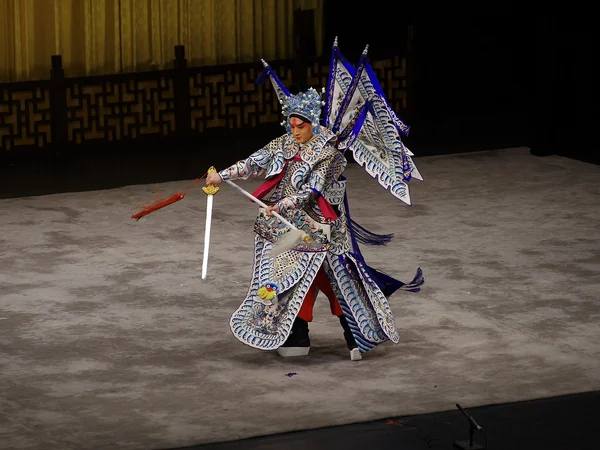
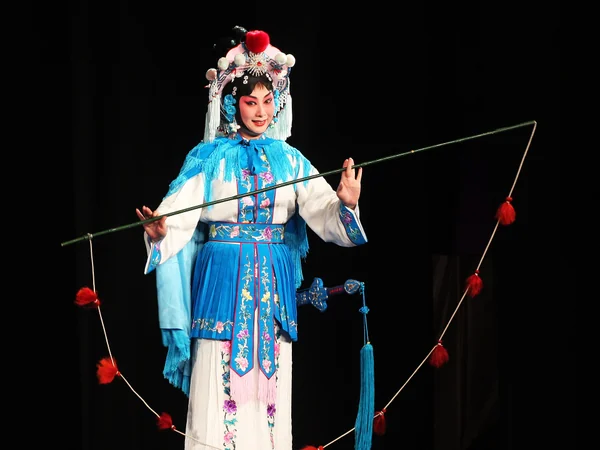
Stage costumes draw heavily on stylized historical dress rather than reproducing one dynasty with archaeological accuracy. Embroidered robes, armor, headdresses, sleeves and footwear help establish role and movement. Long water sleeves extend gesture; flags can signal military command. Visitors should appreciate costume as theatrical design, not use it to date the story literally.
Peking opera costume
Tunes of Peking Opera
Xipi and erhuang are the principal melodic systems. Their modes, rhythmic patterns and vocal contours support different dramatic situations, but the common summary “xipi is happy, erhuang is sad” is too rigid. Performers and musicians select specific patterns according to role type, text and scene.
Speech ranges from stylized recitation to forms closer to Beijing pronunciation. Even fluent Mandarin speakers may need surtitles because pronunciation, vocabulary and musical delivery are specialized. Before booking, check whether the performance provides an English synopsis, projected subtitles or a short pre-show introduction.
Gesture is also codified. A turn, sleeve movement, beard stroke or measured walk can convey emotion, status, opening a door or traveling a long distance. Watch how the orchestra punctuates these movements; visual and musical cues often explain more than a word-for-word translation.
Musical Instruments
The jinghu, a high-pitched two-string bowed instrument, leads much of the melodic accompaniment. Other strings and plucked instruments may include the erhu, yueqin and sanxian, with suona used in particular contexts. Instrumentation varies with school and production, so a small demonstration can be easier to follow than a list of names.
Gongs, drums, clappers and other percussion organize entrances, combat, tempo and dramatic emphasis. Percussion patterns cue both performer and audience. Seats very close to the ensemble can sound intense; travelers sensitive to volume may prefer a position farther back and should carry appropriate hearing protection for children if needed.
Peking opera orchestra
Peking Opera's Important Features
Peking opera uses convention to make a small stage elastic. A table and two chairs can become a court, inn or home; a whip can indicate a horse; an oar can suggest a boat; walking a circle can represent distance. These signs invite the audience to complete the environment through imagination. Martial scenes stylize conflict through rehearsed movement and percussion rather than realistic violence, although loud sound and rapid action may still affect young viewers.
Peking opera stage
Master of Beijing Opera
Mei Lanfang (1894–1961) was a major dan performer and an influential cultural ambassador for Peking opera. His international tours and stage practice shaped global awareness of the form. He was one of several celebrated dan artists, and his legacy should be studied through recordings, photographs, archives and named repertory rather than a claim that one person represents the whole genre.
Recommended Works
A beginner benefits from a synopsis and one or two well-chosen scenes rather than a long list without context. Titles vary in English translation, and commercial programs often present excerpts. Confirm the characters and episode being staged, especially when a familiar story has several operatic versions.
• At the Crossroads — a famous martial-comic scene built around two characters fighting in imagined darkness.
• The Drunken Concubine — associated with Mei-school dan performance and refined singing and movement.
• The Fourth Son Visits His Mother — a vocal drama about divided loyalties and family reunion.
• The Orphan of Zhao — a historical revenge narrative adapted in several Chinese theatrical forms.
• Farewell My Concubine — a well-known scene centered on Xiang Yu and Consort Yu, not the same work as the later film bearing the English title.
• Havoc in Heaven — a martial and acrobatic episode from the Monkey King tradition.
• The Legend of the White Snake — a repertoire story shared across opera genres, with productions emphasizing different episodes.
Recommended Theaters in Beijing
1. Chang'an Grand Theatre
This established Beijing venue has presented traditional opera, but schedules vary and not every date features Peking opera. Verify the current program and performance language through the venue or an authorized seller.
How to plan: use a current navigation app for the entrance, arrive early enough to collect tickets, and confirm whether late seating is allowed. Old bus-route instructions can become inaccurate and should not be the basis of the page.
2. Mei Lanfang Grand Theatre
The theatre is associated with the National Peking Opera Company and is a logical place to check for full productions and specialist programming. Exhibition or performance access may differ by date.
How to plan: compare repertory, running time and surtitles, then choose a seat with a clear view of hand and foot movement. The Beijing Peking opera venue guide should be checked for current options.
3. Liyuan Theatre
Liyuan Theatre has been known for visitor-friendly excerpt programs, often making it easier for first-time audiences to sample makeup, costume and martial scenes. Confirm whether the format is operating on your date.
How to plan: ask whether photography is allowed and never use flash during a performance. Travelers interested in modern stage architecture can separately consider the National Centre for the Performing Arts; it is a different venue and should not be assumed to present Peking opera every day.