Your China & Yunnan Travel Experts

 Ask a Question
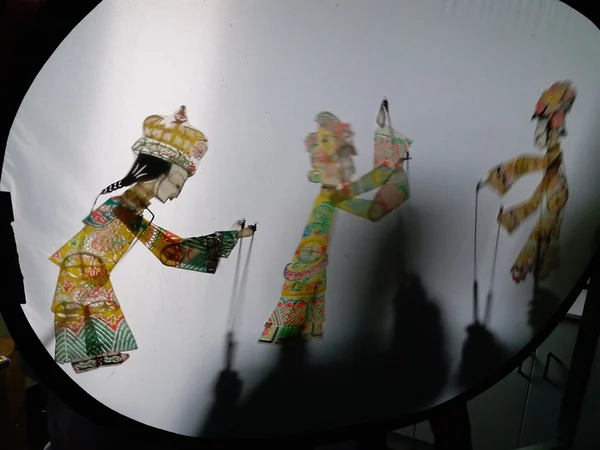
One or more puppeteers control figures with rods while performers deliver dialogue, narration and music. The audience sees colored or dark silhouettes, although the carved puppets themselves can be intricate works of art. Regional traditions differ in figure design, repertory, vocal style and instruments, so a program from Shaanxi will not necessarily look or sound like one from Hebei.
Chinese shadow play
A successful performance coordinates light distance, screen tension, puppet articulation, timing and sound. The screen hides much of the physical work, which is why a backstage demonstration can be valuable. If offered one, watch how separate joints produce walking, fighting or sleeve movement, and ask before handling fragile figures.
History
Shadow theatre has a long history in China, but a precise Western Han invention date is not securely established by the surviving material record. Traditions are strongly associated with north China, including Shaanxi, and the form developed through regional performance networks over many centuries. The Shaanxi History Museum provides broader historical context, though special displays should be confirmed before a visit.
The story of an image created to console Emperor Wu after the death of Lady Li is a famous origin legend. It helps explain later ideas about shadow, memory and presence, but should not be presented as documentary proof of the first performance. Textual references, surviving puppets, workshop practice and local records provide different kinds of evidence.
Shadow Play
Oversea Influence
Shadow theatres developed across Asia, the Middle East and Europe through complex local histories and exchanges. Similar use of light and silhouettes does not mean every form descends through one simple route from China. Dates, names and techniques should be compared tradition by tradition.
Indonesian wayang kulit is a major ritual and theatrical tradition using leather puppets and screen projection. It has its own languages, stories, music and religious contexts; it is not simply an overseas version of Chinese shadow play. A careful comparison can reveal shared technical problems while respecting independent histories.
Characters
Chinese shadow figures may be made from treated hide or paper, then cut, engraved, colored and assembled at joints. Material choice and preparation vary by region. Light passes through translucent colored areas while cut lines define costume and face. Modern educational sets may use synthetic sheets, which should be identified honestly rather than sold as traditional leather work.
Chinese shadow puppets
The finished surface must balance strength with translucency. Traditional makers scrape, flatten, draw, carve and color the material before joining parts with thread or fasteners. Chemical recipes and animal materials require specialist knowledge; visitors should not attempt workshop processes without instruction. For conservation, strong light, heat and repeated flexing can damage historic figures.
Roles of Shadow Play
Role types may draw on categories familiar from Chinese opera, but names and divisions differ locally. A puppet's head, torso, arms and legs are articulated so the performer can transform small rod movements into readable gestures. Experienced artists may manipulate several figures while coordinating cues with singers and musicians. This layered skill is why a live show provides more information than a static silhouette.
Shadow Play
Famous works
Repertory can include historical narratives, legends, romances, religious stories and adaptations of local opera. Titles alone do not identify a standard national version; the same story may be shortened, renamed or performed with different music. Ask for a synopsis before the show if no subtitles are provided.
• The Romance of the Western Chamber
• Episodes adapted from Water Margin
• The White-Haired Girl
• The Story of Mr. Dongguo
The Situation of Shadow Play
Chinese shadow puppetry was inscribed by UNESCO on the Representative List of the Intangible Cultural Heritage of Humanity in 2011. Inscription recognizes living knowledge held by communities; it does not mean every troupe performs an unchanged ancient version. Preservation depends on makers, performers, audiences and opportunities to transmit skills. Travelers can support the form by choosing documented live performances, craft demonstrations or museum programs rather than mass-produced objects presented without origin. The traditional Chinese performance hub places it beside other stage arts, and Xi'an activities can help connect a Shaanxi performance with the rest of a city itinerary. Confirm schedules directly because small troupes may perform seasonally or by arrangement.