Songtsen Gampo was the seventh-century ruler associated with the consolidation and expansion of the Tibetan Empire and the establishment of its court at Lhasa. His exact birth year, age at accession and many familiar childhood episodes are uncertain because surviving sources were written in different periods and traditions. Dates around 617–649/650 are conventional rather than a complete contemporary biography. Reviewed August 29, 2026. Read the broader
Tibetan Empire history before interpreting one ruler as the sole founder of every institution.
Evidence, Early Rule and the Move to Lhasa
Songtsen Gampo succeeded Namri Songtsen during a period of conflict and regional consolidation. Later Tibetan histories supply detailed childhood and palace stories, while Tang records illuminate diplomacy and warfare from another perspective. A responsible account distinguishes contemporary evidence, later chronicle and religious memory instead of assigning a precise birthplace, education or age without qualification.
Consolidation of power
The ruler and his ministers expanded authority across the plateau through alliances, administration and military action. Calling this a single three-year “unification war” oversimplifies a longer process involving older polities and changing frontiers. The imperial center developed institutions capable of taxation, diplomacy, record keeping and mobilization.
Lhasa as an imperial center
The court's association with Lhasa became central to later Tibetan history. Archaeology, inscriptions and textual traditions indicate a developing political and sacred landscape, but the present Potala Palace should not be described as the unchanged palace Songtsen Gampo built; most visible palace construction belongs to much later centuries.
Administration and plateau expansion
Imperial power extended through negotiation as well as conquest. Territory and influence changed over time, so modern borders should not be projected directly onto seventh-century events.
Diplomacy and marriage traditions
Tibetan, Tang and Nepalese connections shaped court culture. The 641 marriage to
Princess Wencheng is securely part of Tang–Tibetan diplomacy, while the biography and dating of the Nepalese princess Bhrikuti are less securely documented in contemporary evidence.
Later sources credit royal marriages with transmitting objects, artisans and religious practices. These accounts are culturally important, but they should not reduce Tibetan Buddhism to a single import event or claim that one princess personally introduced every technology.
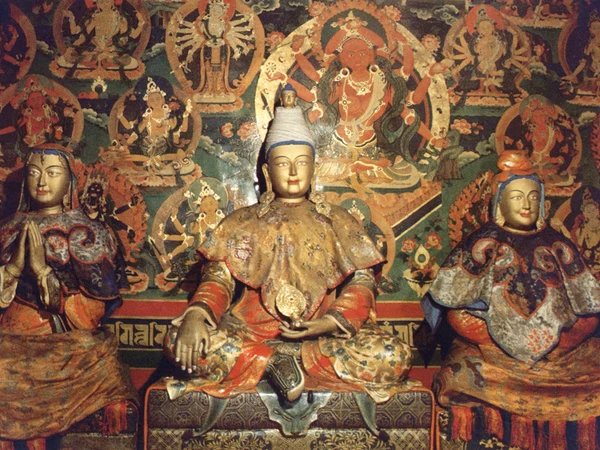
Death, Succession and Historical Legacy
Songtsen Gampo died around 649 or 650. Details of illness, funeral and burial vary among later sources. His young grandson succeeded within an imperial system that continued to develop under ministers and later rulers.
Contributions best supported by historical context:
1. Strengthened an imperial state that linked several plateau regions and engaged neighboring powers.
2. Established Lhasa as a lasting political and sacred center.
3. Supported administrative, legal, military and diplomatic institutions, although surviving descriptions are later and should not be read as a modern code.
4. Patronage and marriage traditions became foundational to later narratives of Buddhism in Tibet.
5. Maintained diplomatic exchange with Tang China, Nepal and South Asian regions.
6. The creation of the Tibetan script is traditionally attributed to minister Thonmi Sambhota under royal sponsorship; scholars debate the details and source chronology. Visit the
Jokhang Temple guide for the living heritage context rather than treating a later sacred tradition as a simple seventh-century inventory.

 Ask a Question