Your China & Yunnan Travel Experts

 Ask a Question
Reviewed August 27, 2026. Cultural differences between China and the United States are better treated as context clues than rules about 1.4 billion or 340 million people. Region, generation, language, family, profession and individual personality matter. Observe first, ask politely and correct misunderstandings without assigning motives. Begin with the traditional Chinese etiquette guide, while remembering that a business dinner, family visit and metro ride follow different norms.
Some Chinese settings emphasize family, team or institutional harmony, while many U.S. settings explicitly reward individual choice and self-expression. These are tendencies used by cross-cultural researchers, not personality tests. A Chinese host may ask what the group prefers; another may state a strong personal choice.
For a traveler, the practical skill is to make needs clear without demanding that everyone reorganize. Say whether you have a dietary restriction, walking limit or fixed departure time, then ask how the group normally decides. Silence does not automatically mean agreement, and an invitation to choose does not always mean that no plan exists.
At shared meals, a host may order for the table after asking preferences. Offer one or two useful constraints rather than replying “anything” and later rejecting dishes. Accepting a group plan can be courteous; declining a food for allergy, belief or health is also legitimate when explained plainly.
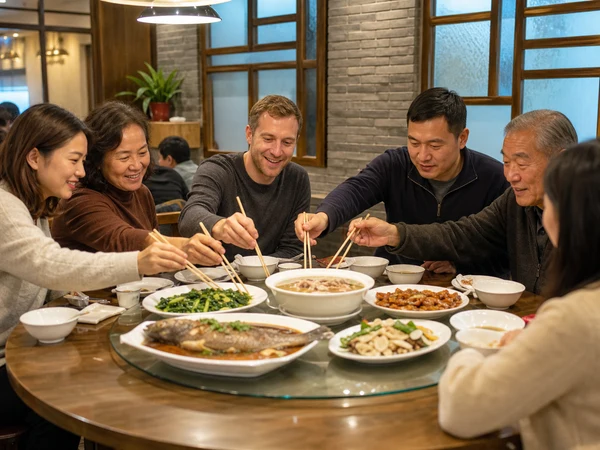
Friends sharing family-style dishes; cooperation at one meal does not define every person's values
Guanxi (关系) refers broadly to relationships and connections, but it should not be reduced to favors, corruption or a secret business technique. Trust often develops through repeated contact, introductions and reliability. Personal and professional networks may overlap more visibly than some U.S. visitors expect, yet boundaries still vary by person and organization.
If a host offers tea or a meal before discussing logistics, the time may help people understand one another. Participate without assuming that hospitality creates a debt. In business, keep contracts, compliance and gift policies clear; relationship-building never overrides law or professional ethics.
For travelers, guanxi is usually simpler: remember names, arrive when promised, thank the person who made an introduction and do not ask a new acquaintance for access that would put them in an awkward position. Read the culture-shock guide
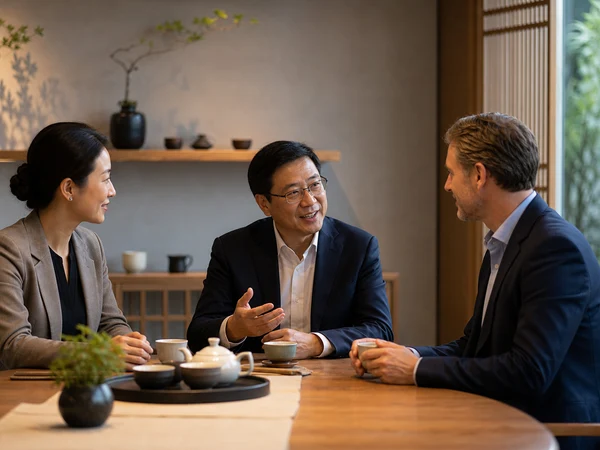
before departure so unfamiliar relationship cues become questions to clarify rather than evidence that someone is evasive.
A compliment in Mandarin may be accepted, downplayed or redirected. “Nǎlǐ, nǎlǐ” (哪里,哪里) is a traditional modest reply, but many people simply say “xièxie.” Age, setting and personality influence the response. Do not insist that a person publicly agree with your praise.
Americans may be more accustomed to naming personal achievements in introductions or accepting praise directly. Neither style proves confidence or sincerity. Give a specific, respectful compliment—about a meal, explanation or craft—then accept the response without turning it into a cultural quiz.
Crowded stations, elevators and attractions can reduce physical space, especially at peak periods. A busy setting does not erase anyone's personal boundaries or imply that touch is welcome. Queuing behavior has also changed across cities and systems; watch floor markings, barriers and local practice rather than assuming that a crowd has no order.
If you need more space, step aside, travel outside rush hour or choose a less crowded entrance. Keep bags close without swinging them into others, let passengers exit before boarding and use a calm “qǐng ràng yíxià” when asking to pass. private transport can reduce crowd exposure for mobility or sensory needs, but historic lanes and scenic sites still involve shared public space. Plan the quietest time instead of expecting a vehicle to remove every queue.
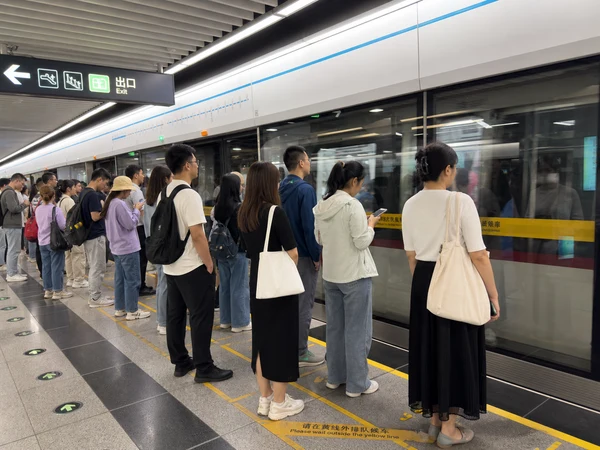
Passengers waiting behind platform markings at a modern Chinese metro station
Mianzi (面子), often translated as “face,” concerns reputation and dignity in social interaction. Publicly cornering or mocking someone can make problem-solving harder in many cultures. Use the Chinese table manners guide for the dining context, and raise a service issue privately with the person able to fix it.
This does not mean people in China never admit mistakes or that Americans ignore reputation. Be factual: state the booking, the agreed service and the requested solution. Avoid a loud accusation before the cause is known, but do not abandon a safety concern simply to appear agreeable.
Ordering many dishes can express hospitality, but portion size, budget and waste also matter. A guest can say that the food is sufficient and praise a favorite dish without interpreting generosity as vanity.
Some English-speaking U.S. visitors prefer an explicit yes or no. In Chinese interaction, disagreement may sometimes be softened through context, pause or alternatives—especially where hierarchy or a host–guest relationship is present. Individuals vary, and a language gap can look like indirectness when the real issue is vocabulary.
Ask concrete questions: “Is the ticket confirmed?” “Which station?” “What time must we leave?” Then repeat the decision in writing. Avoid idioms, sarcasm and long compound questions. A polite “I need to check” is not a confirmed promise in either language.
A local guide can interpret words and context, but travelers should still review dates, names and costs themselves. If an answer affects visa status, health, money or safety, verify it with the responsible authority rather than relying on cultural intuition.
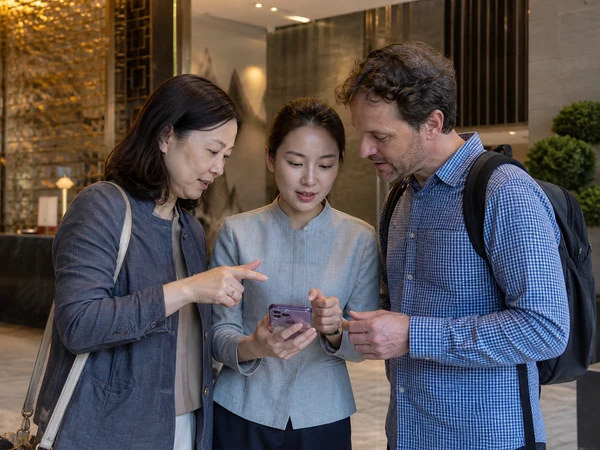
Filial respect has deep roots in Chinese family and social thought, and older relatives may be consulted or cared for across generations. Contemporary families arrange responsibility in many ways. Offer a seat or assistance, but ask before touching a person or mobility device.
Some older U.S. visitors prefer not to be treated as frail, while others welcome practical support. Use the same person-centered approach in China: speak to the traveler directly, describe stairs and distances accurately, and let the individual decide. Respect is compatible with autonomy.
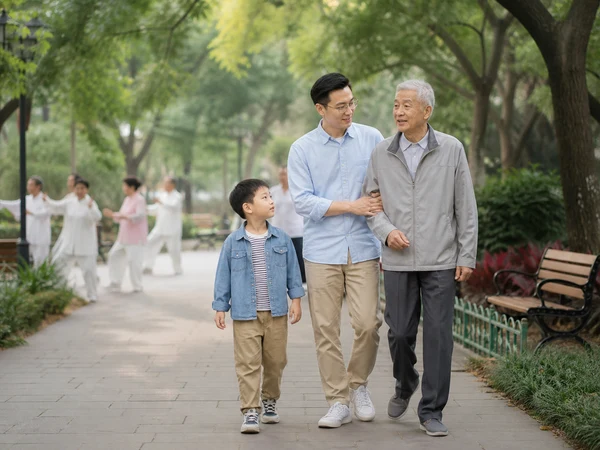
Three generations walking together in a Chinese city park
Bargaining may be expected in some tourist markets, antique-style markets or small stalls, but it is generally inappropriate at supermarkets, restaurants, museums, ticket offices and clearly fixed-price shops. Watch whether prices are marked and whether other customers negotiate.
Ask the total and unit first, make one reasonable counteroffer and remain friendly. If the price does not work, decline and leave without insulting the goods. Never treat a vendor's accent or tourist area as proof of dishonesty; compare material, receipt, return terms and price instead.
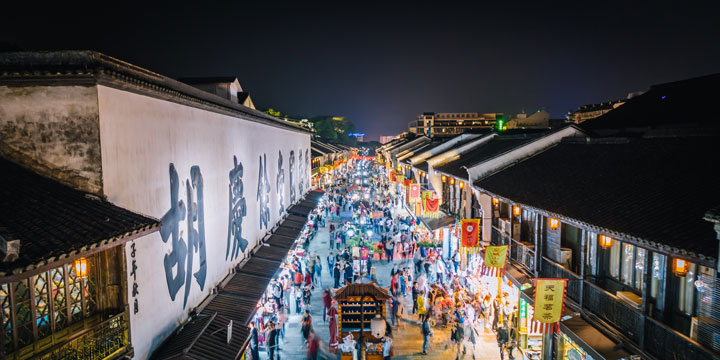
Hefang Street in Hangzhou, where shop type and posted prices determine whether bargaining is appropriate
Hotels and restaurants often offer hot water or tea, and many people carry insulated bottles. Preferences reflect habit, hospitality and convenience, not one medical belief shared by everyone. Tap-water standards and building plumbing vary; international visitors are commonly advised to use properly boiled or sealed water for drinking unless a reliable local source states otherwise.
Ask for “chángwēn shuǐ” (room-temperature water) or “bīng shuǐ” (iced water) if that is your preference, knowing that ice availability differs. Tea may be complimentary or charged; check before choosing a premium leaf or repeated service.
Pale-skin preferences have historical and contemporary visibility in parts of East Asia, while tanning, outdoor sports and many other styles also exist. It is inaccurate to claim one Chinese or American standard of beauty. Parasols, sleeves, hats and sunscreen may reflect ultraviolet protection, comfort, fashion, dermatological advice or personal taste.
Do not photograph a stranger because their sun-protection clothing looks unusual. Ask permission for a portrait and avoid comments about skin color, body shape or age. Practical sun protection is useful for every traveler regardless of culture: check the forecast, seek shade and use products and clothing suitable for your own health needs.
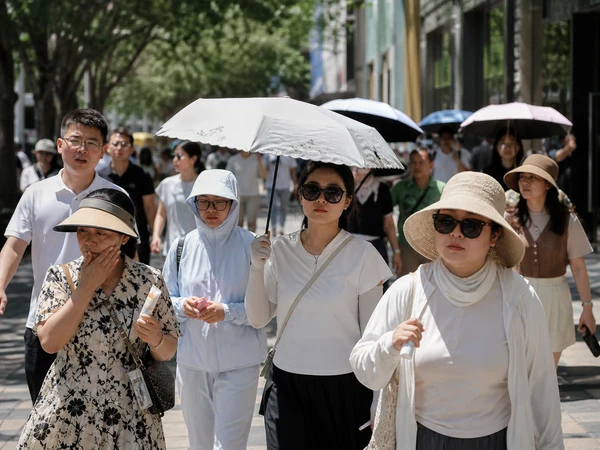
Pedestrians using parasols, hats and sleeves for sun protection on a bright city street
Cultural learning works best when attached to a named place, person and practice. Read museum labels, join a workshop that credits its teacher, ask a food host about regional technique and notice how contemporary neighborhoods use historic spaces. The China culture-shock guide offers a practical framework for the first days.
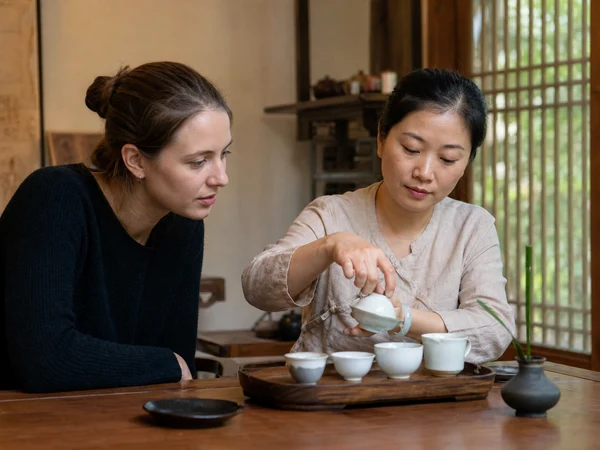
Visitor learning tea etiquette from a local teacher in a small tea room
Before booking a cultural activity, ask who teaches it, which tradition and region it represents, whether the event is public or staged for visitors, how photography works and how the host is paid then leave room for the individual in front of you to be more complex than any guidebook category.

From $ 2498

From $ 22782050
From $ 2983