Your China & Yunnan Travel Experts


 Ask a Question
Time & Duration of Spring Festival
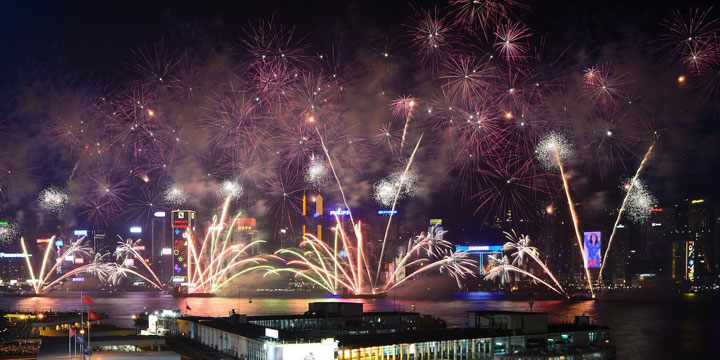
According to the traditional Chinese lunar calendar, Chinese Spring Festival, also known as Chinese New Year, begins with the New Moon and ends on the Full Moon, which is from the first day to the 15th day of the first month in a new year. The last day (the 15th day of the first lunar month) of the New Year is known as the Lantern Festival.The actual date is not a fix date, instead it is changed according to the Chinese lunar calendar every year,learn more about the C hinese new year date, please transfer to the page…
Origin of Spring Festival
The origin of the Spring Festival now is too old to be traced. It is widely believed that the word ‘Nian'(in Chinese means ‘year'), was first the name of a monster beast that started to prey on human being at the night before the beginning of a new year. It had a very big mouth that would swallow many people with one bite. People were very scared. One day, an old man came to their rescue, offering to subdue ‘Nian'. He said to ‘Nian' that ‘I hear that you are quite capable, but can you swallow other beasts on earth instead of people who are by no means of your worthy opponents?' Hence, ‘Nian' did swallow many of the beasts of prey on earth that also harassed people and their domestic animals from time to time. After that, the old man who turned out to be an immoral fairy disappeared riding the beast ‘Nian'. Now that ‘Nian' had gone and other beasts of prey are scared off into the forests, people began to enjoy their life in peace and happiness. Before the old man left, he had told people to put up red paper decorations on their windows and doors at each year's end to scare away ‘Nian' in case it sneaked back again, because red is the color that the beast feared most.
From then on, the tradition of observing the conquest of ‘Nian' is carried on from generation to generation. The term ‘Guo Nian', which may mean ‘Survive the Nian' becomes today's ‘Celebrate the New Year', as the word ‘Guo' in Chinese having both the meaning of ‘pass-over' and ‘observe'. The custom of putting up red paper and firing firecrackers to scare away ‘Nian' had been well preserved
Two Features of Spring Festival
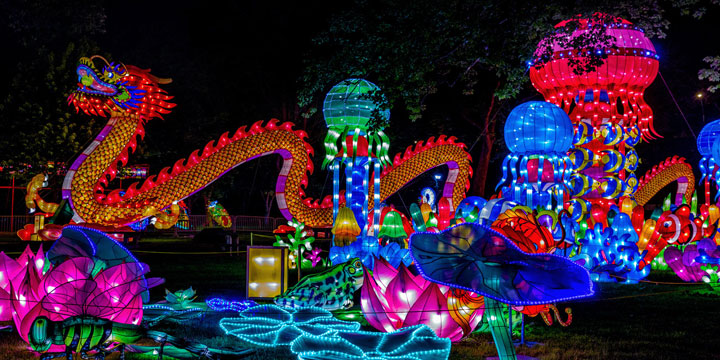
Equal to Christmas of the West in significance, the Spring Festival is the most important holiday in China. Two features distinguish it from the other festivals. One is seeing off the old year and greeting the new. The other is family reunion.
Two weeks before the festival the whole country is permeated with a holiday atmosphere. On the 8th day of the twelfth lunar month, many families will make the Laba Congee, a kind of congee made from more than eight treasures, including the glutinous rice, lotus seed, beans, gingko, millet and so on. Shops and streets are beautifully decorated and every household is busy at shopping and preparing for the festival. In the past, all families would make a throughout house cleaning, settling accounts and clearing off debts, by which to pass the year.
Customs of Spring Festival
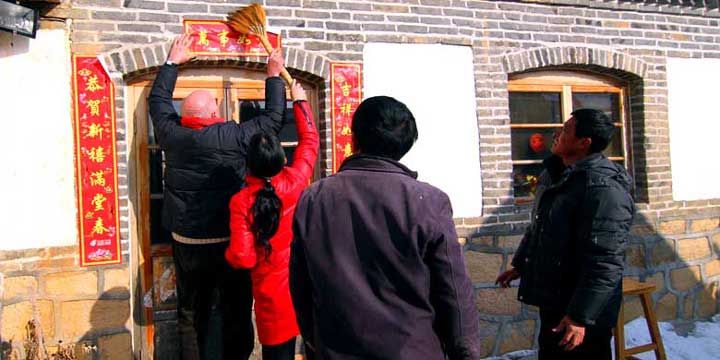
Paste couplets(Chinese: 贴春联): it's a kind of literature. Chinese people like to write some dual and concise words on red paper to express their new year's wishes. On the arrival of New Year, every family will paste couplets.
Paste couplets
Family reunion dinner(Chinese: 团圆饭): people travelling or residing in a place far away from home will back to their home to get together with their families.
Stay up late on New Year's Eve(Chinese: 守岁): it's a kind of way for Chinese people to welcome New Year's arrival. Staying up late on New Year's Eve is endowed with auspicious meaning by people. The old do it for cherishing their past time, the young do it for their parents' longevity.
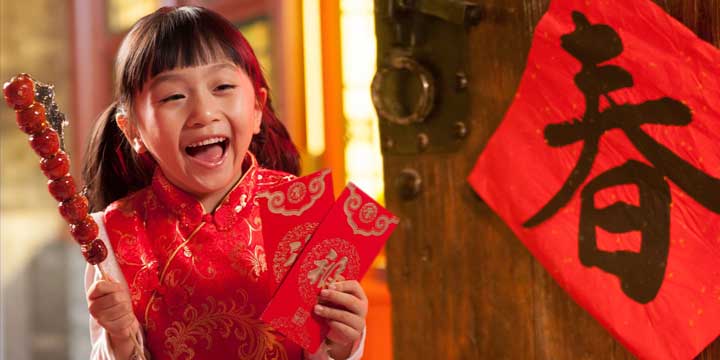
Hand out red packets(Chinese: 发红包): elders will put some money into red packets, and then hand out to the younger generation during spring festival. In recent years, electric red packets are popular among younger generation.
Set off firecrackers: Chinese people think the loud sound of the firecrackers can drive away devils, and the fire of the firecrackers can make their life thriving in the coming year.
Red packets
Celebration Activities on Chinese New Year's Eve
After dinner, people sit together before the TV to watch the New Year's program and chat with each other. About ten minutes before the ringing of the New Year's bell, people let out the fireworks to welcome back the Kitchen God from the Heaven, who is in charge of the fortune and misfortune of the household he dwells.
The meal is more luxurious than usual. Dishes such as chicken, fish and bean curd is necessary, for in Chinese, their pronunciations sounds like ‘Ji', ‘Yu', and ‘Doufu', with the meanings of auspicious, abundant and rich. Sons and daughters working away from home come back to join their parents.
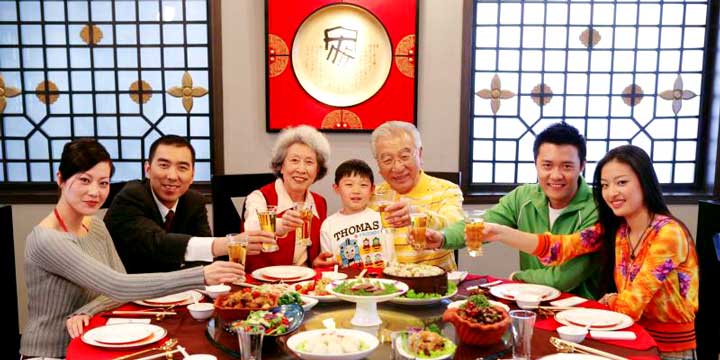
Family reunion dinner
What to Do During New Year Period
With the popularity of smart phone and other mobile devices, more and more people show interest in greeting by smart phone, which is very popular among younger generation.
• Greet by smart phone
Sending congratulations through smart phone gradually becomes the most popular way to greet people during Chinese New Year. Congratulations with text and graphics by smart phone is vivid and convenient. Even the friend is far away from you, he/she still can receive congratulations immediately. Chinese people prefer wechat or QQ, while western people prefer FaceBook or WhatsApp. Besides, red packet in wechat makes Chinese people crazy. No matter how much money they can receive from wechat friend, people still pretty enjoy it and never tire of it.
• Lover rental
Different from western culture, elders will still pay much attention to their children's life even they have been an adult. When single youngsters who have exceeded the lawful marriage age, the elder generation will press them to look for a marriage partner quickly during Spring Festival, this creates new business—fake boy/girl friend rental.
Jiaozi(饺子): a kind of dumplings in China. There are many kinds of jiaozi with different ingredients. Chinese people eat Jiaozi on New Year's Eve, people who eats the Jiaozi with coin or some special ingredient will be the luckiest.
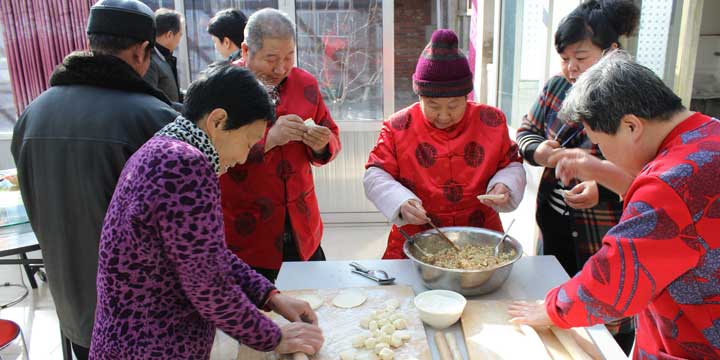
Family making dumpling together
Tangyuan(汤圆): a kind of dumplings in China. Tangyuan with sesame inside is the most common filling. There is a slight difference between northern China and southern China. The filling is salty in northern China, while that is sweet in southern China.
Zongzi(粽子): a kind of dumplings in China. It's made of sticky rice filled with different fillings and wrapped in bamboo leaves. Meat is the main filling in southern China, while bean is main filling in northern China.
Activities in Different Places
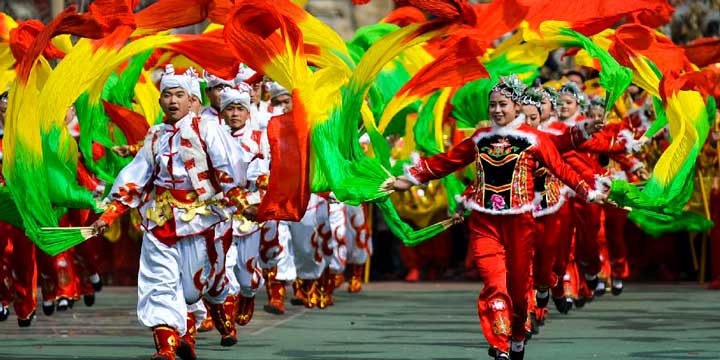
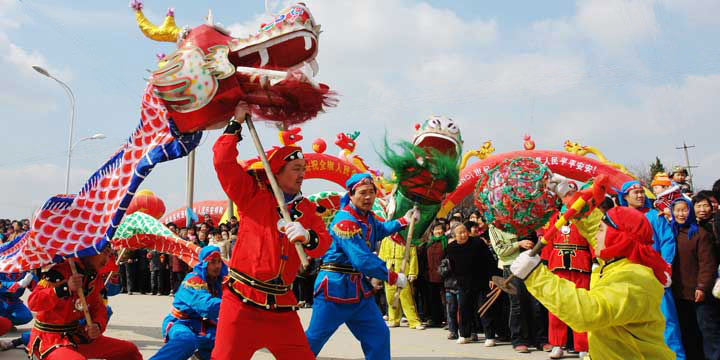
In the capital city Beijing, the most Spring-Festival activity is Temple Fair which held in different ancient temples. Temple fair in Beijing has a time-honored history. Traditionally, there are various kinds of performances in temple. Besides, one can find traditional arts and handicrafts as well as countless tasty local smacks from craftsmen and vendors along the streets. Most temple fairs are features by their dragon and lion dancing as well as folk performances. For foreign visitors, it is a rare opportunity to experience Chinese colorful culture and tradition.
Day-by-Day Guide to Spring Festival
| New Year's Eve | Pasting couplets on the doors; have reunion dinner; stay up late or all night to welcome the new year |
|
The first day
|
Welcome the gods of the heavens and earth; Visit families (especially those older than yourself) and friends to pass on your good wishes for the New Year.
|
|
On the second day
|
Chinese people pray to their ancestors as well as to all the gods.
|
|
The third and fourth days
|
Married Women will come back to their parents' home with the husband and children to pay Spring Festival visits and extend New Year greetings
|
|
The fifth day
|
Known as ‘Po Woo'. On the day people stay home to welcome the God of Wealth. No one visits relatives and friends on this day because it will bring both parts bad luck.
|
|
On the sixth to the 10th day
|
Visit relatives and friends freely. People also go to temples to pray for good fortune and health in the coming year. In addition, the seventh day of the New Year is the day for farmers to display their produce. The seventh day is also considered as the birthday of human beings. Noodles are eaten to promote longevity and fish for affluence.
|
|
The ninth day
|
Present the offerings to the Jade Emperor, the God of the Heaven in Chinese legend.
|
|
From the 10th to 12th
|
Friends and relatives should be invited home to have dinner. After such a sumptuous feast, on the 13th day people are supposed to have simple meals to cleanse the system.
|
|
On the 15th day
|
People celebrate the Lantern Festival by eating Sweet Dumplings, making and displaying lanterns.
|
What Should You Pay attention to While Traveling in Spring Festival in China?
• Transportation: Two weeks before Spring Festival, people who are out of home for work start to come back to hometown from other cities by flight, train or bus to spend the festival with their festival. And usualy within two weeks after the festival, people will travel back to the cities in which they work. If you plan to visit China during Chinese New Year, in order to avoid tickets being sold out, you'd better book it in advance. Besides, the air fares will be more expensive than usual.
• Restaurant: some restaurateurs may be back to their hometown to spend New Year time with their families, so some restaurants may close business for the time of Chinese New Year.
• Hotel: in some tourist cities, hotel price may higher than usual.