Tibetan Buddhism is a group of Vajrayana traditions within the wider Mahayana Buddhist world. It developed through sustained translation, scholarship, ritual practice and institutional exchange among Tibet, India, Nepal, China and other Himalayan and Inner Asian regions. Monastic universities, village temples, hermitages, household practice and pilgrimage all belong to this history; no single ceremony, hat color or political institution defines it.
Reviewed August 27, 2026. This guide is an editorial orientation for travelers, not a statement of belief or a substitute for teaching from a qualified religious community. Distinguish doctrine from local custom, historical evidence from later sacred biography, and active worship from tourist performance. The broader Tibet religion guide places Buddhism beside other religious traditions without treating them as interchangeable.
History of Tibetan Buddhism
• Foundations and the first diffusion
Later Tibetan histories preserve accounts of sacred objects arriving before Buddhism was formally established. These narratives matter within religious memory, but they should not be presented as securely dated archaeological events. The clearest documented expansion began under the Tibetan Empire, when rulers sponsored temples, translation and contact with Buddhist teachers and texts from neighboring regions.
Songtsen Gampo's seventh-century reign is associated with imperial consolidation, diplomatic marriages and the foundation traditions of Lhasa temples including Jokhang. Later sources connect the ruler closely with Buddhism, while historians continue to separate contemporary evidence from devotional biography. The development of Tibetan writing and translation was a longer process than one ruler or one mission.
Under Trisong Detsen in the eighth century, imperial sponsorship supported Samye and an ordained monastic community. Tibetan traditions give major roles to the Indian scholar Shantarakshita and the tantric master Padmasambhava. Translation, debate and institution building involved Tibetan, Indian and Chinese participants; modern summaries should not turn this complex period into a contest with one simple winner.
Ralpachen's ninth-century court is remembered for supporting translation and efforts to standardize terminology. Surviving manuscripts and later catalogues help scholars trace this work, but dates and attributions require source criticism. A temple label or popular legend can introduce the story; it is not the same as a contemporary document.
The reign of Langdarma and the empire's fragmentation disrupted major institutions in the mid-ninth century. The old claim that Buddhism became completely silent for a fixed 136 years is too absolute. Monastic ordination networks weakened in some areas, while texts, rituals and local practitioners continued in others. Regional evidence is uneven, so responsible history describes disruption and continuity together.
• The later diffusion and new institutions
From the late tenth and eleventh centuries, renewed translation and teaching networks connected western and central Tibet with North Indian Buddhist centers. Translators, patrons and teachers founded institutions that later traditions call the “later diffusion.” This was not a simple restart: older transmissions, new texts, local lineages and changing political powers interacted.
Atisha's teaching in the eleventh century influenced the Kadam tradition; Marpa's translations and transmissions shaped Kagyu lineages; the Khön family and Sakya institutions developed influential scholarly and ritual systems; Nyingma communities organized and interpreted older transmissions. Gelug emerged later from the reform and scholarship associated with Tsongkhapa. Labels help orientation, but every school contains internal branches and historical change.
Major Traditions of Tibetan Buddhism
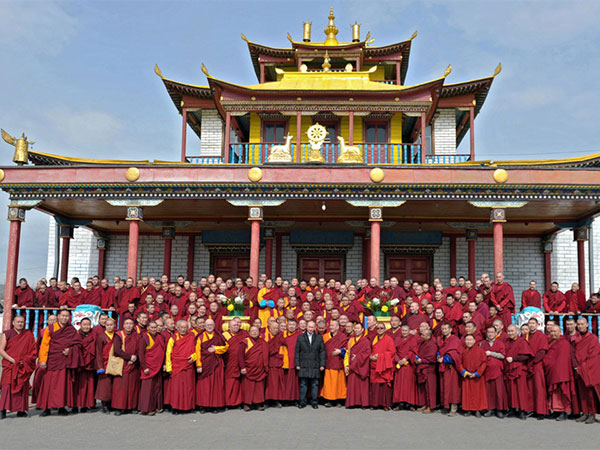
Nyingma means “ancient” and refers to traditions that identify with the earlier translation period. Nyingma practice includes tantric transmissions, Dzogchen teachings and treasure traditions known as terma. Calling it merely a “red-hat sect” or a loose organization hides its monasteries, scholarly systems, ritual communities and diverse lineages.
Important Nyingma institutions include Mindroling, Dorje Drak, Kathok, Dzogchen and Palyul, among others. The retained group photograph shows monks outside a monastery, but clothing alone cannot verify every person's lineage. Use the image as evidence of a real monastic community, not as a complete visual definition of Nyingma.
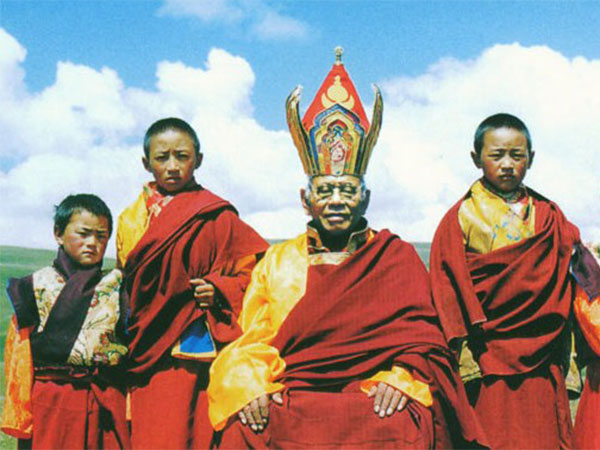
Sakya developed from the eleventh century around the Khön family, Sakya Monastery and transmission networks associated with translators including Drogmi. Lamdre, commonly rendered “Path and Result,” became a central teaching system. The tradition combines ritual practice, philosophical study and hereditary institutional history rather than one founder story.
Sakya leaders played major religious and political roles during the thirteenth-century relationship between Tibet and the Yuan court. Later Sakya branches and institutions developed distinct lines of authority and teaching. Modern place names, historical regions and institutional titles should be dated rather than projected unchanged across centuries.
Red, white and dark exterior bands are associated with Sakya architectural identity at some sites, but color alone is not a reliable school label. The retained lama photograph is a real historical-style portrait; the hat and robes require informed interpretation, and the people shown should not be reduced to costume types.
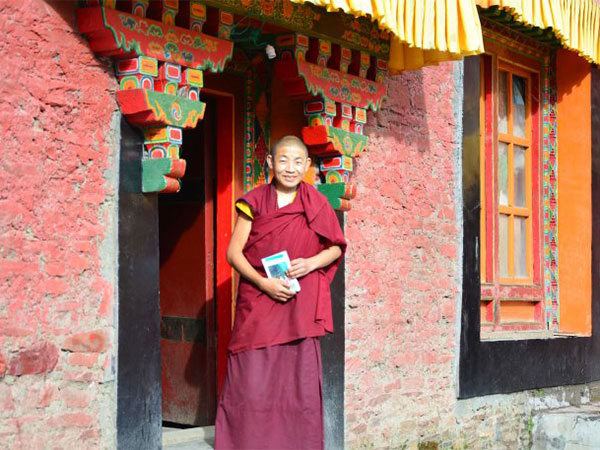
Kagyu is a family of transmission lineages linked to teachers such as Marpa, Milarepa and Gampopa and to practices including Mahamudra. “Oral lineage” describes the importance of direct transmission, not an absence of texts or scholarship. Karma Kagyu, Drukpa Kagyu, Drikung Kagyu and other branches have distinct histories and institutions.
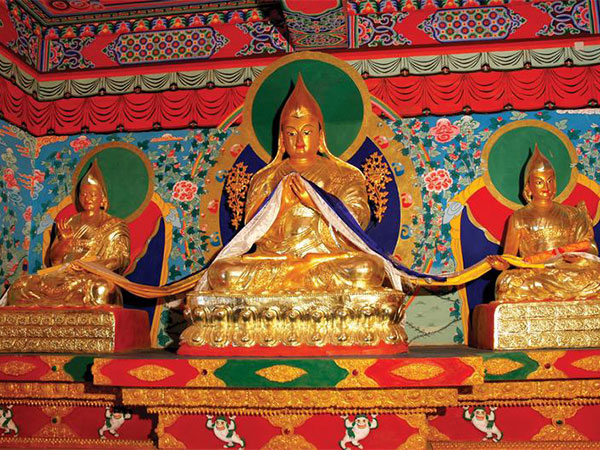
Gelug developed from Tsongkhapa's late fourteenth- and early fifteenth-century teaching and reform work. It emphasizes disciplined monastic study, debate, ethics and a graduated path framework alongside tantric practice. The popular phrase “yellow-hat school” is a visual shorthand, not an adequate explanation of its doctrine or history.
Ganden, Sera and Drepung near Lhasa and Tashilhunpo in Shigatse are major Gelug monasteries with different founding dates and functions. Potala is a palace-fort and administrative-religious complex, not simply a Gelug “ashram.” The retained interior image shows Buddhist statues and painted decoration; it does not establish that every object belongs to the same date.
Kadam was shaped by Atisha and his disciple Dromtonpa in the eleventh century. Its teachings on disciplined practice and the graduated path influenced later Tibetan traditions, especially Gelug. Describing Kadam only as a school that disappeared into Gelug overlooks its texts, lineages and wider intellectual legacy.
Reting Monastery is closely associated with early Kadam history. As with other living and restored sites, confirm which halls are open, what has been rebuilt and where photography is prohibited. Historical importance does not grant visitors access to private residential or ritual areas.
Practice, Teachers and Visitor Etiquette
1. Teachers, monastics and lay communities Lama is a title for a respected teacher, not a synonym for every monk. Monks and nuns follow institutional and lineage-specific training; lay practitioners also sustain temples, pilgrimage, household ritual, patronage and community life. Do not assign status from clothing alone or interrupt someone to ask whether they are a “living Buddha.”
The Dalai Lama institution belongs to one tulku lineage with a particular historical relationship to Gelug and Tibetan government. It is inaccurate to say simply that the Dalai Lama is a reincarnation of “Lord Buddha.” Tulku recognition systems differ among traditions and are understood within specific religious and institutional frameworks.
2. Prayer wheels, circumambulation and sacred space Prayer wheels commonly contain written mantras and are turned as part of devotional practice, often while moving clockwise around a sacred place. Follow the direction used by the local community, do not spin a wheel as a joke or photo prop, and never block pilgrims. Review the
religious etiquette guide before entering an active monastery.
3. Transmission and lineages Teacher-to-student transmission is important across Tibetan Buddhist traditions, not only Nyingma, Kagyu or Kadam. Study may include texts, oral explanation, debate, ritual authorization, meditation instruction and long institutional training. Outsiders should not claim an initiation or teaching merely after observing a public ceremony.
Some Sakya offices have hereditary histories, while other institutions use appointment, election, seniority or recognized reincarnation. These systems vary by period and organization; “family inheritance” is therefore too broad as a general description of an entire tradition.
Tulku lineages are recognized through community and institutional processes that cannot be summarized as one universal succession method. Historical religious authority and modern administration also require separate explanation. Avoid asking guides or worshippers to settle complex political questions during a sacred visit.
4. Doctrine, ritual and life-cycle practices Tibetan Buddhism combines Mahayana commitments to compassion and wisdom with Vajrayana texts, initiations, visualization, mantra and ritual. Sutra study and tantric practice are not mutually exclusive. Bon is a distinct religious tradition with a long history of interaction, not simply a collection of elements “absorbed” by Buddhism. Funerary practice varies with region, lineage, family and circumstance; the
Tibetan burial guide explains this diversity without turning private rites into spectacles. Verify current site rules, ask before photographing anyone, never touch murals or sacred objects, and leave enough time to observe quietly.

 Ask a Question