Your China & Yunnan Travel Experts

 Ask a Question
 Reviewed August 27, 2026. Tibetan funerary traditions are private, regionally varied practices shaped by family, lineage, local custom, law, environment and circumstance. There is no single “Tibetan burial,” and social rank is not a reliable formula for predicting the rite a family will choose. Scholarly studies document sky burial, cremation, earth burial, water burial and interment in or near a stupa, but their meanings and frequency differ across place and period. This page provides cultural context for travelers; it is not a guide to finding or attending a funeral.
Death rites may include prayers, readings, divination, preparation of the body, offerings and memorial observances intended to benefit the deceased and support the living. Tibetan Buddhist ideas about impermanence, compassion, rebirth and the intermediate state can be important, while Bon and local family traditions may frame death differently. The Bon religion guide explains why Bon should not be treated as an early, incomplete version of Buddhism. In every case, the family and religious community—not a visitor—set the boundaries.
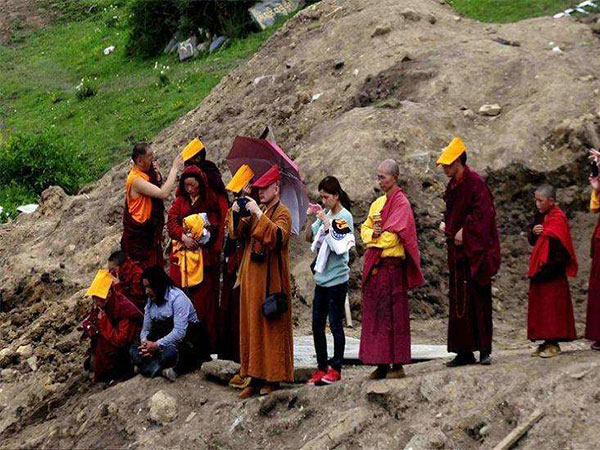
Sky burial, also called celestial burial in English, is a funerary practice in which the body is ritually offered at a designated site, traditionally to vultures. It is one of several Tibetan mortuary practices and is especially associated with some Buddhist communities. The rite cannot be explained only by rocky ground or scarce fuel: scholarship notes religious, ethical, local and environmental explanations, and the balance among them varies. Avoid the sensational phrase “feeding a body to eagles”; Himalayan vultures, not eagles as a generic category, are central to many accounts.
A sky-burial ground is not a tourist attraction. Do not search for a ceremony, follow a funeral party, enter a closed site, use a drone or long lens, or photograph remains, ritual specialists, family members or birds at the rite. Images found online do not create consent. Some viewing platforms and commercial “sky burial tours” have been criticized precisely because they turn grief and sacred practice into spectacle. If a guide proposes uninvited access, decline it.
Within Buddhist interpretations, the body after death may be understood as no longer housing the person's consciousness, and offering it can express generosity and impermanence. That explanation is meaningful but not universal, and it should not be turned into a claim that every family sees the rite in exactly the same way. The retained landscape photograph shows a real outdoor gathering with monastics; it remains intentionally non-graphic and should not be read as access to the private ritual itself.
Ritual specialists perform skilled and socially important work, but common travel articles make unsupported claims about their wealth, jewelry or status. Those claims have been removed. Practice, payment and community role vary. A respectful account also avoids procedural detail that serves curiosity without helping the traveler make a responsible decision. For the wider religious context of death, rebirth and ritual diversity, see the Tibetan Buddhism guide.
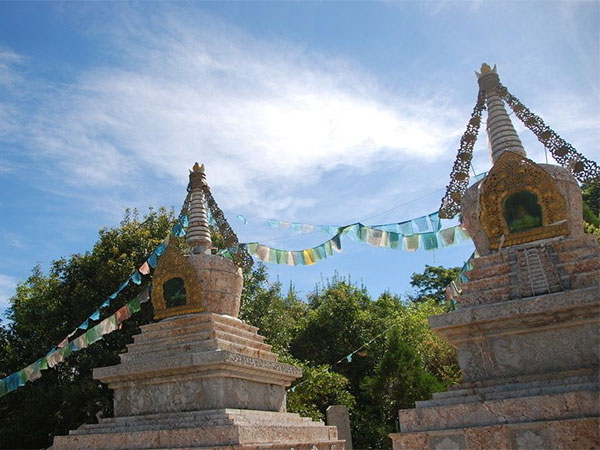
Stupas—often called chortens in Tibetan contexts—can contain relics, ashes, texts, consecrated substances or commemorative deposits. Certain eminent teachers have been commemorated through elaborate reliquary stupas, but “pagoda burial” is too broad if it implies one standardized rite reserved for a fixed list of ranks. The retained photograph shows white stupas with prayer flags in a Tibetan landscape; it illustrates the architectural form, not a specific person's tomb.
The treatment of a respected teacher's remains can include cremation, preservation, division of relics and enshrinement, depending on lineage, period and institution. A small reliquary object and a monumental stupa are not interchangeable. Museum labels, monastery records and conservation documentation are stronger evidence than color, size or a guide's guess. Visitors should not ask staff to identify bodily relics for entertainment.
Stupas are sacred architecture as well as potential reliquaries. Follow the local circumambulation route, do not climb the base, pull prayer flags, place coins in cracks or touch painted surfaces. A photograph from a public path may be permitted even when a chapel interior is not. Check the site rule each time rather than assuming that an outdoor structure is unrestricted.
Material remains also belong to heritage law and community custody. Do not buy bone objects, fragments, soil or “relics” said to come from a burial site. Provenance claims are difficult to verify, and removing material can be illegal and deeply disrespectful. Legitimate museums and monasteries document custody; a souvenir stall's story is not documentation.
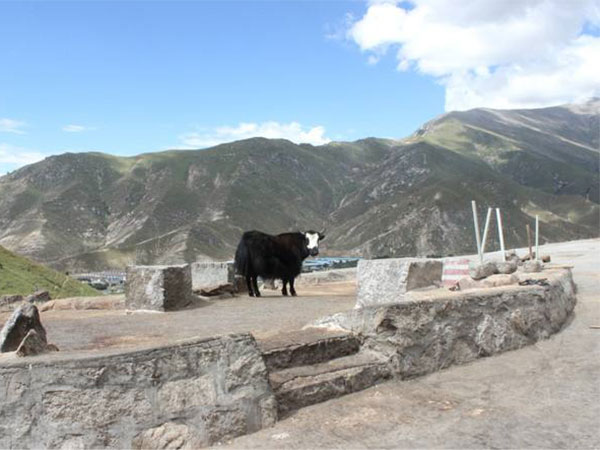
Earth burial has a long archaeological history on the Tibetan Plateau, including royal and elite tomb traditions from the imperial period. Archaeology can describe tomb form, objects and date, but it should not be used to project one ancient practice unchanged onto contemporary families. The retained final landscape photograph shows a yak near stone-built features; it is contextual scenery, not evidence of a modern funeral.
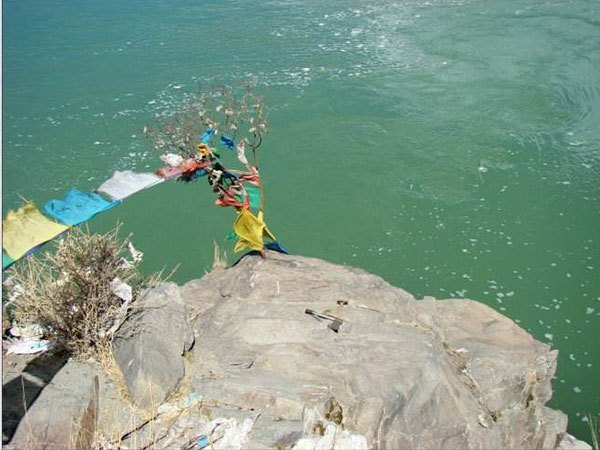
Water burial has been documented in some river communities, but the old page's claims about children, disease and social value were overly general and stigmatizing. Who received a particular rite, how it was performed and what it meant varied by place and source. The retained river photograph provides non-graphic environmental context only. Visitors must never seek a disposal site, enter the water near a rite, photograph a funeral or repeat a local story as a rule for all Tibetans.
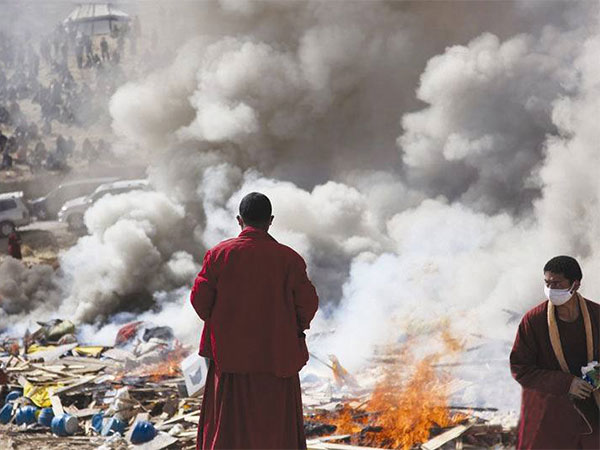
Cremation appears in Tibetan funerary history in monastic, elite and lay contexts, with major regional and temporal variation. Prayers and preparation may precede the fire, while ashes or relics can be enshrined, scattered or otherwise treated according to the family and religious community. The retained photograph shows monastics near an outdoor fire and is used only as a non-graphic visual for cremation context; it does not identify the people, date or exact ceremony.
Earth burial continued alongside other practices and is also visible in archaeological evidence, but modern choice cannot be reduced to an “old custom replaced by sky burial.” Families respond to local rules, landscape, lineage and personal circumstances. The responsible traveler does not rank one rite as more noble, pure or authentically Tibetan than another. Follow the Tibet monastery etiquette guide for behavior at sacred sites: respect closures, never photograph grief without consent, and allow a local expert to distinguish a memorial, a stupa and an archaeological tomb.