Reviewed August 27, 2026. The Butter Lamp Festival in Lhasa is commonly called Chunga Choepa and falls on the fifteenth day of the first Tibetan month. It closes the principal Losar season and is associated with the Great Prayer Festival, or Monlam Chenmo. Lamps, offerings and elaborate butter sculptures give the observance its distinctive visual identity, but it is first a religious occasion rather than a lantern show staged for visitors. Public displays, traffic controls and access can change each year, so a historical date does not guarantee a current program. Meaning, date and setting The Tibetan calendar is lunisolar, which means the corresponding Gregorian date moves from year to year. Check the announced date for the specific year rather than copying last year's itinerary. Our
Tibetan calendar guide explains why a Tibetan festival date cannot be converted with a fixed annual rule.
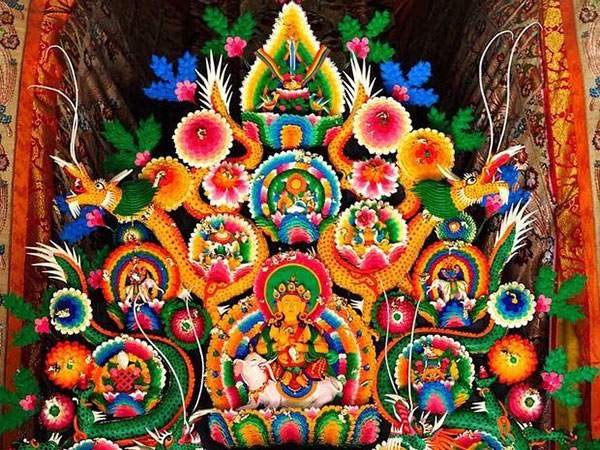
The retained photograph shows an actual butter-sculpture display: colored butter is modeled into flowers, animals, auspicious emblems and religious figures, then arranged as a temporary offering. Such work is perishable and highly skilled. View it as ritual art made for a particular observance, not as evidence that every monastery presents the same subjects or scale.
Festival date: Fifteenth day of the first month in the Tibetan calendar; confirm the Gregorian date and public schedule for your travel year.
Main setting: Lhasa, especially active monasteries and central pilgrimage areas when officially open. Programs outside Lhasa vary by community and monastery.
History and Religious Context
Accounts of the festival are closely connected with Tsongkhapa, the founder of the Gelug tradition, and with the Great Prayer Festival he established in Lhasa in the early fifteenth century. The year 1409 is widely associated with the first Monlam Chenmo at the Jokhang. That historical context is more reliable than the vague claim that one night of street lanterns created the entire festival.
What the date means 1409
is best understood as a landmark in the institutional history of the Lhasa prayer festival, not a claim that butter lamps or butter offerings began in that year. Lamps were already established forms of Buddhist offering, while later institutions, artists and local communities shaped the displays seen in different periods. Separating the history of Monlam from the much older practice of making light offerings avoids an artificial single-origin story.
Why butter sculpture matters Butter sculpture combines religious iconography, craft knowledge and temporary material. Makers must control color, temperature, form and assembly while following the visual requirements of the subject. A finished work may be impressive, but photography never takes priority over worship, crowd movement or conservation. Do not touch a sculpture, lamp, offering table or supporting frame, and do not call every colored butter form a torma; labels and ritual functions differ.
How to Experience the Butter Lamp Festival Respectfully
During daylight, monasteries may receive worshippers making offerings and prayers. Access to a chapel or ceremony should never be assumed, and a general entrance ticket does not authorize photography. Follow the posted route, keep doorways clear and allow pilgrims to move ahead. The
Tibetan Buddhism guide provides context for lamps, offerings and sacred art without treating the festival as a performance.
Evening displays can draw dense crowds around Lhasa's central pilgrimage streets. Wear warm layers, arrange a fixed meeting point, keep valuables secure and avoid tripods or large bags that block movement. Butter lamps involve flame and hot fuel; stay behind barriers and supervise children. Street installations and opening hours are operational details, so confirm them through the current local notice and your licensed guide on the day.
A sensible festival plan leaves the first Lhasa days light for altitude acclimatization, avoids promising access to a private rite and includes a normal cultural day if the display is changed or cancelled. Browse the
Tibet festivals overview to compare public events, then verify the exact venue, time, reservation rule and photography policy locally. This page is cultural orientation, not a substitute for an official annual program.

 Ask a Question