Reviewed August 28, 2026. The Tibetan calendar is a family of lunisolar calendrical and astrological systems used across Tibetan cultural regions. Lunar months organize dates, while solar calculation and periodic leap adjustments keep the calendar aligned with the seasons. It is therefore inaccurate to describe every Tibetan year as exactly 354 days or to convert a festival with one fixed Gregorian formula. Different lineages and communities have historically used related but not identical calculations. Modern calendars may print Tibetan, Gregorian and other date systems side by side, but visual similarity does not make their day boundaries or month numbering interchangeable.
For travelers, the calendar answers two separate questions: the traditional date of an observance and the public date on which a specific organizer will hold an event. The first provides cultural context; the second controls transport, tickets, access and road planning. Always confirm both for the destination and year.
When Does Tibetan New Year Fall?
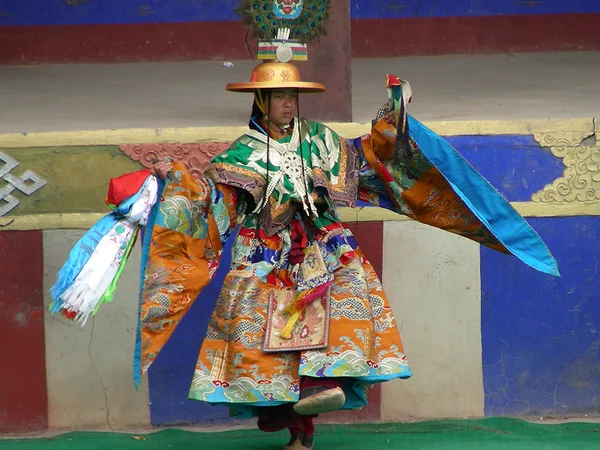
Losar begins on the first day of the first Tibetan month, but its Gregorian date changes. It may coincide with Chinese Lunar New Year in some years and differ in others. Himalayan communities can also celebrate New Year on different dates because their calendrical lineages and local traditions are not uniform.
The replacement photograph shows a monk dancing during Losar at Domthok Monastery near Gyêgu in northern Kham in 2012. It is a real record of that community and year, not a universal image of every Tibetan New Year. Use the current local calendar and announcement rather than copying the date attached to a photograph.
Before reserving travel, identify the exact destination, event and organizer; then check the official Gregorian date, public-holiday notice, opening arrangements and transport controls. A travel seller's undated “festival calendar” is not sufficient evidence.
How the Tibetan Calendar Works
A Tibetan month follows lunar phases, while calendrical astronomy relates months and years to solar motion. Leap adjustments are required because twelve lunar months are shorter than a solar year. Some systems may repeat or omit numbered lunar dates as calculations reconcile lunar days with civil calendar pages; that does not mean a printer made a simple error. A repeated date and a repeated month are different mechanisms, so a conversion should come from the actual annual almanac rather than a hand-built arithmetic shortcut.
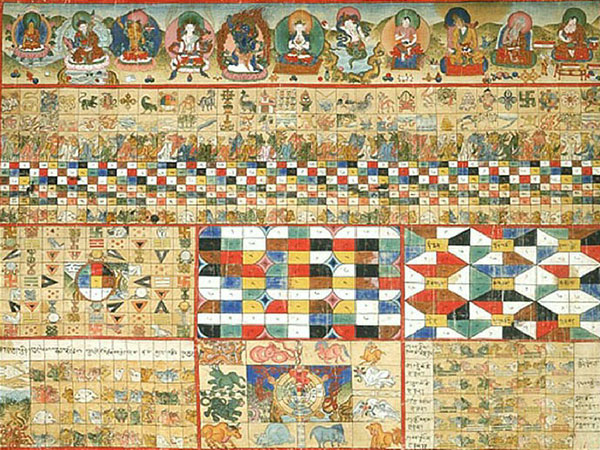
Years are commonly described through combinations of twelve animals and five elements, producing a sixty-year cycle. That cycle is useful for naming years, but it should not be turned into deterministic personality or travel advice. The retained astrological chart includes animals, elements, trigrams and numerical schemes whose ritual and instructional meanings extend beyond a modern wall calendar. Museum descriptions identify protective, cosmological and educational functions in such charts; they are related to calendrical knowledge without being a month-by-month event poster.
Calendrical specialists also calculate religious observances, eclipses and other astrological or medical indications. A general visitor guide can explain the structure, but it cannot replace the annual almanac or the interpretation of a qualified practitioner. For religious context, continue to the
Tibetan Buddhism guide.
History and Development of Tibetan Calendrical Knowledge
Early Tibetan communities reckoned seasons through the environment, herding and farming cycles as well as inherited ritual knowledge. Later written histories sometimes assign very precise ancient dates to legendary events; those claims should not be repeated as settled chronology without a traceable source.
During the Tibetan Empire, contact with neighboring Indian, Chinese and Central Asian knowledge traditions expanded astronomy, mathematics, medicine and divination. This was a long process of translation and adaptation, not a one-time gift that instantly created the finished calendar. The
Tibet history guide provides a broader chronology for this exchange.
The Kalachakra tradition became especially influential in Tibetan astronomy and calendar calculation. The sixty-year cycle convention associated with 1027 is an important historical reference, yet it does not erase earlier local reckoning or later differences among schools. A cycle label identifies a place within a repeating system; it should not be presented as proof that every Tibetan calendrical practice began in one year.
Tibetan calendrical lineages developed distinct computational conventions, including methods commonly identified with Phukpa and Tsurluk traditions. Their existence is one reason a responsible page speaks of Tibetan calendars in the plural when comparing Himalayan New Year dates.
Almanacs joined astronomical calculation with practical and religious guidance. They could identify festival days, agricultural timing, ritual observances and astrological indications. Historical almanacs are evidence of knowledge systems; they are not reliable forecasts for modern flights, road openings or attraction hours.
Institutional learning connected calendar calculation with Tibetan medicine and astrology. Schools, monasteries, court institutions and later specialist institutes all participated in transmission. The balance between textual authority, calculation and local practice changed over time.
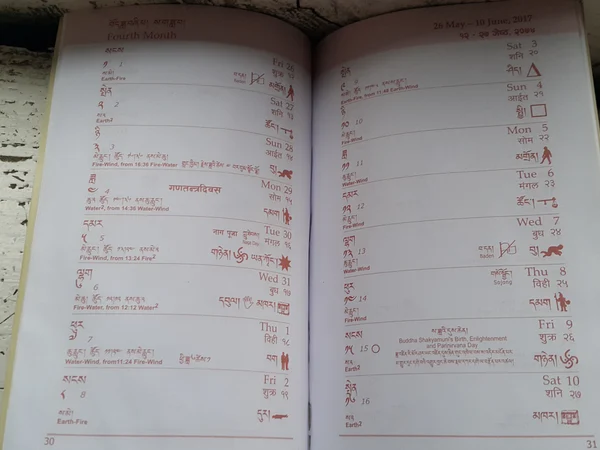
In the modern period, printed and digital calendars circulate more widely, but users still need to know which institution, lineage, region and year a calendar represents. A screenshot without a publisher or date is weak evidence, even if the Tibetan script appears authentic. For high-stakes planning, keep the original notice or almanac title and the date accessed; search snippets and copied tables often lose the caveat that explains a local variation.
The replacement photograph shows a printed Tibetan calendar covering part of May and June 2017. It is kept as a clearly dated example of how Tibetan and Gregorian dates may be presented together; it must not be read as the current festival schedule.
For planning, record the traditional lunar date, the officially announced Gregorian date and the venue as three separate fields. Recheck them close to departure, because event programs, transport and public access can change independently of the calendar calculation.
Use the
Tibet travel planning guide for permits, licensed guiding and altitude pacing. This calendar page explains date logic only; it does not guarantee access to a monastery, family celebration or public event.

 Ask a Question