Your China & Yunnan Travel Experts


 Ask a Question
Chinese New Year and Christmas are both major holiday seasons, yet they arise from different calendars, histories and belief systems. Similarities such as family gatherings, decorations and gifts should not obscure those differences. Christmas practices vary by denomination and country, while Spring Festival customs vary by region and household. The Chinese New Year overview explains the Chinese festival on its own terms.
Social importance. Both holidays can reshape school, work, retail and transport schedules. Their relative religious, cultural or family importance depends on the community rather than a universal ranking.
Family connection. Many people use each season to reunite with relatives, share a special meal and contact family members who live elsewhere. Not everyone travels home, and some celebrate with friends or chosen family.
Winter timing. Christmas Day is December 25. Chinese New Year changes date within the northern-hemisphere winter because it follows the traditional Chinese lunisolar calendar.
A useful comparison therefore asks how each custom functions, not which holiday has an exact equivalent.
Christmas commemorates the birth of Jesus Christ within Christianity, while many secular customs developed in different places and periods. Chinese New Year grew from a long complex of seasonal, agricultural, family and ritual practices. The monster Nian is a popular folk explanation for red decoration and festive noise, not a documented single historical origin of the festival.
Christmas Day has a fixed Gregorian date, although Advent, Christmas Eve, Epiphany and local public holidays create different seasonal spans. Chinese New Year begins on the first day of the first lunar month, so travelers must check the matching Gregorian date each year.
Spring Festival celebrations may extend through the Lantern Festival in cultural terms, while official public-holiday dates and business closures are set for each year. Do not assume every venue closes for the entire traditional period.
The pre-holiday travel rush can make rail and air seats scarce. Anyone visiting China at this time should confirm ticket-release rules, reserve early where possible and expect altered opening hours. Current transport and holiday notices matter more than old schedules.

Christmas preparation may include Advent observance, travel, cards, meals, church services, shopping and decorating. These choices differ widely between religious and secular households and among countries.
Spring Festival preparation often includes cleaning before the holiday, arranging reunion travel, buying food, preparing gifts and displaying seasonal decorations. Shopping dates are personal and commercial promotions are not part of a fixed ritual calendar.
Red, green, gold, white and other colors appear in Christmas decoration depending on local custom. Red and gold are especially visible during Chinese New Year because they are associated with celebration, vitality and auspicious wishes.
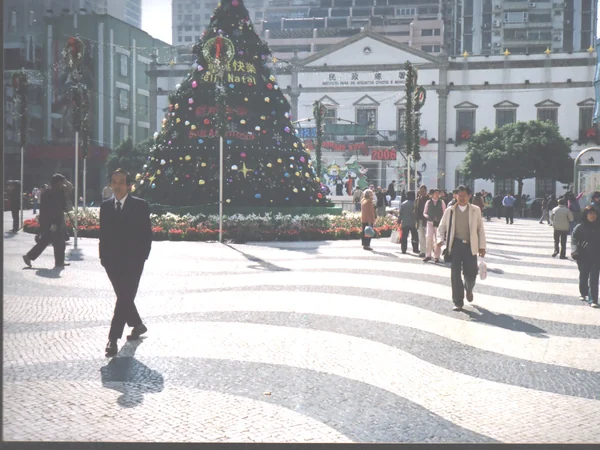
Christmas trees, lights, wreaths and nativity scenes can carry secular, family or religious meaning. Travelers should avoid assuming every Christmas display represents the same belief.
Spring Festival couplets, paper cuttings, lanterns, New Year pictures and the character 福 are common visual elements. The Chinese New Year decoration guide explains placement and regional variation.

Kumquat trees and seasonal flowers are particularly prominent in parts of southern China. Their popularity is not a direct equivalent of the Christmas tree; each belongs to its own linguistic and regional context.
Christmas activities may include worship, charitable giving, family visits, community events, meals, music and gift exchange. Participation differs by faith, age and national tradition.
Chinese New Year's Eve may include a reunion dinner and the televised Spring Festival Gala, while red envelopes, greetings and visits occur in many families over subsequent days.
Lion dances, dragon dances, lantern displays and temple fairs are public cultural events in some destinations. Firework rules vary and are often restricted in cities, so visitors should use authorized displays only.

Holiday travel and modern entertainment are now part of both seasons. Cinema visits, domestic trips and digital greetings coexist with older customs rather than replacing them in a simple way.
Christmas meals differ substantially by country, religion and family. Chinese New Year food also varies: northern households may emphasize dumplings, while niangao, tangyuan, whole fish, poultry, hot pot and many local dishes appear elsewhere.
Food symbolism often relies on shape, color or wordplay. Fish can suggest surplus and tangyuan reunion, but no dish is mandatory nationwide. Dietary restrictions and allergies should be discussed before a shared meal.

Christmas gifts may be placed under a tree, exchanged at a gathering or omitted entirely. Stories about Santa Claus are part of many childhood traditions, with forms that differ across countries.
At Spring Festival, red envelopes are common gifts from older generations to children and younger relatives. Other gifts should suit the recipient's health, habits and household rather than follow a generic luxury list.

For practical choices and culturally sensitive exclusions, use the Chinese New Year gift guide. The safest approach in either holiday is to ask the host, respect personal belief and avoid presenting one family's custom as universal.
A visitor can enjoy public decorations, markets, museums and authorized events without intruding on private family rituals. Plan around transport demand, confirm schedules and ask permission before photographing worship or family activities.