Your China & Yunnan Travel Experts

 Ask a Question
Reviewed August 27, 2026. A useful history of Tibet begins with evidence, dates and the limits of what can be proved. Archaeology shows long human occupation of the plateau, but material finds, later chronicles, religious biographies and oral traditions do not answer every early question in the same way. Treat origin stories as culturally important narratives rather than simple substitutes for archaeological evidence. The clearest documented political turning point came in the seventh century, when the Yarlung rulers consolidated a kingdom under Songtsen Gampo and his successors. The Tibetan Empire, conventionally dated from the seventh to the mid-ninth century, became a major power connecting Tang China, Central Asia, Nepal and the Indian subcontinent. British Museum Silk Roads material places the empire across these regions and records its later control at Dunhuang; surviving inscriptions and manuscripts help historians reconstruct diplomacy, administration, military expansion and translation activity without pretending the record is complete.
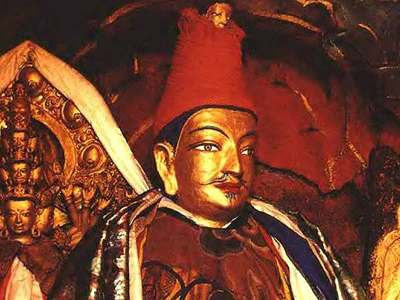
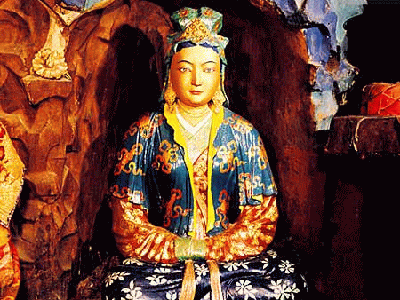
Songtsen Gampo matters both as a historical ruler and as a figure shaped by later religious memory. His reign is associated with state formation, diplomacy and marriage alliances, including Princess Wencheng of the Tang court. Later Tibetan traditions link his period to the institutional roots of Buddhism and to revered images and temples in Lhasa. Those traditions should be read beside object-based scholarship: the Metropolitan Museum, for example, identifies an early surviving Tibetan silk painting as a later representation of Songtsen Gampo rather than a contemporary portrait. That distinction helps readers understand why the two traditional paintings retained below are historical artworks, not documentary photographs of seventh-century people. For the evidence and legends preceding the imperial period, continue to the early history of Tibet.
The empire fragmented after the ninth century, and political authority became more regional. Buddhist institutions, local rulers, trade networks and relationships with neighboring powers shaped different periods that cannot be compressed into one uninterrupted dynasty. From the thirteenth century onward, Tibet was increasingly connected to successive central governments in China through changing political and religious arrangements. The Yuan, Ming and Qing periods each require their own sources and terminology; later institutions should not be projected backward onto the seventh century. A responsible overview names the period, identifies the kind of evidence and avoids turning a complex history into either a sacred legend or a modern slogan.
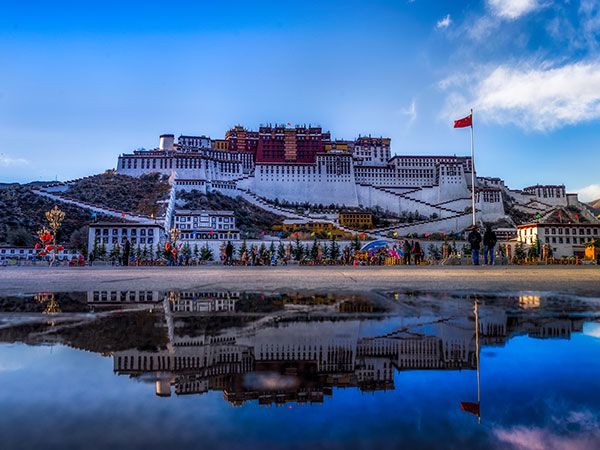
Lhasa's monuments reveal layers rather than one date. UNESCO describes the Historic Ensemble of the Potala Palace as three linked components: the Potala Palace, Jokhang Temple and Norbulingka. Jokhang was founded in the seventh century; the Potala's present White and Red Palace complex largely reflects seventeenth-century construction on Red Mountain; Norbulingka developed as an eighteenth-century summer palace. The retained Potala photograph therefore represents the later architectural landscape associated with Tibetan government and religion, not a surviving seventh-century imperial building. Read the Tibetan Empire guide for the seventh-to-ninth-century chronology, and the Songtsen Gampo profile for the ruler, diplomacy and later religious memory.
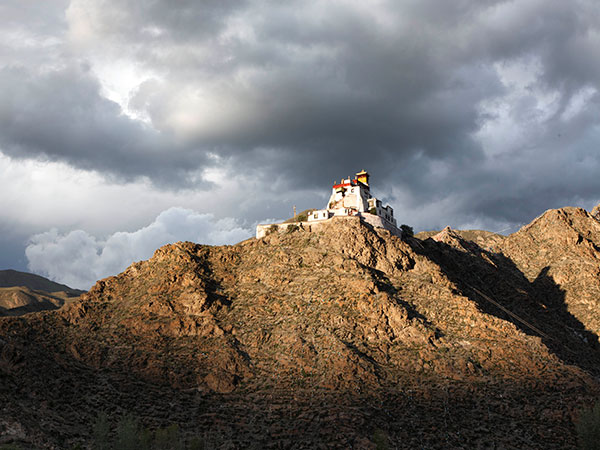
For travelers, chronology improves the visit. At Jokhang, distinguish the seventh-century foundation and the sacred traditions of the Jowo image from later rebuilding, artworks and living worship. At Potala, notice how architecture, murals, manuscripts and ceremonial spaces preserve many periods; do not describe every object as “ancient” or assume all rooms are open. At Norbulingka, read the garden and palace complexes as an eighteenth-century and later landscape. In Shannan, Yumbulakang is tied to early royal narratives, but the visible structure has a long history of rebuilding. At Samye, Gyantse, Shalu or other monasteries, ask which elements are original, reconstructed or restored. Site labels and specialist interpretation are more reliable than repeating a guidebook caption written decades ago.
History is also living heritage. Monasteries are active religious places, pilgrims are not performers, and a portrait or mural may be an object of devotion. Follow local photography rules, never use flash where prohibited, do not touch murals or manuscripts, and ask before photographing a person. Political, religious and biographical topics can be sensitive; a qualified guide should explain what is documented, what is a local tradition and what remains debated. Opening hours, visitor limits and protected-area rules change, so verify them with the responsible site and a licensed operator close to travel. This page is an editorial introduction, not a substitute for archival research. Its aim is to give readers a dated framework, show how historians use different evidence and make the monuments below more intelligible without erasing uncertainty or cultural meaning.