Your China & Yunnan Travel Experts


Tujia brocade is a living textile tradition of the Tujia communities of western Hunan and neighboring areas, not a generic factory-print pattern. China's national intangible-cultural-heritage database lists Tujia brocade weaving among the first group of national projects in 2006 and identifies the Xiangxi Tujia and Miao Autonomous Prefecture as a principal area of transmission. The name Xilankapu is often used for the representative patterned bedcover tradition, while woven bands form another important category. For regional route context, begin with the Zhangjiajie travel guide.
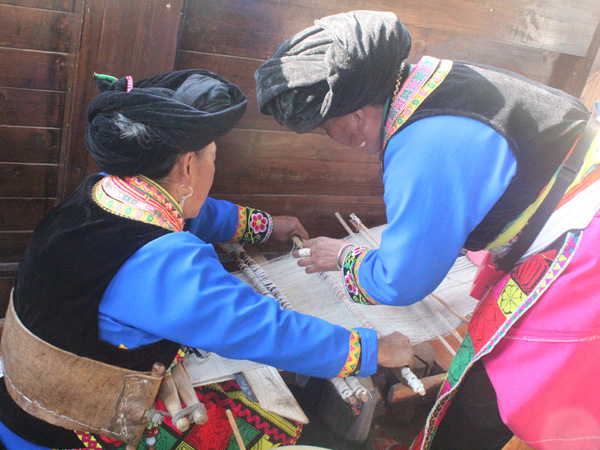
Traditional weaving uses a wooden waist loom and a discontinuous-weft technique often described as “continuous warp, discontinuous weft.” The official craft record documents a sequence that includes preparing and dyeing yarn, arranging warp threads, heddle work, pattern picking and reverse-side weaving. Geometric diamonds, hooks, flowers, animals and objects from daily life are organized through counting rather than printed on the surface. The retained photograph shows real Tujia weavers at work and remains paired with this explanation.
How to recognize woven Tujia brocade
Look closely at the structure. A genuine woven pattern is formed by interlaced threads; it should not sit on top like ink or plastic transfer. Turn the piece over, with permission, to see the reverse construction and joins. Ask what fibres were used, whether the work was handwoven or machine-assisted, where it was made, who designed or wove it and how long the piece took. Natural fibre, handwork and cooperative provenance can influence price, but none should be assumed from a traditional motif alone.
Cultural meaning without stereotypes
Brocade has appeared in bedding, clothing, household decoration, festival dress and family gifts, but customs vary by village, generation and household. Avoid repeating fixed claims about a bride's status or treating ceremonial textiles as tourist props without a reliable local source. Purchase from a named artisan, cooperative, museum shop or transparent workshop where possible; request a receipt and written material details. To compare regional paper craft rather than textile weaving, read the Chinese folk paper-cut guide; for another functional craft tradition, see the Rongchang paper-fan guide.
Care and responsible buying: keep the textile dry, out of direct sun and away from moths; do not machine-wash a piece unless the maker confirms it is safe. Fold loosely with acid-free tissue for long storage and seek a textile conservator for historic work. Do not buy objects claimed to be old, sacred or excavated without lawful provenance. Last reviewed: August 28, 2026; workshop access, sellers and demonstrations should be confirmed locally.

From $ 438

From $ 451
Editorial accountability
Hu Lei, CEO. The named owner is responsible for travel-planning accuracy and escalation of time-sensitive checks.
Yuntian Travel (Yunnan) Group is identified in its corporate profile as a licensed professional inbound travel service provider based in Kunming, China. Registration and travel-service documents can be requested before booking.
Page-specific references where cited, official destination, transport and entry notices, YUNSKY route-planning records, and direct provider confirmation before a booking is finalized.
Content is reviewed when rules, transport, access, pricing or route conditions change. Final availability and operating details are reconfirmed for each traveler’s dates.
Quality review: Page updated: