Your China & Yunnan Travel Experts


A field-aware guide to what science can tell us about giant pandas—from bamboo digestion and cub development to fragmented habitat and responsible viewing.
Reviewed by the YUNSKY Travel Planning DeskBiology and visitor information check: 29 August 2026
Giant pandas are famous enough to be reduced to a few easy claims: they eat bamboo, sleep often and have difficulty reproducing. Each statement is broadly true, but none explains the animal very well. A panda is still a bear, not an oversized herbivorous toy. Its bamboo diet works through a combination of anatomy, behaviour and enormous feeding time—not through a cow-like digestive system—and its conservation story is more complicated than a single population number.
This guide separates strong evidence from popular shorthand. The biological details are based on zoo research, field studies and conservation institutions; conditions at visitor centres can change, so opening hours, animal visibility and ticket rules must be checked directly before a trip.
The giant panda's scientific name is Ailuropoda melanoleuca. Genetic and anatomical evidence places it in the bear family, Ursidae. The red panda is not a smaller version of the same animal; it belongs to a different family, Ailuridae. Their shared taste for bamboo and similar “false thumbs” are striking examples of adaptation, not proof that they are close cousins.
Wild giant pandas live in cool, wet mountain forests in central China, chiefly in Sichuan and also in Shaanxi and Gansu. Bamboo species and usable plant parts change with altitude and season, so a healthy habitat needs more than dense vegetation in one isolated patch. It needs connected forest across the elevations pandas use over the year.
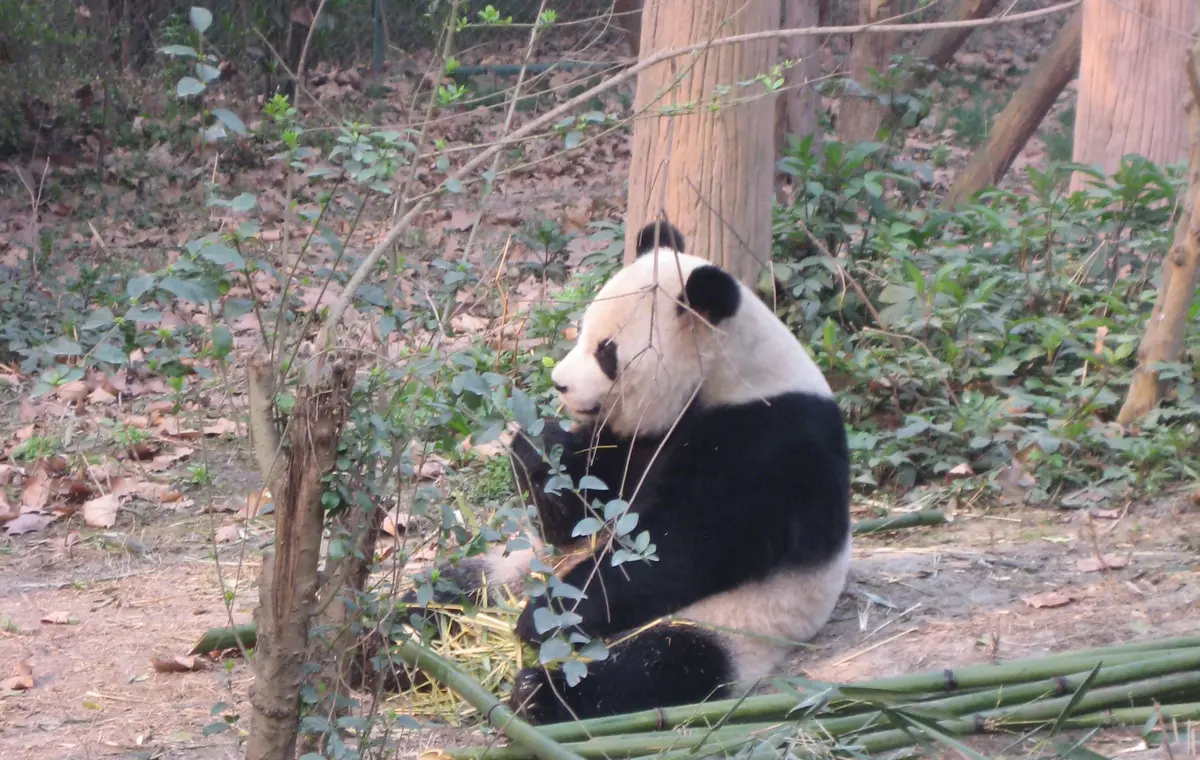
A panda can hold a bamboo stem with surprising precision because one wrist bone, the radial sesamoid, is enlarged and padded. It works against the true fingers as a pseudo-thumb. The structure is not a sixth finger, although it performs some of the same gripping work a thumb does for humans.
Strong jaws, broad molars and powerful chewing muscles handle bamboo that would defeat most carnivores. The forelimbs position the stem, the incisors strip leaves or outer layers, and the molars crush the fibrous material. Watch closely at a responsible panda centre and the feeding process is more revealing than any posed photograph.
A giant panda's digestive tract remains relatively short and simple, closer to a carnivore's than to the multi-chambered system of a ruminant. It therefore extracts limited energy from fibrous food. The solution is volume and time: an adult may spend 10 to 16 hours a day feeding and consume a large quantity of bamboo, with the exact amount varying by body size, bamboo type and plant part.
Pandas do not eat every bamboo stem indiscriminately. They select species and switch among shoots, leaves and stems as nutritional value changes. Spring shoots offer more protein and less fibre than mature culms. Captive diets may include specially formulated biscuits and small portions of produce, but bamboo remains central.
Researchers have proposed that the white areas help pandas blend with snow while the black limbs and shoulders reduce contrast in shade. Dark ears and eye patches may also contribute to communication or recognition. These explanations are plausible but should not be repeated as settled fact. Coat pattern is difficult to test in a solitary forest animal, and more than one function may be involved.
Scent is less visible but central to panda communication. Individuals leave chemical information on trees, rocks and paths. These marks can advertise identity, sex and reproductive condition while helping normally solitary animals avoid unnecessary encounters.
Female giant pandas have a brief fertile period once a year, usually in spring. Behavioural observation and hormone monitoring are therefore important in managed breeding. Pregnancy is also difficult to diagnose because delayed implantation and pseudopregnancy can produce similar signs.
Gestation from mating to birth may range widely. Cubs are born pink, blind and exceptionally small relative to their mother. Twins are possible, but in the wild a mother usually cannot provide equal care to two highly dependent cubs. Modern centres sometimes rotate twins between maternal care and an incubator under veterinary supervision; that is a managed-care intervention, not a natural routine.
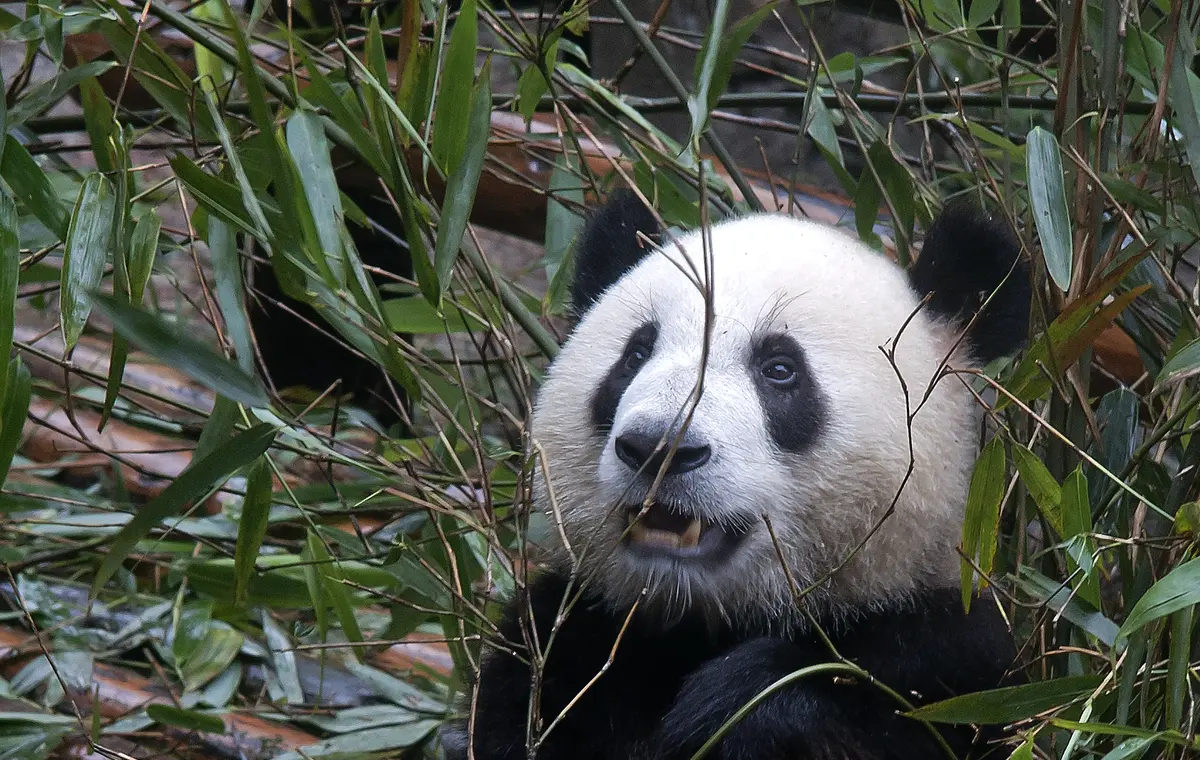
Newborn cubs cannot regulate their needs independently. Their eyes open after several weeks, mobility develops gradually, and weaning does not mean immediate separation. Young pandas may remain with their mother for roughly one and a half to three years. That long investment helps explain why wild females cannot raise a cub every year.
Age labels at visitor centres can be misleading if “baby” is used for any small panda. Our giant panda cub development guide follows the milestones from newborn dependence to juvenile behaviour and explains why nursery visibility is never guaranteed.
The giant panda is classified as Vulnerable rather than Endangered on the IUCN Red List, an improvement that reflects decades of habitat protection, anti-poaching work, surveys and managed breeding. Vulnerable does not mean secure. Wild groups remain separated by roads, settlements and altered forest, and climate change may shift the distribution of suitable bamboo.
China's protected areas and the Giant Panda National Park are intended to safeguard larger connected landscapes. Corridors matter because a forest patch can hold pandas yet still lose genetic diversity if animals cannot move between populations. Conservation also protects many less famous species sharing those mountain ecosystems.
Captive breeding contributes research, genetic management and—in carefully selected cases—reintroduction work. It cannot substitute for functioning wild habitat. A high birth count in a breeding centre and a resilient wild population answer different questions.
Chengdu offers the largest concentration of visitor facilities, but Dujiangyan and other centres can fit different routes. Compare transport time, ticketing and viewing conditions in our guide to the best places to see giant pandas in China. For the broader species-and-travel collection, return to the China giant panda guide.
The most informative moment may be quiet: a panda chooses a fresh shoot, strips it, shifts grip with the pseudo-thumb, pauses to scent the air and returns to feeding. That sequence connects anatomy, nutrition and behaviour in a way a list of “cute facts” cannot. Plan enough time to observe rather than racing between enclosures, and accept that an animal sleeping out of view is exercising the same choice a well-managed facility should protect.

From $ 389

From $ 509

From on request
Editorial accountability
Hu Lei, CEO. The named owner is responsible for travel-planning accuracy and escalation of time-sensitive checks.
Yuntian Travel (Yunnan) Group is identified in its corporate profile as a licensed professional inbound travel service provider based in Kunming, China. Registration and travel-service documents can be requested before booking.
Page-specific references where cited, official destination, transport and entry notices, YUNSKY route-planning records, and direct provider confirmation before a booking is finalized.
Content is reviewed when rules, transport, access, pricing or route conditions change. Final availability and operating details are reconfirmed for each traveler’s dates.
Quality review: Page updated: