Your China & Yunnan Travel Experts


Reviewed August 27, 2026. This guide is an editorial orientation for travelers, not a statement of belief or a substitute for teaching from a qualified religious community. Distinguish doctrine from local custom, historical evidence from later sacred biography, and active worship from tourist performance. The broader Tibet religion guide places Buddhism beside other religious traditions without treating them as interchangeable.
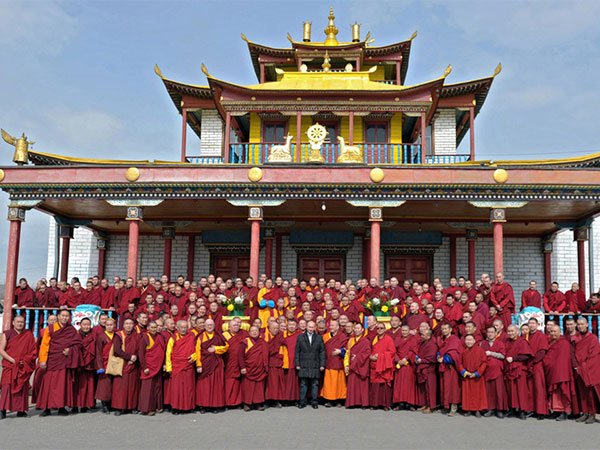
Nyingma means “ancient” and refers to traditions that identify with the earlier translation period. Nyingma practice includes tantric transmissions, Dzogchen teachings and treasure traditions known as terma. Calling it merely a “red-hat sect” or a loose organization hides its monasteries, scholarly systems, ritual communities and diverse lineages.
Important Nyingma institutions include Mindroling, Dorje Drak, Kathok, Dzogchen and Palyul, among others. The retained group photograph shows monks outside a monastery, but clothing alone cannot verify every person's lineage. Use the image as evidence of a real monastic community, not as a complete visual definition of Nyingma.
Sakya developed from the eleventh century around the Khön family, Sakya Monastery and transmission networks associated with translators including Drogmi. Lamdre, commonly rendered “Path and Result,” became a central teaching system. The tradition combines ritual practice, philosophical study and hereditary institutional history rather than one founder story.
Sakya leaders played major religious and political roles during the thirteenth-century relationship between Tibet and the Yuan court. Later Sakya branches and institutions developed distinct lines of authority and teaching. Modern place names, historical regions and institutional titles should be dated rather than projected unchanged across centuries.
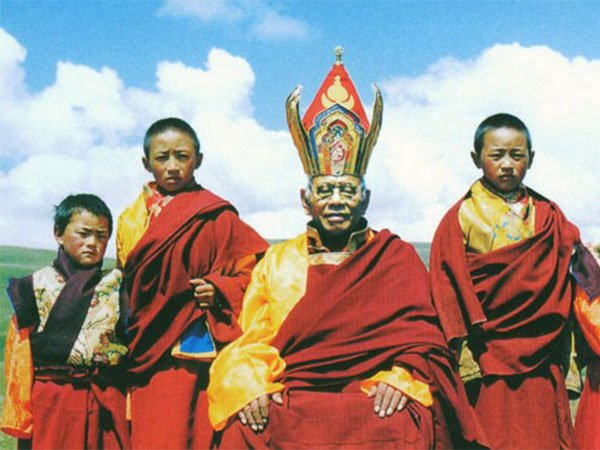
Red, white and dark exterior bands are associated with Sakya architectural identity at some sites, but color alone is not a reliable school label. The retained lama photograph is a real historical-style portrait; the hat and robes require informed interpretation, and the people shown should not be reduced to costume types.
Kagyu is a family of transmission lineages linked to teachers such as Marpa, Milarepa and Gampopa and to practices including Mahamudra. “Oral lineage” describes the importance of direct transmission, not an absence of texts or scholarship. Karma Kagyu, Drukpa Kagyu, Drikung Kagyu and other branches have distinct histories and institutions.
Gelug developed from Tsongkhapa's late fourteenth- and early fifteenth-century teaching and reform work. It emphasizes disciplined monastic study, debate, ethics and a graduated path framework alongside tantric practice. The popular phrase “yellow-hat school” is a visual shorthand, not an adequate explanation of its doctrine or history.
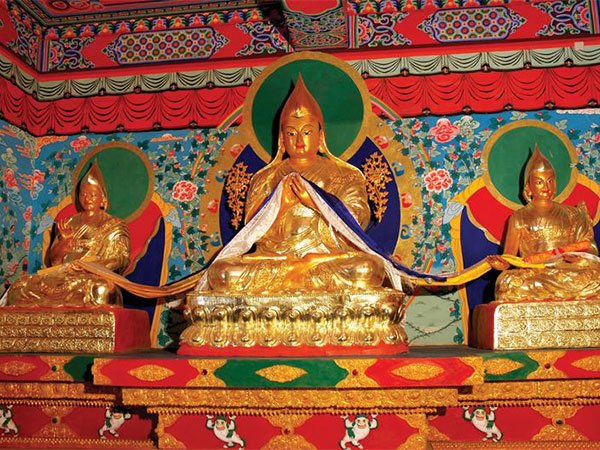
Ganden, Sera and Drepung near Lhasa and Tashilhunpo in Shigatse are major Gelug monasteries with different founding dates and functions. Potala is a palace-fort and administrative-religious complex, not simply a Gelug “ashram.” The retained interior image shows Buddhist statues and painted decoration; it does not establish that every object belongs to the same date.
Kadam was shaped by Atisha and his disciple Dromtonpa in the eleventh century. Its teachings on disciplined practice and the graduated path influenced later Tibetan traditions, especially Gelug. Describing Kadam only as a school that disappeared into Gelug overlooks its texts, lineages and wider intellectual legacy.
Reting Monastery is closely associated with early Kadam history. As with other living and restored sites, confirm which halls are open, what has been rebuilt and where photography is prohibited. Historical importance does not grant visitors access to private residential or ritual areas.
The Dalai Lama institution belongs to one tulku lineage with a particular historical relationship to Gelug and Tibetan government. It is inaccurate to say simply that the Dalai Lama is a reincarnation of “Lord Buddha.” Tulku recognition systems differ among traditions and are understood within specific religious and institutional frameworks.
Some Sakya offices have hereditary histories, while other institutions use appointment, election, seniority or recognized reincarnation. These systems vary by period and organization; “family inheritance” is therefore too broad as a general description of an entire tradition.
Tulku lineages are recognized through community and institutional processes that cannot be summarized as one universal succession method. Historical religious authority and modern administration also require separate explanation. Avoid asking guides or worshippers to settle complex political questions during a sacred visit.
Editorial accountability
Hu Lei, CEO. The named owner is responsible for travel-planning accuracy and escalation of time-sensitive checks.
Yuntian Travel (Yunnan) Group is identified in its corporate profile as a licensed professional inbound travel service provider based in Kunming, China. Registration and travel-service documents can be requested before booking.
Page-specific references where cited, official destination, transport and entry notices, YUNSKY route-planning records, and direct provider confirmation before a booking is finalized.
Content is reviewed when rules, transport, access, pricing or route conditions change. Final availability and operating details are reconfirmed for each traveler’s dates.
Quality review: Page updated: