Your China & Yunnan Travel Experts



Everest speed claims are meaningful only when the category is stated. Route, start point, finish point, oxygen use, fixed-rope support and timing method can all differ. A number presented without those details should not be compared directly with another record. See the Everest records overview for other firsts and milestones.
Hans Kammerlander, an Italian climber from South Tyrol, reported a 1996 ascent from north-side advanced base camp to the summit in 16 hours 45 minutes without supplemental oxygen. The achievement is commonly cited in mountaineering histories, but the start was not the public base camp and the category is not equivalent to a south-side ascent.
Kammerlander had extensive experience on 8,000-metre peaks before Everest. That background matters: a speed ascent is not an accelerated version of a normal commercial schedule, and the published time does not include the weeks of acclimatization and preparation that precede summit day.
His 1996 expedition also attempted a ski descent. He skied sections of the north side but removed his skis where terrain or conditions made continuous skiing impractical. Describing it as an uninterrupted summit-to-base ski descent would therefore be inaccurate.
Many historical record lists mix “base camp,” “advanced base camp” and a timed point above base camp. When researching a claim, check the exact elevation and whether descent was included.
A clock does not measure safety margin. Moving faster can reduce exposure, but it can also narrow the time available for assessment, hydration, oxygen checks and response to changing weather.
Reported times should be linked to a named route and date. Weather, fixed-line placement and route preparation vary between years, so even correctly timed ascents are not controlled experiments.
Kammerlander's climb is most useful as a case study in high-altitude efficiency, not a target time for travelers or developing mountaineers.
His broader career included thirteen of the fourteen 8,000-metre peaks and fast or ski-style ascents on other mountains. Those achievements explain his capability but do not verify every number repeated online.
Records can also be revised when governing bodies or record organizations examine new evidence. Responsible writing preserves that distinction between a reported claim and an accepted category record.
For ordinary visitors, there is no speed benefit to rushing the Tibet route. Acclimatization and regulated transport determine the itinerary, not a climber's summit time.
The key question is therefore not “Who was fastest overall?” but “Fastest under which defined conditions, verified by whom?”
Where sources disagree, preserve the disagreement and the authority's decision instead of choosing the most dramatic number.
Use the record as historical context, never as training or pacing advice for an Everest attempt.

Kammerlander climbed several major peaks with Reinhold Messner, including a 1984 traverse linking Gasherbrum I and Gasherbrum II without returning to base camp between summits. Their partnership helped develop a lighter, more continuous style on the highest mountains.
Messner's best-known Everest milestones are separate: in 1978 he and Peter Habeler made the first ascent without supplemental oxygen, and in 1980 Messner completed the first solo ascent. The Reinhold Messner profile explains why those categories must not be merged with a speed record.
Partnership records should credit the route and all participants rather than presenting one famous name as the entire expedition. Historical images also need captions that distinguish the climb shown from later achievements.
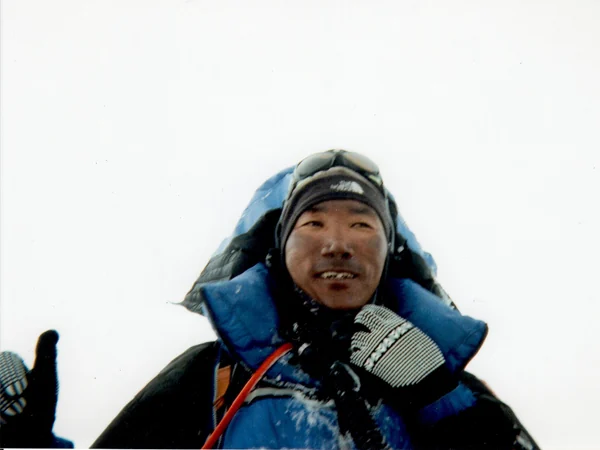
Pemba Dorje Sherpa reported an ascent from south-side base camp to the summit in 8 hours 10 minutes on 21 May 2004. The claim was widely repeated and was initially recognized in Nepal, but it later became the subject of a legal and evidentiary dispute.
Nepal's Supreme Court ultimately rejected the claim after challenges to the supporting evidence. It should not be described as the current official fastest south-side ascent.
Guinness World Records lists Lhakpa Gelu Sherpa's 26 May 2003 climb via the Southeast Ridge at 10 hours 56 minutes 46 seconds as the fastest ascent of Everest from the south side.
The difference between those two statements is important: one is a disputed historical claim; the other is the category record currently published by the record authority.

Even an accepted time needs its category. It does not establish the fastest ascent from Tibet, the fastest without supplemental oxygen, the fastest round trip or the fastest by every gender and age class.
Future evidence or a newly ratified ascent can change a leaderboard. Date any “current record” statement and recheck the responsible organization before publication.
Do not use speed records to compare tour itineraries. A visitor journey prioritizes acclimatization, road access and viewing time; an expedition is an entirely different regulated activity.
For route geography and visitor planning rather than competitive claims, return to the Mount Everest hub.
From $ 1637
From $ 3179
Editorial accountability
Hu Lei, CEO. The named owner is responsible for travel-planning accuracy and escalation of time-sensitive checks.
Yuntian Travel (Yunnan) Group is identified in its corporate profile as a licensed professional inbound travel service provider based in Kunming, China. Registration and travel-service documents can be requested before booking.
Page-specific references where cited, official destination, transport and entry notices, YUNSKY route-planning records, and direct provider confirmation before a booking is finalized.
Content is reviewed when rules, transport, access, pricing or route conditions change. Final availability and operating details are reconfirmed for each traveler’s dates.
Quality review: Page updated: