Your China & Yunnan Travel Experts


How Do US Citizens Visit China without Visa?

Reviewed August 27, 2026. U.S. citizens do not have a blanket visa exemption for ordinary tourism in mainland China. A qualifying itinerary may instead use China's 240-hour visa-free transit policy or another narrow transit arrangement. Eligibility depends on nationality, passport validity, routing, port and permitted stay area; immigration officers make the admission decision at the border.
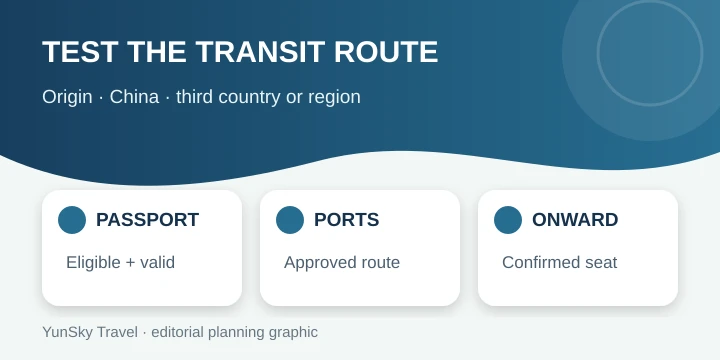
China visa-free transit route test for U.S. passport holders
China visa-free transit is a route-based immigration arrangement, not a substitute for every tourist visa

How Can U.S. Citizens Visit China without a Visa?

Start with the itinerary rather than the number of days. The National Immigration Administration currently includes the United States among the nationalities eligible for 240-hour visa-free transit, while its unilateral 30-day visa-free list does not include ordinary U.S. passports. A standard U.S.–China–U.S. vacation therefore normally needs a visa; a genuine onward journey may qualify for transit. A 240-hour transit application generally needs all of the following:
 

  • A valid eligible passport with at least three months' remaining validity on arrival; a damaged or expiring document can disrupt travel even when a ticket is valid.
     
  • A confirmed onward ticket with a fixed date and seat to a third country or region within the allowed period; keep the full booking available offline.
     
  • Permission to enter the onward destination, including a visa when that destination requires one for the traveler.
     
  • Arrival through an approved port and departure through an approved port while remaining within the authorized area announced for that entry route.
     
  • Accurate entry information, a credible temporary address and final approval by border inspection; meeting the checklist does not guarantee admission.

Which Ports and Areas Support 240-Hour Visa-Free Transit?

The official port network has expanded over time, so an old city list is unsafe. At this review date, the National Immigration Administration describes 65 ports in 24 provincial-level regions. Use the current official port-and-area table for the exact arrival and departure date, because permitted movement is defined by policy boundaries rather than by the destination name on a marketing page.

What Does 24-Hour Visa-Free Transit Cover?

A separate 24-hour transit arrangement may allow eligible international transit passengers to remain in the controlled port area. Leaving that area requires a temporary entry permit, which may be refused. A long overnight connection, airport transfer or sightseeing plan should never assume landside access; ask the carrier and border inspection at the actual port.

Run the Third-Country Route Test

  • Origin: identify the country or region from which the traveler arrives directly at the Chinese port.
     
  • Transit: list every stop in mainland China and confirm that each port and movement area is authorized.
     
  • Onward destination: identify the first country or region reached after leaving mainland China, not the traveler's eventual home.
     
  • Ticket evidence: confirm the onward segment has a fixed date, flight or train number where accepted, and a reserved seat.
     
  • Entry evidence: check passport validity and the onward destination's admission rules before departure.

A route can satisfy the directional test and still fail because the port, transport mode or planned movement is outside the current policy. Before purchasing, compare the proposed itinerary with the China visa and entry guide, then recheck the National Immigration Administration notice.
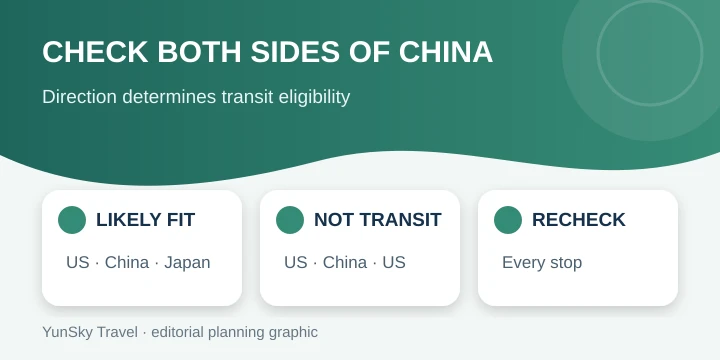
Examples That Explain the Route Logic

  • Likely directionally valid: United States → Beijing → Japan, when Beijing is an approved entry, the onward booking is confirmed and all other conditions are met.
     
  • Likely directionally valid: United States → Shanghai → Hong Kong, because Hong Kong is treated as a separate region for this transit test; current port and movement rules still control.
     
  • Likely directionally valid: Canada → Guangzhou → Thailand for an eligible U.S. passport holder, subject to the approved port, permitted Guangdong stay and onward ticket.
     
  • Not a third-country transit: United States → Shanghai → United States. The destination after mainland China is the same country as the origin.
     
  • Not fixed by adding a connection: United States → Seoul → Beijing → Seoul → United States. For the China segment, South Korea appears on both sides of mainland China.
     
  • Potentially invalid: arriving at an approved port, leaving the permitted area for an unrelated province, then attempting to depart from another region.
     
  • Potentially invalid: separate onward tickets without a confirmed seat or with a departure after the authorized period.
     
  • Potentially invalid: planning to enter by a transport mode or port that is not included in the current official list.
     
  • Needs carrier confirmation: an itinerary involving through-check baggage, airport changes, overnight connections or a schedule that the carrier cannot document for border inspection.
     
  • Needs official confirmation: a multi-stop mainland itinerary whose cities span more than one permitted area; do not infer nationwide movement from “240 hours.”
     
  • Needs a full visa instead: ordinary tourism with no genuine third-country transit, or a route whose purpose, duration or location falls outside the exemption.
     
  • Decision record: save the official port rule, complete ticket and permitted-area check used for the itinerary.
     
  • Fallback: keep a changeable reservation or obtain the appropriate visa when any condition remains uncertain.


Third-country transit itinerary examples for China visa-free entry
For the full application alternative, use the current China visa application guide for U.S. residents.
 

Never ask an airline agent or tour seller to “guarantee” border admission; request the official rule they are relying on and keep a flexible fallback. At the border, the traveler's documents and current policy—not a saved third-party article—determine whether temporary entry is granted.

When Does the 240-Hour Period Begin?

The National Immigration Administration states that the 240-hour period is counted from 00:00 on the day following entry. That calculation does not extend a ticket beyond its scheduled departure or excuse a missed connection. The border-issued permission and latest exit time shown to the traveler are the practical limits to follow.
 

Entry Checklist at the Approved Port

  1. Tell the operating carrier before departure that you intend to request visa-free transit so staff can check documentation and transmit required information.
     
  2. Carry the eligible passport used for every booking; do not rely on a photo of the identity page.
     
  3. Show the confirmed onward ticket and, when required, evidence that you may enter the onward country or region.
     
  4. Provide the first night's address and contact details; keep the hotel name and address in Chinese as well as English.
     
  5. Use the designated border-inspection channel and answer questions about route, stay area and purpose consistently.
     
  6. Check the temporary entry record before leaving the counter and ask how the authorized area and latest departure time apply to the itinerary.
     
  7. If border inspection declines temporary entry, follow the carrier and immigration instructions rather than attempting to leave the controlled area.


Movement, Registration and Departure Rules

Visa-free transit does not mean unrestricted travel throughout China. Match every hotel, rail journey and day trip to the area authorized for the selected port. Do not copy regional examples from an older 72-hour or 144-hour article; the current official table is the controlling reference.
 

  • Approved entry port : record its full name, terminal and local border-inspection contact information.
     
  • Approved exit port : it may differ from the entry port only when the current policy permits both and the itinerary remains within the authorized area.
     
  • Permitted stay area : plot every overnight and day trip against the official provincial or municipal boundary.
     
  • Accommodation registration : hotels usually register guests; travelers staying in a private residence must complete the required local registration within the applicable time.

How to Plan the Stopover without Overloading It

Build the schedule backward from the international departure, reserving time for the airport or station, document checks and ordinary disruption. A Beijing stop might support one Great Wall day and one central heritage day; a Shanghai-area route may support the city plus an authorized nearby destination. Feasibility depends on arrival time, reservations, traffic and the exact movement boundary.
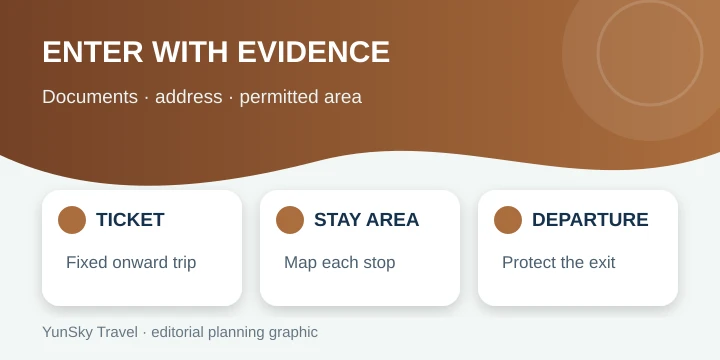
 

China visa-free transit entry and movement checklist
Great Wall stopover planning requires an approved route, timed admission and protected transfer time
 

For a stay under 24 hours, treat sleep, baggage and the next departure as priorities. A rushed attraction is not worth missing the onward segment. For a longer approved stay, limit daily travel and keep the final night close to a reliable departure route. The first China trip planning guide helps coordinate bookings, payments, transport and offline records after eligibility is clear.

Choose Visa-Free Transit Only When the Route Truly Fits

Visa-free transit is useful for a genuine stop between different countries or regions; it should not be forced onto a round trip to avoid an application. Compare the savings with fare flexibility, baggage handling, restricted movement and the cost of a missed connection.
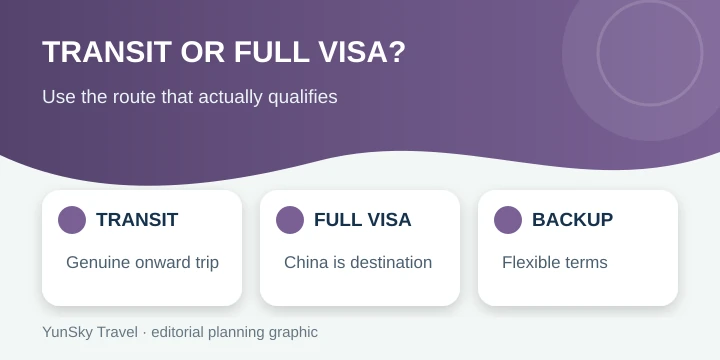
 

China visa-free transit decision framework for U.S. citizens
China visa-free transit decision graphic for U.S. passport holders

  • Route option : use visa-free transit only after the direction, approved ports, permitted area and onward evidence all pass the current official test.


  • Full-visa option : choose the appropriate visa when China is the main destination, the route returns to its origin country or the itinerary needs wider movement.

Contingency option : keep changeable onward transport, insurance appropriate to the trip and enough time to follow carrier or immigration instructions. Before departure, recheck the National Immigration Administration, the Chinese Embassy or Consulate responsible for the traveler, the onward country's entry rules and the operating carrier. A travel planner can organize a route that fits published conditions, but cannot waive a requirement or promise admission. Send the exact passport nationality, direct arrival point, every mainland stop, onward destination and travel dates when requesting itinerary help.

 

Editorial accountability

How this guide is checked

Named content owner

Hu Lei, CEO. The named owner is responsible for travel-planning accuracy and escalation of time-sensitive checks.

Company and licence status

Yuntian Travel (Yunnan) Group is identified in its corporate profile as a licensed professional inbound travel service provider based in Kunming, China. Registration and travel-service documents can be requested before booking.

Source basis

Page-specific references where cited, official destination, transport and entry notices, YUNSKY route-planning records, and direct provider confirmation before a booking is finalized.

Update basis

Content is reviewed when rules, transport, access, pricing or route conditions change. Final availability and operating details are reconfirmed for each traveler’s dates.

Quality review: Page updated:

Open WhatsApp chat with YunSky Travel