Your China & Yunnan Travel Experts


Reviewed August 27, 2026. Is China a good travel destination? It can be an excellent fit for travelers who value layered heritage, regional food, large-scale rail travel and contrasting landscapes, but it is not a universal yes. The right answer depends on pace, weather, digital preparation, accessibility, budget and comfort with local rules. This guide turns those tradeoffs into a practical decision.

Kanas Lake in Xinjiang; long distances, seasonality and local access should be checked before route design
China's geography supports very different journeys: karst valleys near Guilin, sandstone pillars in Zhangjiajie, alpine scenery in western Sichuan, desert corridors in the northwest and forested mountains in the east. A strong itinerary chooses one or two regions instead of collecting distant landmarks on consecutive days.
For a first nature-focused trip, compare walking difficulty, altitude, rain, visibility, transfer time and seasonal access. The same photograph can represent a calm viewpoint or a demanding multi-hour route, so use trail and transport details—not scenery alone—to decide.

High-altitude scenery requires gradual acclimatization, realistic exertion and a medical discussion when the traveler has relevant conditions
 Explore route clusters in the China destinations directory, then verify each site's official reservation and weather information.
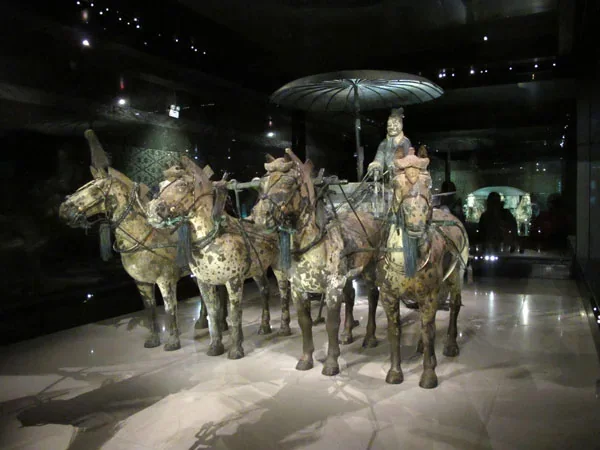
China's UNESCO-listed properties and extensive museum network offer evidence from imperial capitals, archaeological sites, trading routes, sacred landscapes and twentieth-century history. The value comes from understanding what survives, what was reconstructed and how the site is used now—not from repeating a vague age claim.
Beijing, Xi'an and Suzhou can anchor a heritage route, but they answer different questions. Beijing helps explain state ritual and urban planning; Xi'an connects archaeology with successive capitals; Suzhou shows gardens, canals and literati culture. Build time for a museum or guided interpretation before adding another photo stop.
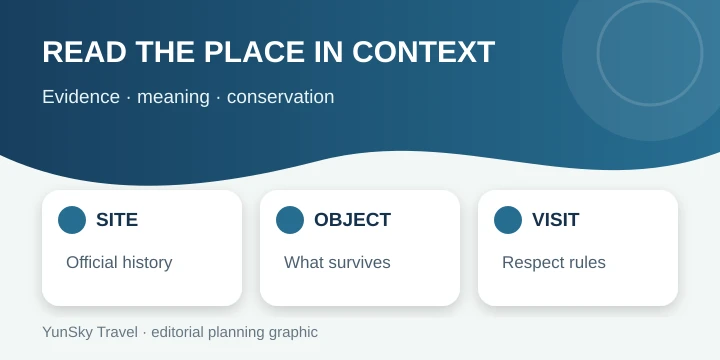
Heritage visits are more credible when captions distinguish the represented place from a nationwide claim
 Useful preparation includes reading the official site description, confirming timed admission, and learning why a building, collection or landscape matters before arrival.
Cultural route decision marker
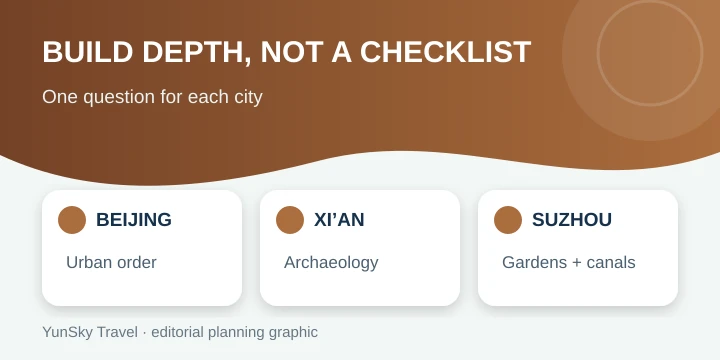
A regional alternative—such as Chengdu with nearby heritage and landscape stops—may offer more depth with fewer hotel changes.
Browse places to visit in China as a shortlist, then narrow it by interests and practical constraints.
Visitors may encounter generous help, limited shared language, curiosity or simple indifference, just as experiences vary anywhere. Download addresses in Chinese, keep the hotel phone number, learn a few courtesy phrases and use a reliable translation tool. Do not assume that every young person speaks English or that attention from strangers has one meaning.
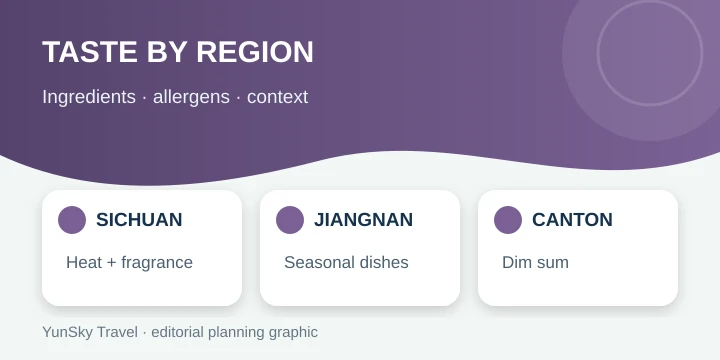
A food-focused route can compare Sichuan spice and fragrance, Jiangnan seasonal cooking, Cantonese dim sum, northwestern noodles and regional vegetarian traditions. “Chinese food” is too broad to predict a meal. Ask about ingredients, heat level, allergens, shared dishes and cross-contact at the venue.
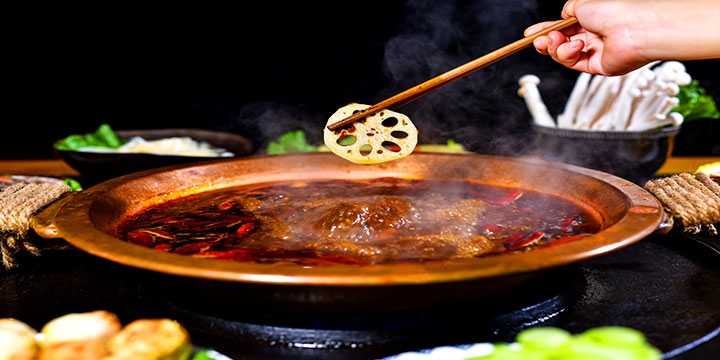
Chengdu hotpot represents one regional dining tradition; broth, ingredients and spice level should be confirmed
 Travelers with dietary restrictions should carry a written Chinese card, identify several suitable restaurants near each hotel and keep a simple backup meal. Busy stalls are not a safety guarantee; observe hygiene, choose thoroughly cooked food and follow current health guidance.
High-speed rail can connect major city pairs efficiently, but passport-based booking, station names, security queues and sales windows require attention. International flight availability changes by season and gateway. Visa, visa-free transit, mobile payment, connectivity and attraction reservations must be resolved before calling the trip “easy.”
 Prepare the first 48 hours: exact airport transfer, hotel address in Chinese, tested payment methods, connectivity plan and one nearby meal.
The U.S. Department of State currently lists mainland China at Level 2, “Exercise Increased Caution,” citing risks including arbitrary enforcement of local laws and exit bans. That advisory does not predict an individual trip, but it should shape document, communication and contingency planning. Ordinary risks also include traffic, pickpocketing, heat, altitude, food and water illness, and weather disruption.
Read current government advice, understand local law, protect passports and devices, avoid unauthorized demonstrations or restricted photography, and know how to contact the nearest U.S. diplomatic post. Travelers with dual nationality, prior legal disputes or sensitive work should review the specific advisory language before booking.
 Fit check: a prepared visitor who accepts local rules and keeps a contingency plan may find the trip manageable.
A good destination is one whose practical demands match the traveler—not one declared safe or easy for everyone.
Decision rule: keep the route only when entry, access, health, transport and payment requirements have workable answers.
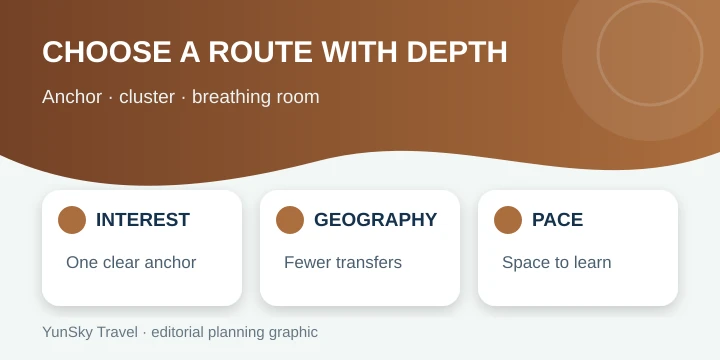
Begin with one anchor interest, one geographic cluster and a realistic number of hotel changes. A classic route can use Beijing, Xi'an and Shanghai; a nature-and-food route may center on Chengdu and one nearby region. Protect free time so markets, neighborhoods and museums are experienced rather than merely photographed.
For travelers who prefer shared logistics, review China group tours by exact inclusions, operator, pace, group size and shopping policy. Independent travel offers flexibility but requires more booking, navigation and disruption management. A private itinerary can adapt pace, though every inclusion and cancellation term still needs to be written. Before choosing, send the travel dates, U.S. gateway, available nights, mobility or dietary needs, preferred pace and the experience that matters most. A responsible planner should explain what was verified, what remains variable and which current official sources control entry, safety and venue access. China is a good travel destination when its culture, landscapes and logistics match the traveler and the route leaves space for real understanding.

From $ 2498

From $ 22782050
From $ 2983
Editorial accountability
Hu Lei, CEO. The named owner is responsible for travel-planning accuracy and escalation of time-sensitive checks.
Yuntian Travel (Yunnan) Group is identified in its corporate profile as a licensed professional inbound travel service provider based in Kunming, China. Registration and travel-service documents can be requested before booking.
Page-specific references where cited, official destination, transport and entry notices, YUNSKY route-planning records, and direct provider confirmation before a booking is finalized.
Content is reviewed when rules, transport, access, pricing or route conditions change. Final availability and operating details are reconfirmed for each traveler’s dates.
Quality review: Page updated: