Your China & Yunnan Travel Experts


Reviewed: August 27, 2026. You can travel in China without speaking fluent Mandarin, but the reliable strategy is redundancy: Chinese addresses, offline information, a tested data connection, a few practical phrases and human help when needed. No app works everywhere, and no population shares one language ability. Prepare the tasks below before arrival rather than depending on improvisation.
Check roaming, eSIM or local SIM support with the provider and the phone's compatibility before departure. Some international services may be unavailable or operate differently in mainland China; do not rely on a specific VPN or app as a guaranteed workaround. Download essential addresses, tickets and translations offline, keep account recovery methods accessible and follow local law and provider terms.
Install at least one translation or dictionary tool that supports downloaded Chinese language data, camera text and phrase playback. Test airplane mode before travel. A paper phrase card or hotel-written note remains useful when the battery, data connection or recognition result fails. Treat automated translation as an aid, not an authority for medical, legal or safety decisions.
Save the property's Chinese name, full address, district, nearby landmark, phone number and check-in instructions as both text and screenshot. Show the destination—not an unlocked phone—to a licensed taxi driver. Confirm the correct airport or railway station and the station exit. The China transportation guide helps compare rail, metro, taxi and bus preparation.

The Fairmont Peace Hotel façade is an address-recognition example, not a recommendation or guarantee of English service.
Use the venue's official site for current ticketing, identification, closure and photography rules. Download the Chinese venue name and a short source-based overview. At museums and heritage sites, prefer official labels, audio guides or named interpreters; ask what is original, reconstructed or uncertain rather than treating every display as self-explanatory.

The Forbidden City image illustrates a site where advance rules and historical context matter; verify current Palace Museum instructions before visiting.
Save Chinese statements for allergies, dietary restrictions and ingredients that must be avoided. A dish photograph can help identify a style, but recipes and cross-contact vary, so point-and-hope is unsafe for serious allergies. Confirm quantity, spice, bones, shared oil and price before ordering; use professional translation for medical risk.
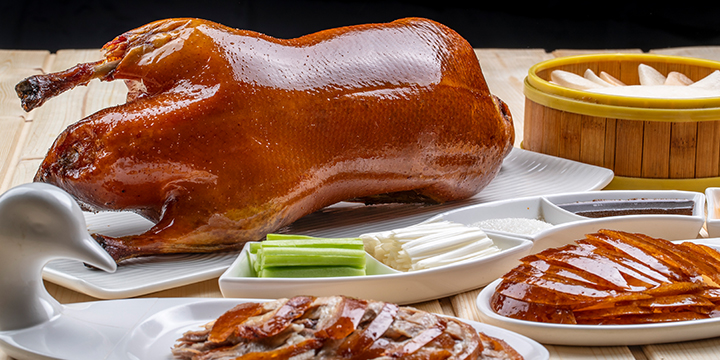
Beijing roast duck illustrates one named regional dish and should not be used as a generic picture of all Chinese food.
Use a calculator or typed amount to confirm the total, currency, quantity and whether a deposit or service charge applies. Bargaining is context-dependent and inappropriate in many fixed-price shops. Pay only through the merchant's stated channel, review the amount before authorizing and keep a card and RMB cash alternative. The China payment guide explains supported visitor options and failure backups.

Prioritize greetings, numbers, “please,” “thank you,” “I do not understand,” “please write it down,” “where is…,” and phrases for allergies or medical needs. Pronunciation does not need to be perfect to show respect, but a written Chinese version prevents ambiguity. Practice with the useful Chinese phrases guide and save the most important lines offline. Phrase list: show Chinese characters, pinyin and an English meaning together. Use the written version when accuracy matters.
Seek staff whose role matches the problem: station service desk for a platform, hotel reception for an address, venue staff for admission and emergency services for urgent risk. Do not assume any passer-by speaks English or is obliged to help. Keep the request short, show the Chinese destination and protect passport and payment details from unnecessary disclosure.
A local guide can reduce language friction and add accountable interpretation, especially for a complex heritage site, rural transfer or traveler with accessibility needs. Ask the operator to confirm guide language, credentials where applicable, itinerary scope, shopping stops, emergency contact and cancellation terms. A guide supports decisions; the traveler should still retain documents and know the day's route.

The guide photograph shows visitors listening at the Great Wall; it does not endorse the individuals or guarantee a particular experience.
Before committing, request the plan in writing and check that the service solves a real language or logistics need rather than adding unnecessary stops.

From $ 2498

From $ 22782050
From $ 2983
Editorial accountability
Hu Lei, CEO. The named owner is responsible for travel-planning accuracy and escalation of time-sensitive checks.
Yuntian Travel (Yunnan) Group is identified in its corporate profile as a licensed professional inbound travel service provider based in Kunming, China. Registration and travel-service documents can be requested before booking.
Page-specific references where cited, official destination, transport and entry notices, YUNSKY route-planning records, and direct provider confirmation before a booking is finalized.
Content is reviewed when rules, transport, access, pricing or route conditions change. Final availability and operating details are reconfirmed for each traveler’s dates.
Quality review: Page updated: