Your China & Yunnan Travel Experts


Reviewed August 27, 2026. Is China safe for American tourists? Many visits are completed without a serious incident, but no responsible guide can promise personal safety. The U.S. Department of State currently rates mainland China Level 2, “Exercise Increased Caution,” and highlights arbitrary enforcement of local laws and exit bans. Travelers should weigh those issues alongside everyday risks, health needs and their own circumstances.
Use this guide as a planning framework, then read the latest official advisory and destination notices immediately before travel.
A travel-advisory level is a risk-management signal, not a prediction that every traveler will face the cited problem. The State Department's China page asks U.S. citizens to exercise increased caution because of arbitrary enforcement and exit bans and provides specific advice on local law, citizenship, devices and emergency communication. Read the full page, not only the level number. Note the distinction between mainland China, Hong Kong and Macao because the advisory language and local systems are not identical.
For a wider official-source checklist, read current China travel safety guidance.
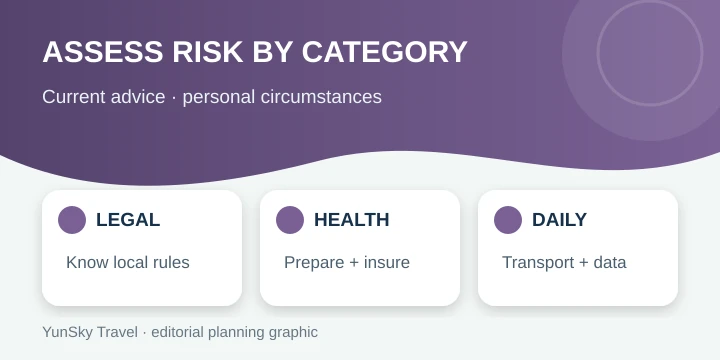
China safety preparation is strongest when legal, health, transport and communication risks are handled separately
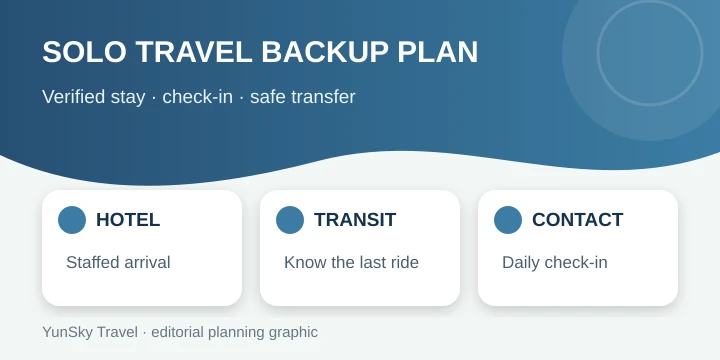
Solo travel can be workable, but it removes the immediate backup that another traveler provides. Share an itinerary, use accommodations with a verifiable address and staffed arrival window, and avoid isolated shortcuts or informal rides. Confirm the last reliable transport before an evening activity. If a person or situation feels intrusive, move to a staffed public place and contact the hotel, transport operator or police as appropriate. A daily check-in plan is more useful than relying on continuous connectivity.
Li River routes range from organized cruises to independent rural transfers; plan the actual mode rather than judging safety from the scenery
Women travelers should use the same evidence-based precautions: control drinks, verify vehicles, meet new contacts in public, and choose late-night transport before leaving a venue. Staring or requests for photographs can occur, but intent cannot be assumed; a clear refusal and leaving the situation are reasonable. Travelers concerned about identity-related treatment should consult current government and community-specific resources.
The goal is not to avoid local food; it is to choose and handle it sensibly. Favor food cooked thoroughly and served hot, observe refrigeration and hand hygiene, and be cautious with raw items, unpasteurized products or food left at room temperature. A crowded stall is not proof of safe preparation. Wash hands before eating, pace unfamiliar rich or spicy dishes, and carry oral rehydration supplies only as advised by a health professional.
Travelers with allergies or celiac disease should carry a precise Chinese-language card, name cross-contact risks, and keep prescribed emergency medicine accessible. A guide can help communicate, but the restaurant and traveler still need to confirm ingredients and preparation.

Chengdu hotpot requires attention to shared broth, spice, cooking time, allergens and cross-contact
The U.S. Centers for Disease Control and Prevention advises that tap water in China is not safe to drink, including in major cities. Use sealed bottled water or properly boiled water for drinking, and consider the same source for brushing teeth when advised. Check the seal, carry water on long transfers and use a refill method only when the treatment is reliable. Ice and uncooked produce washed in uncertain water deserve the same case-by-case judgment.
Hot tea may be made with boiled water, but a beverage's appearance does not confirm safe preparation. People with gastrointestinal symptoms, fever or dehydration should seek appropriate medical advice rather than self-treating indefinitely.
There is no single experience shared by all Americans. Interactions vary by person, place, language and current circumstances. Avoid claims that every local is welcoming or hostile. Use respectful communication, follow local law, keep political or sensitive discussions situationally aware and leave any encounter that becomes uncomfortable. Nationality does not remove the need for ordinary judgment.
Separate common travel problems from higher-impact legal and health risks so that the checklist remains useful. The following controls are simple, but each should be adapted to the city, travel style and traveler. The China travel safety tips turn them into a pre-departure and daily checklist.
Emergencies: know the hotel address, local emergency numbers, insurer process and nearest suitable medical facility before a problem occurs.
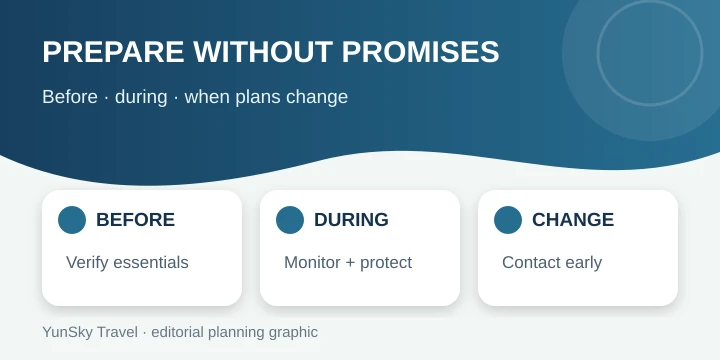
A route should fit the traveler's health, mobility, communication and legal-risk profile. Confirm hotel registration, station access, realistic transfer time and emergency options. Ask who is responsible when a train is missed, a road closes or a traveler needs medical support. Do not hide a long mountain day, inaccessible bathroom or remote overnight behind a generic “easy” label. Record the answers with the itinerary so another person can act if the primary traveler cannot. China safety decision framework for legal, health, transport and communication preparation Before departure:
contact the carrier, hotel, insurer or relevant authority early and preserve written records rather than improvising an unauthorized route. For U.S.-specific logistics, the U.S.-to-China travel preparation guide covers documents, payments, connectivity and bookings. A local planner can reduce logistical uncertainty and explain what has been checked, but cannot guarantee safety, immigration admission or third-party actions. China may be manageable for a well-prepared American visitor; unresolved legal, medical or access concerns deserve specific advice before booking.

From $ 2498

From $ 22782050
From $ 2983
Editorial accountability
Hu Lei, CEO. The named owner is responsible for travel-planning accuracy and escalation of time-sensitive checks.
Yuntian Travel (Yunnan) Group is identified in its corporate profile as a licensed professional inbound travel service provider based in Kunming, China. Registration and travel-service documents can be requested before booking.
Page-specific references where cited, official destination, transport and entry notices, YUNSKY route-planning records, and direct provider confirmation before a booking is finalized.
Content is reviewed when rules, transport, access, pricing or route conditions change. Final availability and operating details are reconfirmed for each traveler’s dates.
Quality review: Page updated: