Your China & Yunnan Travel Experts


This page began as a 2018 forecast. That forecast is now history: the eight China high-speed rail projects below have opened, although not all on the dates or with the journey times the old article predicted. This revision turns the list into a route-planning guide. It explains what each completed corridor connects, which stop names matter, and when the line is useful in a visitor's itinerary. For a broader network overview, start with the China high-speed train guide.
Do not use the journey times printed on an old project announcement as a current timetable. Train patterns change by date, direction and operating plan; the quickest service may not run every day or stop where you need it. Search the exact travel date and station pair on the official railway platform, then use our China train ticket guide to understand booking, identity-document and boarding basics. Station suffixes matter: “North,” “East,” “South” or “West” can indicate a different terminal, sometimes far from the historic centre.
The route maps remain in their original positions because each one still matches the corridor discussed beneath its heading. Treat them as orientation diagrams, not track-accurate maps. China's network has also expanded beyond these eight lines; the high-speed rail history and development page provides the larger context. For a workable itinerary, plan the full chain—hotel to departure station, security and boarding, the rail journey, and arrival-station transfer—instead of comparing train time alone.
Editorial scope and evidence: this page was fact-checked on 26 August 2026 against China Railway or Chinese government records for the mainland openings and official Hong Kong transport information for the cross-boundary section. Historical opening dates and line descriptions are stable; live train numbers, fares, ticket-sale windows, direct destinations and border procedures are not. Recheck those details on Railway 12306 or, for Hong Kong journeys, the MTR High Speed Rail site before travel. This is independent trip-planning information, not a timetable or ticket guarantee.
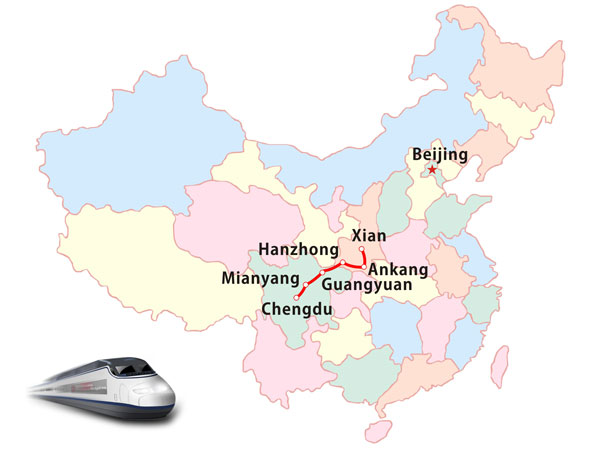
Status: open. The full Xi'an–Chengdu corridor began operation on 6 December 2017, so it had already opened when the former “2018 projects” article was published. The line runs from Xi'an North through Hanzhong, Guangyuan, Mianyang and other intermediate stations to Chengdu East. Official opening information records an operating distance of about 658 kilometres and a 250 km/h design speed. Its defining feature is the Qinling crossing, which created a direct fast-rail link between northwest China and the Sichuan Basin. The old page's three-hour claim was an opening-era fastest-time estimate, not a promise for every current train.
Why travelers use it: Xi'an and Chengdu make a strong two-city pairing—imperial history and the Terracotta Army on one end, Sichuan food and major panda bases on the other. Hanzhong can turn the journey into a less hurried Shaanxi stop, while Mianyang or Guangyuan may suit a more regional itinerary. Search Xi'an North and Chengdu East first, then check whether a direct train serves your intended intermediate station. A fast through service is best for a simple city pair; a stopping service can be more useful when the rail journey is part of the trip rather than merely a transfer.
Planning note: allow generous time to reach Xi'an North or Chengdu East, both of which are outside the traditional sightseeing core. Do not book a tight same-day connection to a flight, an appointment or the last onward bus. Mountain weather, network regulation and holiday demand can affect operations even on a modern line. If visiting the Terracotta Army before departure or a panda base after arrival, budget for the separate road or metro leg; neither attraction is located inside the high-speed railway station.
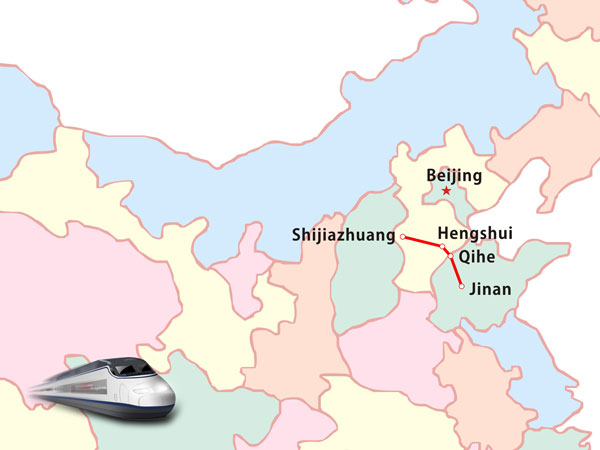
Status: open since 28 December 2017. The Shijiazhuang–Jinan passenger railway connects the two provincial capitals through the Hengshui and Dezhou area, creating an east–west link between major north–south corridors. Official opening reports describe a route of a little over 300 kilometres. Its value is network connectivity: a traveler can move between Hebei and Shandong without routing north through Beijing or relying on the former slower path. The old article's 80-minute prediction should be discarded; opening reports and present-day schedules vary by stopping pattern, so the live station search is the only reliable timing check.
Use this corridor when combining Shijiazhuang-area heritage with Jinan, Qufu or the Shandong Peninsula. Some journeys beyond Jinan continue on another high-speed line, while others require a change at Jinan, Jinan West or Jinan East; those are separate stations. Likewise, confirm whether your departure is Shijiazhuang or Shijiazhuang East. When building a same-day connection, compare the actual arrival and departure terminals before judging the transfer by city name. A 40-minute change at the same station and a 40-minute change across Jinan are entirely different plans.
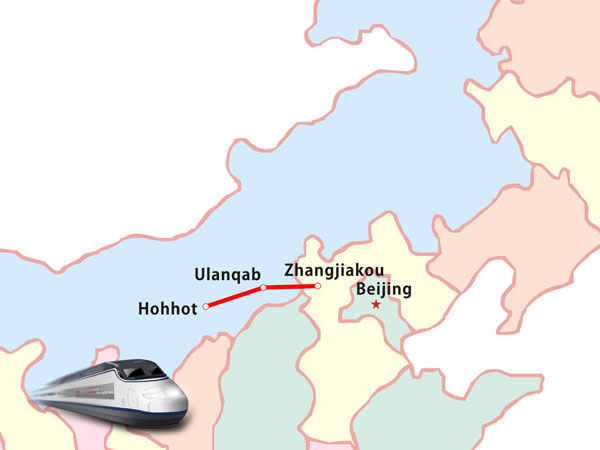
Status: open. The Zhangjiakou–Hohhot high-speed railway entered full operation on 30 December 2019, together with the new Beijing–Zhangjiakou line. It runs through the Ulanqab area and forms part of the Beijing–Lanzhou corridor. This corrected date matters: the former article expected an opening in 2018, but travelers did not gain the completed fast connection until the end of 2019. Official railway information describes it as Inner Mongolia's first high-speed railway and a direct link into the Beijing rail hub through Zhangjiakou.
Why travelers use it: the corridor makes a Beijing–Zhangjiakou–Ulanqab–Hohhot sequence practical without a domestic flight. It can support an Inner Mongolia city visit, museum trip or an onward road itinerary, but the high-speed line itself does not deliver passengers to a grassland camp. Operators use several station names in this region, including Hohhot and Hohhot East as well as Ulanqab; check the address and onward pickup point before buying. If a tour driver is meeting you, send the complete station name in Chinese and English rather than only the city.
Planning note: do not infer a Beijing departure terminal from the route map. Services toward Zhangjiakou and Inner Mongolia may use Beijing North or Qinghe, while other trains and connections use different Beijing stations. Current direct patterns must be confirmed for the travel date. Winter cold, wind and snow are real operational and comfort considerations in this corridor, so keep a buffer before a fixed activity. During major holidays and summer grassland season, buy only through an authorised channel and avoid assuming that an unconfirmed seat will become available at the station.
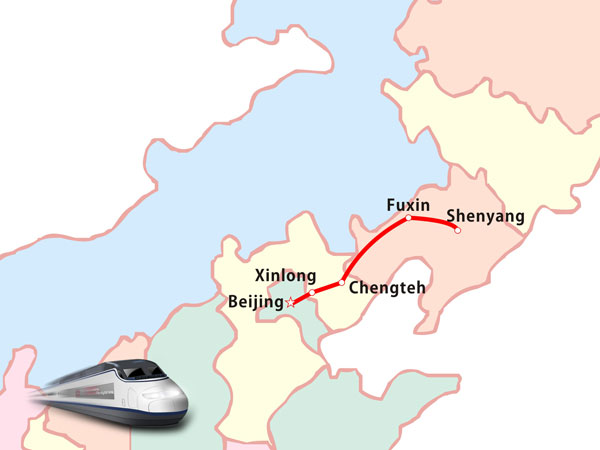
Status: fully open since 22 January 2021. The last Beijing–Chengde section completed the Beijing–Shenyang part of the Beijing–Harbin high-speed railway. The National Railway Administration records Beijing Chaoyang–Shenyang fastest opening-era journeys of 2 hours 44 minutes and a 350 km/h design speed for the corridor, but those figures describe capability and the launch timetable—not every train. This was the latest of the eight projects on this page to become fully operational, three years after the former article expected completion.
Why travelers use it: the line is the principal fast-rail option for combining Beijing with Shenyang and for continuing deeper into northeast China. It can also serve Chengde and other intermediate cities when the selected train stops there. Search Beijing Chaoyang—not simply “Beijing”—and check whether the arrival is Shenyang or Shenyang North. For a Forbidden City morning followed by an afternoon train, include cross-city travel to Beijing Chaoyang and the station's security process; a short rail time does not make a rushed city-centre connection safe.
For onward travel to Changchun or Harbin, compare a through train with a connection at Shenyang North. A through service reduces transfer risk, but a connection can provide more departure choices. In winter, leave contingency time before an international flight or a prepaid activity. The line is useful for regional touring, yet it should not be described as access to every northeast attraction: mountain areas, the Great Wall sites near Chengde, ski resorts and border regions still require separate local transport and, in some places, additional permits or seasonal planning.
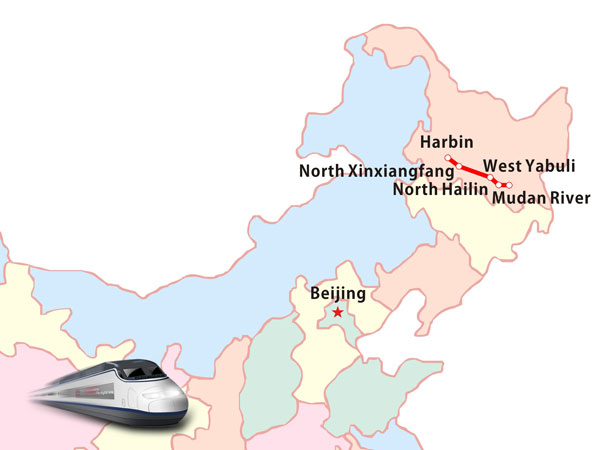
Status: open since 25 December 2018. The Harbin–Mudanjiang high-speed railway is roughly 293 kilometres long and was built for 250 km/h operation; official opening coverage recorded a fastest launch journey of 1 hour 28 minutes. It links Harbin with stations including Yabuli West and terminates at Mudanjiang, making it useful for a broader eastern Heilongjiang route. For travelers, the important distinction is between the railway and the attraction transfer: Yabuli West can support a ski trip, but a resort vehicle or local transfer is still needed; China Snow Town is not a high-speed rail station and normally requires a substantial road journey. Verify the best rail-and-road combination with the accommodation. Winter services are designed for cold conditions, but severe weather can still disrupt a tightly timed plan, so avoid a same-evening flight connection after a long excursion.
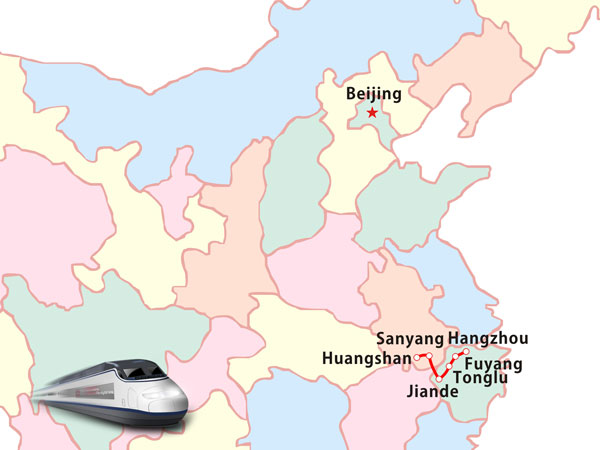
Status: open since 25 December 2018. Official railway records give the Hangzhou–Huangshan line a length of 265 kilometres—correcting the former page's 287-kilometre figure—and an initial operating speed of 250 km/h. The nine-station opening route linked Hangzhou East with Fuyang, Tonglu, Jiande, Qiandaohu, Sanyang, Jixi North, Shexian North and Huangshan North. It is often called a tourism railway because it connects the West Lake region, Qiandao Lake and southern Anhui's mountain and heritage destinations, but no single train stops at every place.
Build the itinerary around station geography. Qiandaohu station is the rail gateway for Thousand Island Lake, not a lakeside pier; Huangshan North is the main rail gateway for Huangshan City and Mount Huangshan, not the mountain entrance; historic villages such as Hongcun and Xidi need onward road transport. A Hangzhou–Qiandaohu–Huangshan sequence can work well over several days, while trying to visit the lake and summit Mount Huangshan in one transfer day usually creates more transport than sightseeing. Check which trains stop at the intermediate station, confirm the last local connection, and keep mountain weather separate from city weather when packing.
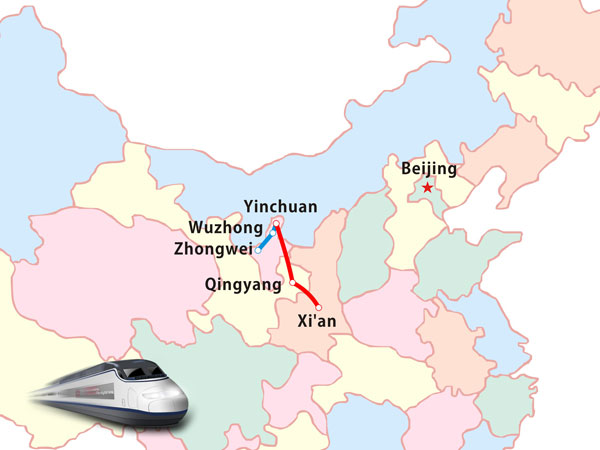
Status: both relevant sections are open, but they did not open together in 2018 as the former text implied. The Yinchuan–Zhongwei route, including the Wuzhong–Zhongwei intercity section, began operation on 29 December 2019. The full Yinchuan–Xi'an high-speed railway opened on 26 December 2020. Official records describe the latter as a 617-kilometre corridor designed for 250 km/h operation and running through Ningxia, Gansu and Shaanxi. The map correctly shows the regional relationship, though its single red line should not be read as one 2018 opening event.
Why travelers use it: Xi'an–Yinchuan is the main interregional pairing; Wuzhong and Qingtongxia can support Ningxia stops, while Zhongwei is the rail gateway for a desert-focused itinerary. Shapotou and other desert experiences require onward transport from Zhongwei South or another appropriate station, and operating locations can be distant from central hotels. Some trains are direct and others require a change, so search the exact station pair rather than assuming every departure runs end to end. Desert temperature swings, wind and seasonal activity schedules deserve a buffer. Confirm the operator, meeting point and cancellation terms before coordinating a rail arrival with a private excursion.

Status: the 26-kilometre Hong Kong section opened to passengers on 23 September 2018, connecting Hong Kong West Kowloon through Futian with the mainland high-speed network. The full corridor links the Greater Bay Area through stations such as Guangzhou South, Shenzhen North, Futian and Hong Kong West Kowloon. The original map remains a useful regional sketch, but its Dongguan label is not enough to choose a station: current short-haul services can use several Dongguan-area and Guangzhou-area stations, and not every train follows the same stopping pattern.
This journey is operationally different from a domestic mainland train. Cross-boundary tickets use real-name booking, and passengers must travel with the same accepted identity document used to buy the ticket. At Hong Kong West Kowloon, security plus Hong Kong and mainland immigration procedures take place before boarding; MTR advises allowing more time for passport holders, busy periods and traditional immigration counters. Entry permission is separate from a train ticket. Check visa or visa-free eligibility for the traveler's nationality and circumstances through official authorities, and never describe a valid ticket as proof that immigration entry is guaranteed.
Plan by the actual city pair. Hong Kong–Shenzhen is a short regional movement, while Hong Kong–Guangzhou depends heavily on whether the train serves Guangzhou South, Guangzhou East or another listed destination. A through long-distance train can remove a mainland transfer, but its frequency may be lower than connecting via Shenzhen or Guangzhou. MTR's official site and Railway 12306 publish the current destinations, fares and schedules; consult them for the intended date instead of retaining the old page's eight-hour Shanghai or ten-hour Beijing estimates. Leave enough time at West Kowloon, carry the booked identity document, and confirm the arrival station before arranging a pickup.

From on request
From $ 1613
Editorial accountability
Hu Lei, CEO. The named owner is responsible for travel-planning accuracy and escalation of time-sensitive checks.
Yuntian Travel (Yunnan) Group is identified in its corporate profile as a licensed professional inbound travel service provider based in Kunming, China. Registration and travel-service documents can be requested before booking.
Page-specific references where cited, official destination, transport and entry notices, YUNSKY route-planning records, and direct provider confirmation before a booking is finalized.
Content is reviewed when rules, transport, access, pricing or route conditions change. Final availability and operating details are reconfirmed for each traveler’s dates.
Quality review: Page updated: