Your China & Yunnan Travel Experts


The Great Wall of the Qin Dynasty

The Great Wall of the Qin dynasty was the first imperial-scale effort to connect and extend selected northern defenses after political unification. It was not the beginning of all wall-building in China, nor is it the brick Great Wall seen around Beijing today. Qin frontier works were commissioned under Qin Shi Huang after 221 BCE, using earlier walls, new links, forts and natural barriers against threats from the north.
 

Qin conquered the rival states in 221 BCE and established China's first unified imperial government. Earlier states had already built long barriers against one another and against northern groups. Some internal walls were dismantled after unification, while useful northern defenses were retained. Read the Warring States Great Wall guide for that pre-imperial foundation.

Territory and frontier geography in the Qin dynasty

Qin power expanded across a large and varied territory. The northern frontier included parts of present-day Liaoning and Inner Mongolia as well as the Ordos bend of the Yellow River. Ancient frontiers did not match modern provincial lines, and exact wall routes remain subjects of archaeology. Eastern territories reached the coast, while southern expansion extended toward areas now within Guangxi and Guangdong . These expansions should not be mistaken for the route of one continuous northern wall.
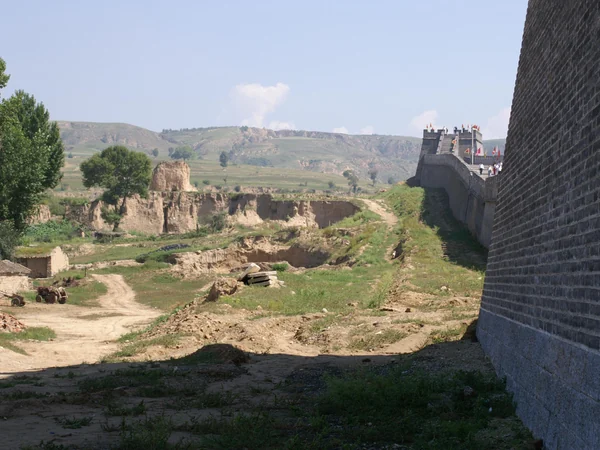
Low rammed-earth remains in the northern landscape associated with Qin frontier defenses

Political and military conditions under Qin Shi Huang

Qin standardized writing, weights, measures and currency while replacing many hereditary domains with commanderies and counties. These reforms strengthened central administration but also demanded enormous labor and resources. Walls between former rival states could obstruct internal movement, so Qin policy distinguished obsolete internal barriers from strategically useful northern defenses.

 
The Xiongnu were a powerful confederation north of the Qin frontier—not a group “living south of China .” Relations included conflict and shifting control across frontier zones. Avoid treating the wall as a modern ethnic or national border.
 
General Meng Tian led northern campaigns traditionally dated to the late 210s BCE. Popular claims about millions of soldiers or laborers are not secure counts and should not be presented as audited figures. Military forces, conscript labor and transported supplies all contributed to frontier construction. The Ordos region around the Yellow River was strategically important for routes, pasture and access. Fortifications followed terrain and connected positions rather than forming a uniform masonry line. Campaigns pushed Qin control northward for a time, but the dynasty was brief and the frontier remained dynamic.

Qin Shi Huang's contribution to the Great Wall

Qin linked and repaired selected walls of the former Qin, Zhao and Yan states and built new connecting segments. UNESCO summarizes this imperial connection as occurring around 220 BCE. Materials were local—often rammed earth—so surviving Qin features can be low and visually subtle. The origin of the Great Wall explains why “first wall” and “first imperial connection” are different ideas.
 
The exact eastern and western endpoints described in later texts remain debated, and no responsible guide should stretch the Qin line to modern Korea as settled fact. Archaeological surveys continue to refine routes. The Han later extended frontier systems farther west; continue to the Han Dynasty Great Wall. When visiting Qin remains, expect earthworks, ditches and landscape context rather than Ming-style towers, and protect fragile sites by staying off unmarked ruins.

Editorial accountability

How this guide is checked

Named content owner

Hu Lei, CEO. The named owner is responsible for travel-planning accuracy and escalation of time-sensitive checks.

Company and licence status

Yuntian Travel (Yunnan) Group is identified in its corporate profile as a licensed professional inbound travel service provider based in Kunming, China. Registration and travel-service documents can be requested before booking.

Source basis

Page-specific references where cited, official destination, transport and entry notices, YUNSKY route-planning records, and direct provider confirmation before a booking is finalized.

Update basis

Content is reviewed when rules, transport, access, pricing or route conditions change. Final availability and operating details are reconfirmed for each traveler’s dates.

Quality review: Page updated:

Open WhatsApp chat with YunSky Travel