Your China & Yunnan Travel Experts


Reviewed August 27, 2026. Culture shock is the strain of interpreting unfamiliar routines while tired, jet-lagged or unable to communicate—not proof that one society is normal and another is strange. China is internally diverse, and an encounter in a Shanghai metro cannot represent a village, another generation or 1.4 billion people. Use the China–U.S. cultural-differences guide for a broader framework. On the ground, separate observation (“the carriage was crowded at 8 a.m.”) from judgment (“people have no boundaries”), ask what the local rule is and give yourself recovery time. These ten adjustments address common traveler friction without turning individual behavior into a national stereotype.
Chinese American cuisine has its own immigrant history and value; it is not “fake.” It also does not predict every menu in China. A Cantonese dim sum breakfast, a Sichuan hot pot, a Xi'an noodle shop and a Yunnan mushroom restaurant use different ingredients, techniques and meal rhythms. Begin with a regional specialty and one familiar texture rather than treating unusual food as a dare. Shared dishes may arrive as they are ready, not in Western course order, and the host may place food in your bowl as hospitality. Observe first, use serving utensils when provided and ask before changing a communal dish.
Dietary needs require specific language. “Vegetarian” may still include broth, lard or oyster sauce, while a photographed dish cannot show allergens or cross-contact. Carry a professionally translated card naming the ingredient, severity and emergency response; speak to the restaurant before ordering. People with serious allergies or celiac disease should consult a clinician and plan backup food rather than assuming a guide or app can guarantee a safe kitchen.

Sichuan hot pot is a shared regional meal, not a test of how adventurous a visitor can be
Large Chinese cities often have extensive metro and bus networks, but rush-hour density, security checks, station size and digital ticketing can surprise a first-time visitor. Stand behind platform markings, let passengers exit, keep bags close and avoid blocking doors. A route app may show the correct line while missing the distance between exits. Save the destination in Chinese, confirm the final train time and choose an exit number near the hotel or attraction. Travelers who need elevators should allow extra time because the accessible route may not match the shortest transfer.
High-speed rail is useful between cities, yet the train name is only part of the plan. China Railway 12306 uses real-name tickets; enter passport details exactly and carry the original passport used to book. Check the city's precise station and arrive with time for security. Learning a few useful Chinese phrases for travelers helps with platforms and taxis, but a written station name is more reliable than pronunciation alone.
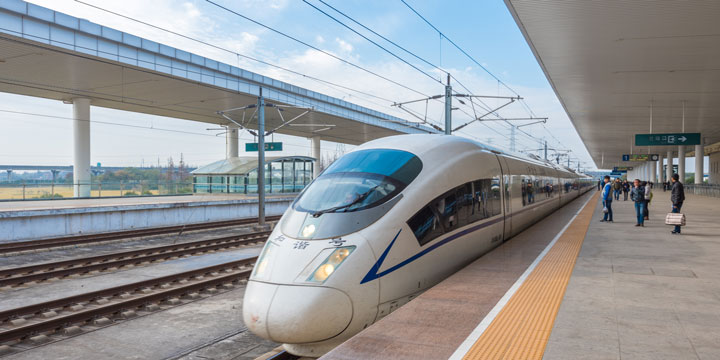
High-speed train boarding depends on the correct station, passport and departure time
Some foreign websites and services are restricted in mainland China, and an app that works at home may behave differently on hotel Wi-Fi or mobile data. Before departure, download offline maps and translation, save booking confirmations as files, confirm international roaming or eSIM compatibility and create a second way to reach family. Bring a compatible charging setup and a power bank that meets airline and railway rules. Follow local law and service terms. Most importantly, do not make one cloud account the only place where passport copies, medication details or the next hotel address can be found.
Smoke exposure is not uniform. Local restrictions, building enforcement and social practice vary, so request a non-smoking room in writing and reconfirm at check-in. In restaurants, ask for a smoke-free area or choose another venue if the air is uncomfortable. The China etiquette and “things not to do” guide covers practical boundaries without shaming people. Travelers with asthma or cardiovascular conditions should discuss a plan with a clinician and carry prescribed medication.
Older travel writing often describes coughing or spitting as a fixed “culture.” That is neither precise nor useful. Standards and enforcement change, and behavior varies by individual and setting. Keep distance from a hygiene concern, wash hands and address a specific problem with staff rather than using it to label a population.
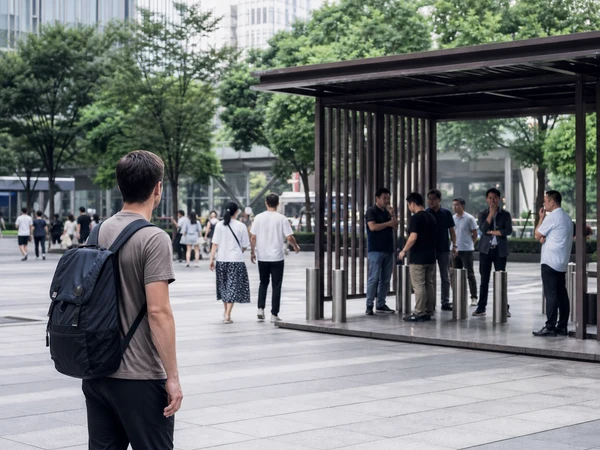
A packed commuter train, a quiet museum and a neighborhood café have different spacing norms. Crowding often reflects peak demand and physical layout rather than hostility. Travel after the morning rush when possible, wait for the next carriage if boarding feels unsafe and position children away from platform edges. In queues, watch floor markings and what staff enforce. A clear “please give me space,” a step sideways or a request for assistance is more effective than pushing back. Travelers with sensory needs can build quieter meals and private transfers into selected days without assuming the entire trip needs to be isolated.
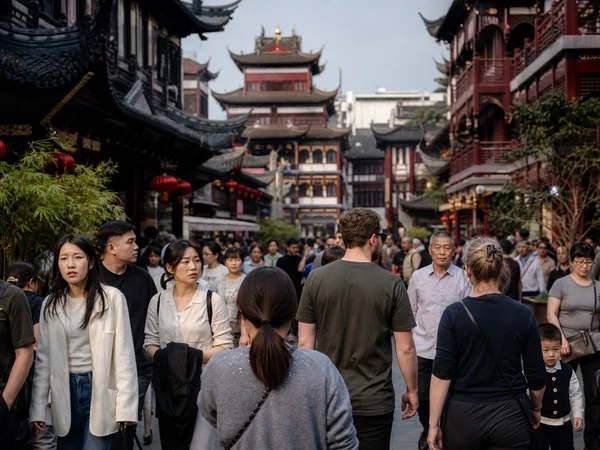
Chenghuang Temple area in Shanghai, where crowd density changes sharply by hour and holiday
Squat and western-style toilets can both appear in stations, parks and attractions. Signs may indicate the accessible stall, but availability and maintenance vary. Carry tissues and sanitizer, keep hands free for balance and watch for wet floors. Do not place bags on the ground or flush products when signs say to use the bin. Travelers with mobility limitations should ask the hotel or operator for recent, route-specific accessibility information rather than accepting “no problem” as an answer.
Facilities are improving in many transport hubs and visitor sites, so claims that public restrooms “never” have paper or soap are outdated. Prepare for shortages without presenting them as inevitable. Parents should supervise children and use a restroom; split-crotch clothing still exists in some families, but it should not be used to generalize about hygiene or parenting across modern China.
Pack a small hygiene pouch and refill it each morning. A predictable routine—restroom before a long transfer, tissues in an outside pocket and sanitizer after crowded transport—reduces stress more effectively than focusing on shock.
Air quality varies by city, season, weather and day. Check a current local forecast rather than assuming every destination is smoggy or that a clear-looking sky is risk-free. The CDC's 2026 China guidance notes that short-term particle exposure can affect the eyes and respiratory system and that children, older adults and people with heart or lung conditions may be more vulnerable. Those travelers should ask a clinician how to adjust outdoor activity and whether a well-fitted respirator is appropriate. Build one indoor alternative for a poor-air day and avoid presenting a mask as a universal medical solution.
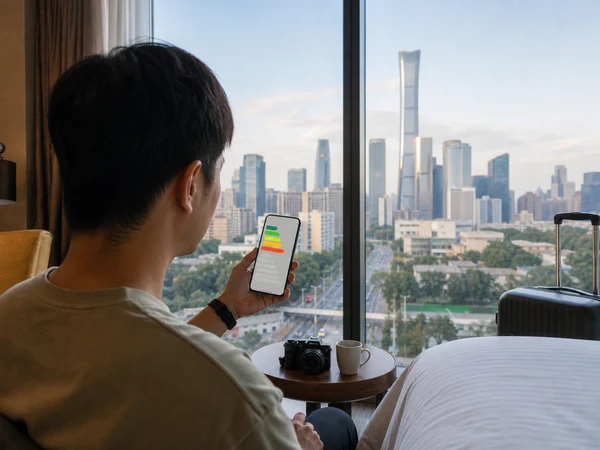
A phone forecast beside a hotel window is more informative than an unrelated landmark photograph
On sunny days, pedestrians may carry parasols or wear hats, face coverings and light sleeves. Reasons include ultraviolet protection, comfort, fashion, dermatology advice or personal preference. Historical beauty ideals can shape choices, but it is inaccurate to say that all Chinese women want one skin tone or that Americans prefer another. Practical sun care crosses cultures: check the UV forecast, seek shade, hydrate and use clothing or sunscreen suitable for your health and activity.
Do not photograph someone because their sun-protection clothing looks unfamiliar. Ask before taking a portrait and avoid comments about skin color, body shape or age. Treat the clothing as a useful adaptation to heat and ultraviolet exposure, not a spectacle.
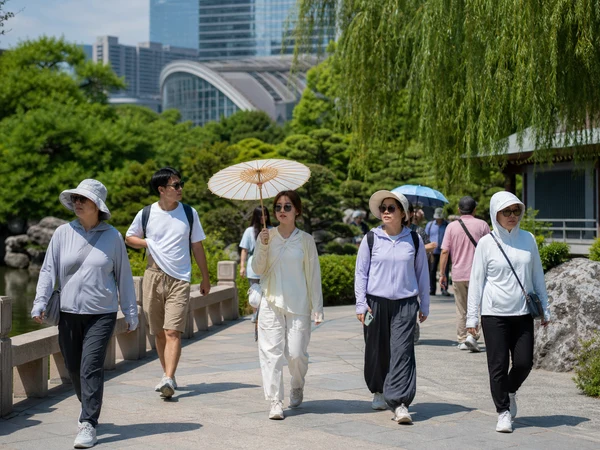
Pedestrians using parasols, hats and sleeves for sun protection in a Chinese city garden
China contains global business districts, industrial towns, farming communities, heritage neighborhoods and households at very different income levels. A damaged building, street vendor or person asking for money does not by itself explain poverty, policy or a whole community. Avoid photographing vulnerable people for “contrast” without consent. If approached for money, follow your normal safety boundaries; donate through a reputable local organization if you want to help. For deeper understanding, use museums, named research and conversations with people who can describe their own experience rather than treating a brief street view as evidence.
An international traveler may receive little notice in one place and repeated looks or photo requests in another. Age, location, group size and novelty can all affect the encounter. A smile or greeting is an option, not an obligation. If you do not want a photograph, say no clearly, use a hand gesture, step away or ask staff for help. Parents should decide in advance how to protect children from unwanted pictures. Do not assume that curiosity is malicious, but do not excuse persistent conduct as something a visitor must accept.
Culture shock usually eases when the traveler sleeps, slows the itinerary and gains a few reliable routines. Keep notes about what happened, ask a local contact for context and revise the interpretation when new evidence appears. If anxiety persists or affects daily function, contact a qualified health professional or insurer. The goal is not to stop noticing differences; it is to respond with evidence, humility, practical boundaries and respect for the individual in front of you.
For first timers traveling to China from USA, this article may help you if you don't know how to deal with culture shock in China. If you want enjoy your China tour more smoothly, joining Yun Sky Travel will be an ideal choice. Check tours below if you have trouble planning your first trip to China.
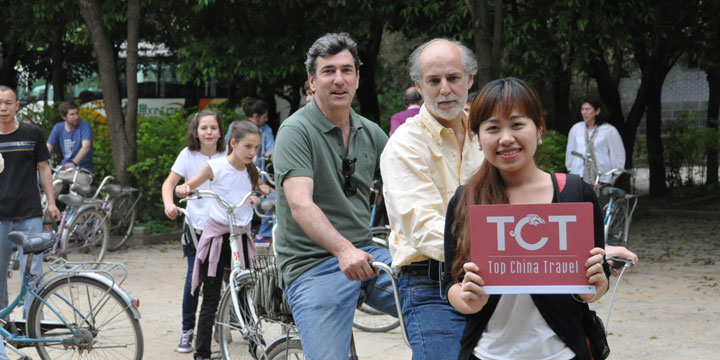
Our Customers in Guilin
Know more China tours. You can also have a tailor-made tour, with more flexible schedule and plenty more fun activities.

From $ 2498

From $ 22782050
From $ 2983
Editorial accountability
Hu Lei, CEO. The named owner is responsible for travel-planning accuracy and escalation of time-sensitive checks.
Yuntian Travel (Yunnan) Group is identified in its corporate profile as a licensed professional inbound travel service provider based in Kunming, China. Registration and travel-service documents can be requested before booking.
Page-specific references where cited, official destination, transport and entry notices, YUNSKY route-planning records, and direct provider confirmation before a booking is finalized.
Content is reviewed when rules, transport, access, pricing or route conditions change. Final availability and operating details are reconfirmed for each traveler’s dates.
Quality review: Page updated: