Your China & Yunnan Travel Experts


Reviewed August 27, 2026. These 9 China travel tips for seniors focus on decisions that can be verified: health preparation, pacing, weather, insurance, medicines, food, transport and support. China is not uniformly safe, accessible or difficult; risk and access vary by traveler, route and date. Use this guide as a planning checklist, not medical, legal or insurance advice.
Write one full day from hotel door to hotel door: curb, security, walking, steps, toilets, meals, medicines, seating and return transport. If that day is unrealistic, reduce stops before adding assistance. One major sight plus an optional small activity is often more rewarding than three rushed landmarks.
Record the traveler's own walking tolerance, recent practice and recovery pattern. “Senior-friendly” should never replace distances, surfaces and a clear way to stop early.
China spans tropical coast, humid river cities, cold northern winters and high plateaus. Use the China climate guide for broad patterns, then check a reliable short-range forecast, air-quality information and site notices for every stop. There is no nationwide best month.
Beijing, Xi'an, Shanghai, Chengdu and Guilin offer major transport and healthcare networks, but each has different walking, heat, rain and crowd demands. High-altitude routes need separate acclimatization and clinical planning. CDC's 2026 Yellow Book notes that fitness does not prevent altitude illness.

Older traveler and guide checking rain layers beside the Li River in Guilin
Compare medical treatment, pre-existing-condition terms, trip cancellation, interruption, baggage, activity exclusions and medical evacuation. Confirm whether the insurer pays providers directly or reimburses later and save the assistance number offline. A credit-card benefit may not equal comprehensive cover. Read the policy wording and obtain qualified advice for individual needs.
Keep a secure copy of passport and insurance details separate from the originals, share the route with a trusted contact and use registered transport. At stations, allow time for large concourses and security. China's 2024 transport guidance calls for staffed assistance, wheelchairs and accessible routes, but facilities vary, so request and reconfirm the specific service.
Use the China travel safety checklist to plan crossings, valuables, emergency contacts and communications without claiming that any destination is risk-free. Keep identification and essential medicine with the traveler rather than in a group bag.
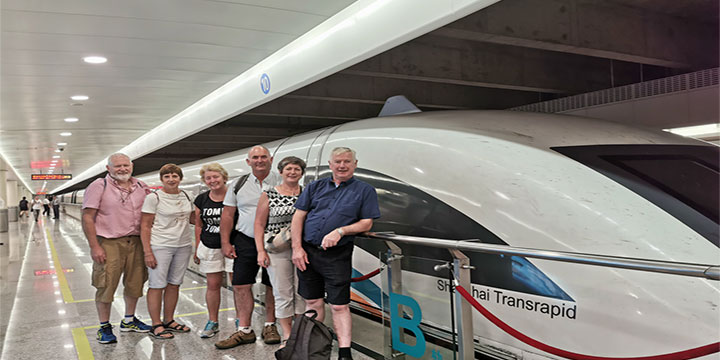
Older travelers arriving with organized luggage at a modern China railway station
Put seats, meals and toilet stops into the schedule. Begin later after a long flight, avoid a major sight on transfer days and leave one flexible half-day every few days. Rest is not wasted tour time; it protects attention, balance and enjoyment. A guide should accept a shorter route without pressure or embarrassment.

CDC advises travelers with chronic conditions to seek pre-travel care four to six weeks before departure when possible. Carry an adequate supply in original labeled packaging, a medication and condition list, copies of prescriptions where appropriate, and critical doses in hand luggage. Check airline, transit-country and Chinese entry rules for each medicine; do not assume a brand or substitute will be available locally.
Save the hotel name, address, guide number, insurer and emergency contacts offline in English and Chinese. Agree on a daily check-in with family, but keep medical and passport data private. Test roaming, an eSIM or local service before relying on it, and carry backup power. Availability of overseas apps can change, so use at least two contact methods.
WHO's Five Keys emphasize cleanliness, separating raw and cooked food, thorough cooking, safe temperatures and safe water. Choose freshly cooked food served hot, ask about ingredients and carry a bilingual allergy card while recognizing that it cannot guarantee a cross-contact-free kitchen. Follow individualized advice for diabetes, kidney, heart or swallowing conditions.

Xiao long bao served hot in a bamboo steamer
Ask hotels for door width, bathroom layout, lift access and vehicle approach; ask stations and airlines how to request assistance; ask attractions for the exact route and toilet location. Use the China high-speed train guide to understand the journey, then confirm the chosen station and train. Discounts and priority rules vary by age, residency, venue and date.
A private guide or organized tour can reduce language and transport friction, but it cannot remove medical risk or make every site accessible. Give the planner the real constraints, request written confirmations for important access and keep the traveler involved in every decision.

Older travelers confirming a railway pickup plan with a local guide

From $ 1599

From on request

From $ 23332100
Editorial accountability
Hu Lei, CEO. The named owner is responsible for travel-planning accuracy and escalation of time-sensitive checks.
Yuntian Travel (Yunnan) Group is identified in its corporate profile as a licensed professional inbound travel service provider based in Kunming, China. Registration and travel-service documents can be requested before booking.
Page-specific references where cited, official destination, transport and entry notices, YUNSKY route-planning records, and direct provider confirmation before a booking is finalized.
Content is reviewed when rules, transport, access, pricing or route conditions change. Final availability and operating details are reconfirmed for each traveler’s dates.
Quality review: Page updated: