Your China & Yunnan Travel Experts


The Great Wall of the Han dynasty was not a single brick barrier. It was a shifting frontier system of rammed-earth walls, ditches, forts, beacon sites and supply points built or reused across northern and northwestern China. Its roles included defense, warning, communication and control of strategic corridors.
The Han ruled from 202 BCE to 220 CE, conventionally divided into Western Han and Eastern Han periods with an interruption under Wang Mang. Western Han capitals were at Chang'an, near modern Xi'an , while the Eastern Han capital was Luoyang in Henan Province. Frontier priorities changed as political and military conditions changed. Across both periods, defense priorities shifted with court power, garrison capacity and relations with neighboring peoples.
Early Han rulers combined diplomacy, trade and defense in relations with the Xiongnu. Under Emperor Wu, military campaigns and new commanderies expanded Han control toward the northwest. Wall-building was one element of this strategy, not an isolated project. Defenses were strengthened north of the Yellow River and across corridors linking the central plains to the northwest. The earlier Qin Great Wall guide explains the systems inherited and adapted by the Han.
After campaigns secured the Hexi Corridor, forts, beacons and wall lines supported movement between commanderies and guarded routes through Gansu. This corridor later became a core part of what travelers call the
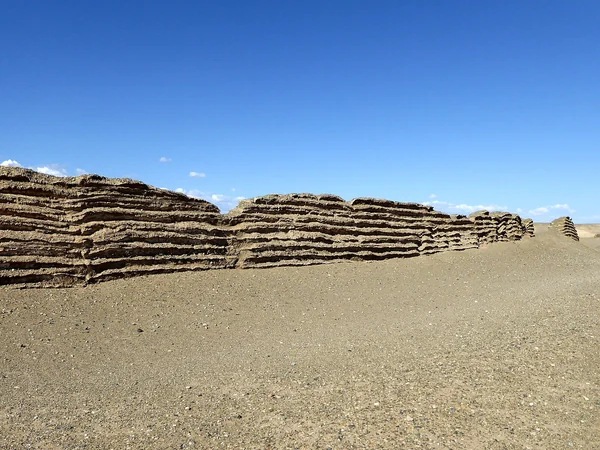
. The fortifications did not “protect the Silk Road” as one timeless route; they supported specific Han administrative and military networks that also enabled movement and exchange. Sites around Jiuquan, Dunhuang, Yangguan and Yumen Pass help reveal this western system. Farther west, beacon lines and barriers extended into arid landscapes toward the Lop Nur region. Survival is uneven: compacted earth, reeds and gravel can remain visible in desert sites, while elsewhere erosion leaves low traces. Distances and exact phases differ across archaeological reports.
Eastern Han rulers inherited a different political geography and used walls, forts and garrisons selectively. Popular lists of four exact routes simplify a complex record; the reliable point is that defenses protected approaches to capitals and commandery networks.
Historical accounts describe a line across parts of Shaanxi, but its precise modern alignment requires archaeological confirmation.
Other defenses connected approaches across Shaanxi and Shanxi.
Routes toward Taiyuan and the Taihang corridors linked military geography with interior communications.
Eastern lines reached toward parts of Hebei and Henan, but surviving remains should not automatically be assigned to one campaign without site evidence.
Changes within Xiongnu groups and Han policy reduced the need for some construction while keeping garrisons and communication important. Xinjiang and the Mongolian Plateau belonged to a wider diplomatic and military context, not a fixed modern-style border. For scale, the guide to how Great Wall length is measured distinguishes dynastic lines from one continuous wall.
Archaeological surveys continue to document Han-period walls and beacon sites in Gansu and other regions. Announcements of newly identified segments should be checked against the responsible heritage authority because dating and length estimates can change after fieldwork. When visiting, expect fragile earthworks rather than high battlements: stay on marked paths, avoid climbing ruins and use museums or site interpretation to understand features that can be difficult to recognize in the landscape.

From $ 389

From $ 509

From on request
Editorial accountability
Hu Lei, CEO. The named owner is responsible for travel-planning accuracy and escalation of time-sensitive checks.
Yuntian Travel (Yunnan) Group is identified in its corporate profile as a licensed professional inbound travel service provider based in Kunming, China. Registration and travel-service documents can be requested before booking.
Page-specific references where cited, official destination, transport and entry notices, YUNSKY route-planning records, and direct provider confirmation before a booking is finalized.
Content is reviewed when rules, transport, access, pricing or route conditions change. Final availability and operating details are reconfirmed for each traveler’s dates.
Quality review: Page updated: