Your China & Yunnan Travel Experts


The Great Wall of the Spring and Autumn Period

Long defensive walls that later became part of Great Wall history began to appear during the Spring and Autumn period and expanded in the Warring States period . These were separate state barriers, not one national frontier. They defended borders, passes and vulnerable corridors from neighboring states as well as groups beyond the central plains.
 
The Zhou era is conventionally divided into Western Zhou (c. 1046–771 BCE) and Eastern Zhou (770–256 BCE). The Eastern Zhou encompasses the Spring and Autumn and Warring States periods, though exact boundary dates vary slightly by scholarly convention. Political fragmentation encouraged states to build walls for their own strategic needs.
 

Across the long history of China later states and dynasties repaired, abandoned, crossed or reused earlier defenses. By the Ming dynasty wall systems had a very different scale, architecture and frontier function. Treating every phase as one unchanged monument obscures that development . The origin of the Great Wall guide explains the difference between early state walls and later imperial networks.
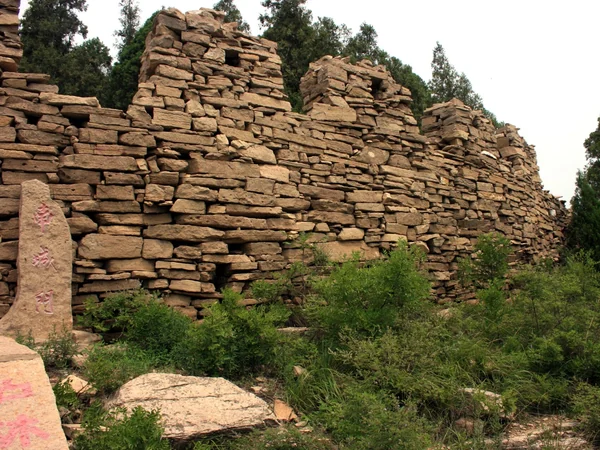
Ancient earthwork remains of the Qi Great Wall crossing the Shandong landscape

The Great Wall of the Chu state

The state of Chu occupied a broad southern and central region whose boundaries shifted over centuries. Its geography related mainly to the Yangtze and Han river systems rather than simply the lower Yellow River . As Chu expanded, it faced other states across multiple frontiers.

 
Ancient texts and archaeological research associate Chu with an early long barrier often called Fangcheng, or “rectangular wall.” Dating individual segments is difficult, and claims that one exact year marks the birth of the entire Great Wall go beyond the evidence. The important idea is that linked walls, passes and terrain were used to control approaches before imperial unification.
 
During the Warring States period, Chu strengthened border defenses as competition intensified. Surviving traces in Henan are generally earthworks integrated with mountains and passes, not high brick battlements. Their identification depends on archaeology and historical geography; travelers should use interpreted heritage sites rather than searching across farmland or climbing unmarked ruins in Henan .

The Great Wall of the Qi state

Qi's capital was Linzi in present-day Shandong. The state faced rivals to the south, west and north and developed a long southern defensive line.

 
Construction and extension occurred in stages. Historical tradition associates major work with Qi rulers during the Warring States period, so attributing the entire line to one king or to the earlier Spring and Autumn era is too simple. The Qi wall runs for hundreds of kilometres across Shandong from the Yellow River region toward the coast. Exact length depends on the surveyed route and preservation criteria; avoid repeating a rounded 500 km as if it were a single ancient measurement. The line crosses areas linked with Mount Tai but wall and mountain should be planned as distinct heritage experiences. Continue with the Warring States Great Wall to see how other states expanded defensive building, then use when the Great Wall was built for the full chronology. Early earthworks are exceptionally fragile: view them from designated paths, do not remove soil or stones, and treat local museum interpretation as essential context.
 

Editorial accountability

How this guide is checked

Named content owner

Hu Lei, CEO. The named owner is responsible for travel-planning accuracy and escalation of time-sensitive checks.

Company and licence status

Yuntian Travel (Yunnan) Group is identified in its corporate profile as a licensed professional inbound travel service provider based in Kunming, China. Registration and travel-service documents can be requested before booking.

Source basis

Page-specific references where cited, official destination, transport and entry notices, YUNSKY route-planning records, and direct provider confirmation before a booking is finalized.

Update basis

Content is reviewed when rules, transport, access, pricing or route conditions change. Final availability and operating details are reconfirmed for each traveler’s dates.

Quality review: Page updated:

Open WhatsApp chat with YunSky Travel