Your China & Yunnan Travel Experts


Reviewed August 27, 2026. Hiking in China can mean a level city-park loop, stone steps on the Great Wall, a humid karst trail or a high-altitude route. Age alone does not decide whether a walk is appropriate; current health, balance, experience, surface, weather, altitude and access to help do. Use these eight decisions to match the trail to the traveler, then check the China climate guide and a reliable short-range forecast for the exact place and date. This guide supports preparation and does not replace individualized advice from a clinician or the rules of the site operator.
CDC's 2026 Yellow Book advises travelers with chronic conditions to prepare with their healthcare team several weeks before international travel and to consider the destination, activity and previous travel experience. Share the exact distance, elevation, sleeping altitude, stairs and remoteness—not merely the word “hike.” Discuss stable conditions, medicines, emergency signs and any device or backup-power needs. Build walking time gradually at home in the shoes and pack intended for the trip. A checkup cannot make a route risk-free, and fitness does not prevent altitude illness. Leave the itinerary flexible enough to shorten or skip the walk without losing the trip.
Check temperature, rain, wind, sun exposure and trail notices. Breathable layers are easier to adjust than one heavy garment; add a weatherproof outer layer when conditions justify it. Wear sturdy, broken-in footwear with dependable grip and enough toe room on descents. A shoe that is automatically “half a size bigger” is not a universal rule: fit depends on the foot, sock, swelling, lacing and terrain. Test the complete system on comparable walks before departure.
Carry a sun hat, appropriate eye protection and any clinician-approved skin protection. Bright or reflective detail can improve visibility, but loose straps, long hems and unsecured scarves can catch on railings. Keep the pack light, close to the body and free of objects swinging near other walkers.
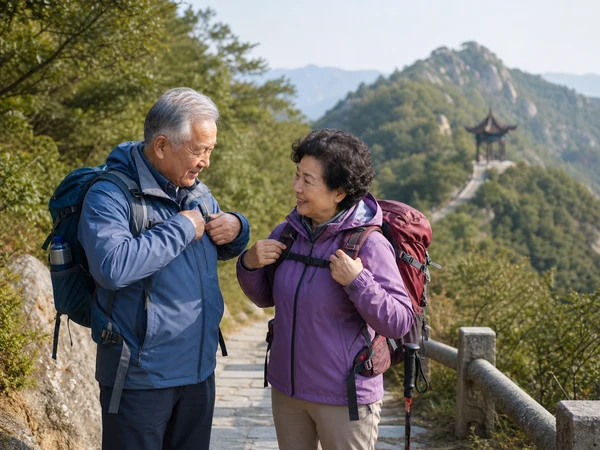
Older hikers checking layered clothing and fitted daypacks before a mountain walk in China
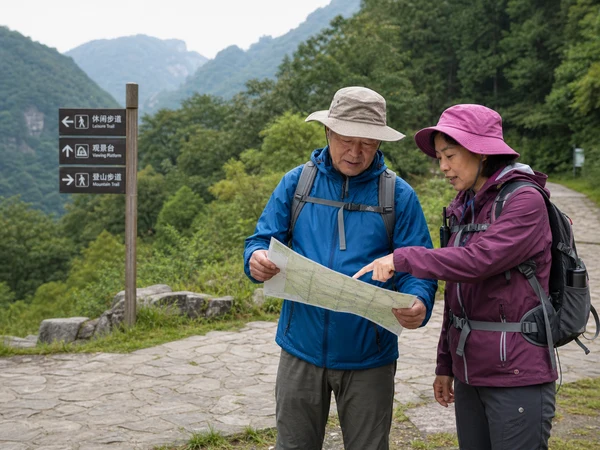
Compare distance, ascent, step height, handrails, shade, toilets, seating, mobile coverage, staffed exits and the last transport home. “Easy” is subjective, while online trail times often exclude photography and rests. At the Great Wall, sections and entrances differ; consult the Great Wall access guide for seniors and wheelchair users and verify current cable-car, lift and closure information directly. Set a turnaround time before starting, and keep a shorter route that delivers the main view without requiring an exhausting return.
Start with several minutes of easy walking and movements already familiar to the traveler. Cold muscles, abrupt deep stretches and unfamiliar exercises can be counterproductive. Anyone with joint replacement, osteoporosis, balance concerns or a rehabilitation plan should use movements approved by the relevant clinician or therapist. The aim is to notice pain, dizziness or unusual breathlessness early—not to complete a ritual before the group leaves.
Walk at a pace that permits controlled breathing and safe foot placement. Stop before fatigue changes balance, and use seats or stable ground rather than narrow stairs. Drink according to weather, exertion and personal medical guidance; a universal water target can be inappropriate for travelers with fluid restrictions. Carry safely treated water and a practical snack, and avoid relying on untreated stream water. Headache, confusion, chest discomfort, faintness, severe shortness of breath or loss of coordination requires stopping and appropriate help, not encouragement to “push through.”
Trekking poles can add contact points and confidence on uneven ground, but poor length, loose wrist straps or unfamiliar technique can create a new trip hazard. Adjust them to the terrain, keep tips away from companions and stow them where required on cable cars or indoor routes. They do not prevent every fall or eliminate knee load. Travelers using a cane, walker or other mobility aid should test the actual equipment with an appropriate professional and confirm how it will be transported.
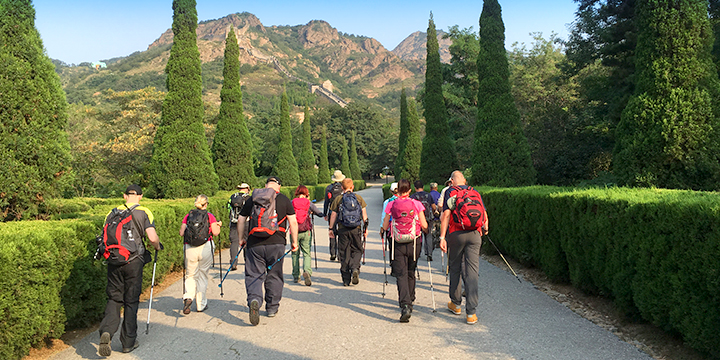
A trekking pole can support balance when it is correctly fitted and practiced
Carry identification, emergency contacts, route information, a charged phone and backup power, necessary medicine in original packaging, a compact first-aid kit, rain and sun protection, safely treated water and a suitable snack. Save the site name, entrance and return transport offline in English and Chinese. Tell someone the route and expected return time. Keep both hands available on steps; a companion can carry shared weight, but each traveler should retain critical medicine and identification rather than putting every essential in one group bag.
A companion or trained guide cannot remove all risk, but can help with navigation, weather decisions, communication and an early turnaround. Agree on who leads, who stays last, rest signals and what will happen if one person stops. Do not let a group separate a traveler from essential medicine or pressure anyone toward a summit. Guided China tours designed for older travelers should disclose the real walking and stair demands, not simply label an itinerary senior-friendly.
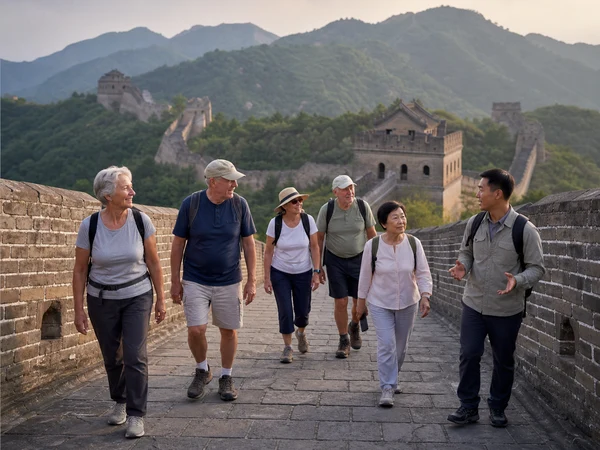
Older travelers walking together with a local guide on the Great Wall
Use our route-planning contact form to describe walking tolerance, recent practice, steps, altitude and required equipment. Then request a tailored hiking day with a named entrance, turnaround point, weather alternative and vehicle pickup. A responsible plan preserves the option to stop without embarrassment.

From $ 1599

From on request

From $ 23332100
Editorial accountability
Hu Lei, CEO. The named owner is responsible for travel-planning accuracy and escalation of time-sensitive checks.
Yuntian Travel (Yunnan) Group is identified in its corporate profile as a licensed professional inbound travel service provider based in Kunming, China. Registration and travel-service documents can be requested before booking.
Page-specific references where cited, official destination, transport and entry notices, YUNSKY route-planning records, and direct provider confirmation before a booking is finalized.
Content is reviewed when rules, transport, access, pricing or route conditions change. Final availability and operating details are reconfirmed for each traveler’s dates.
Quality review: Page updated: