Your China & Yunnan Travel Experts

Yunnan history is easiest to understand through places and connections: the kingdoms around the Erhai basin, Buddhist monuments near Dali, trading settlements and Lijiang's cultural setting. Use those themes to choose visits, while asking what is original, restored or interpreted for present-day visitors.
The Tea Horse Road was a network of routes and exchanges, not one single road that can be followed as a uniform attraction. Likewise, today's townscapes contain layers from different periods. A building that looks old does not automatically date to the kingdom mentioned in its story.
| Period or transition | Why it matters | A question to take on a visit |
|---|---|---|
| Nanzhao, especially the 8th and 9th centuries | A powerful kingdom centered in the Erhai region, connected with neighboring powers | Which surviving objects or monuments support the account? |
| Dali Kingdom, beginning in 937 | A later regional kingdom strongly associated with Buddhist patronage | How does a monument relate to this period rather than to later rebuilding? |
| Mongol conquest in 1253 and Yuan-era change | A major transition in regional rule and administration | How did local institutions continue or change? |
| Ming and Qing periods | Further layers of urban development, administration and commerce | Which streets or buildings belong to these later histories? |
| Modern conservation and tourism | Restoration and new uses shape the places visitors see today | What was reconstructed, and how is it interpreted? |
This is a selective framework rather than a complete provincial chronology. The date anchors are consistent with the supplied Dali history reference; some of that reference's dramatic stories and generalized claims are not repeated here. Historical interpretation should be tied to evidence at the specific visit.
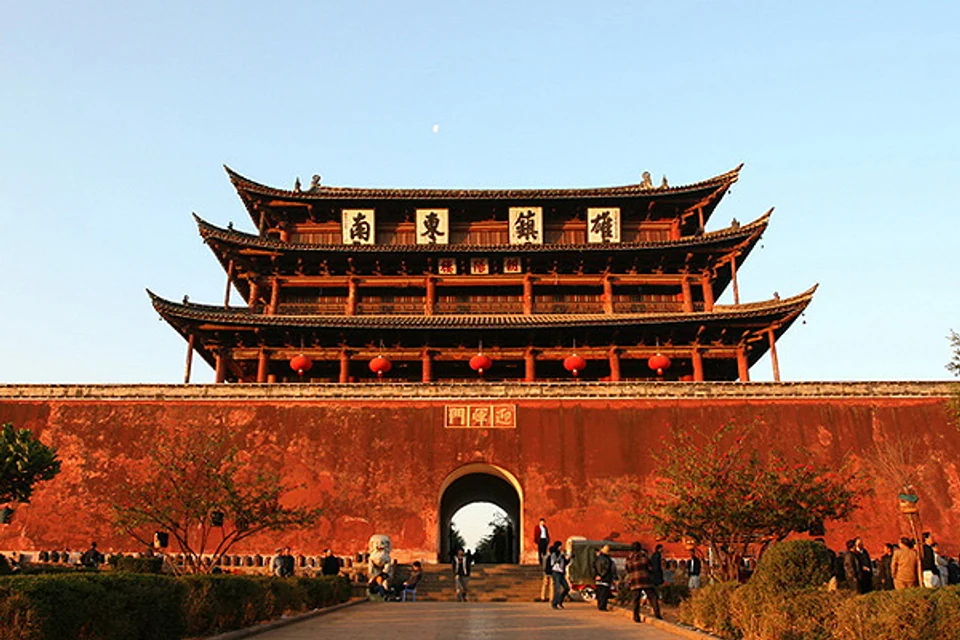
The Erhai region offers a useful starting point for the Nanzhao and Dali kingdom periods. The Three Pagodas are a major architectural reference to investigate, but the surrounding complex and different structures should not all be assumed to have one date.
During a visit, ask a guide to identify the period and function of the particular monument, what has survived and what has been repaired or rebuilt. That turns a distant skyline photograph into a more informative encounter.
The streets of Dali Old Town introduce another historical layer. Do not label every gate, courtyard or shop as a Nanzhao-era survival. The Bai culture guide adds the living regional context that a timeline alone cannot provide.
Tea, horses and other goods moved through networks that connected production areas, towns and mountain routes. Trade also carried ideas, skills and religious influences. The phrase Tea Horse Road is useful orientation, but it should lead to a specific question about a place, object or journey.
In a trading settlement, look for evidence of storage, market activity, lodging, religious institutions or merchant patronage where it is interpreted and accessible. Ask what records or buildings support the story rather than accepting that every picturesque lane was a major caravan route.
The Yunnan tea guide distinguishes present-day tea types and production regions. A modern tasting can complement historical interest, but it is not evidence that a particular current tea product or shop has an ancient lineage.
Lijiang provides a setting for exploring Naxi history, cultural exchange and the relationship between a living town and visitor interpretation. A Dongba museum visit can introduce manuscripts, ritual objects or other exhibited material, depending on the current display.
Read the Naxi culture guide before treating a script, religious tradition and modern ethnic identity as the same thing. A manuscript tradition may require specialist oral knowledge; it should not be described simply as a decorative alphabet for translating any tourist sentence.
A music performance offers another form of transmission to investigate. Ask about repertoire, teaching and adaptation instead of relying on claims that a whole concert has remained unchanged for centuries.
A Dali-and-Lijiang journey can pair architecture with museum and cultural interpretation. Give one full day a clear theme, such as Dali's monuments and townscape, and another the Naxi subjects you want to understand. Add a trading-town extension only if the route and available interpretation justify the travel.
Use the Yunnan itinerary guide to count those days. Visiting more historical names does not necessarily teach more if each stop is reduced to a photograph and a date.
For a shorter trip, choose one region and ask for a guide who can explain the specific subject and distinguish established evidence from local storytelling. A general sightseeing script may not answer the questions that drew you to the topic.
Confirm current opening, ticket and photography arrangements for the actual venue. A historical monument may sit within an active religious setting, a museum or a reconstructed visitor complex, and each has different expectations.
Ask before photographing worshippers, private interiors or people at work. The regional communities guide explains why cultural respect concerns present-day people as well as historical objects. Allow time for captions or translation rather than rush through exhibits.
For costs, compare the guide's actual scope and the venues included using the budget guide. A more focused visit may be more useful than an itinerary with many loosely connected admissions.
Dali had major roles in earlier regional kingdoms. Kunming is the current provincial capital. These belong to different political and historical contexts.
They are distinct kingdoms in the region's history. The later Dali Kingdom began in 937, after the Nanzhao period and intervening changes.
It is better understood as a network of routes and exchanges. Investigate specific towns, objects and documented connections rather than expect one uniform visitor trail.
No such assumption should be made. Ask about the date, surviving fabric and restoration of each structure; appearance alone does not establish age.
They answer different questions. Objects and interpretation can clarify history, while a town walk shows spatial relationships and current uses. A focused combination can be useful.
Name the period or subject that interests you and ask which sites and evidence the guide will use. Leave enough time for explanation and questions instead of maximizing stops.
Compare Yunnan itineraries for a Dali-and-Lijiang framework. To give the subject more depth, request a Yunnan journey centered on history and cultural interpretation and specify the themes you want to explore.
Editorial accountability
Hu Lei, CEO. The named owner is responsible for travel-planning accuracy and escalation of time-sensitive checks.
Yuntian Travel (Yunnan) Group is identified in its corporate profile as a licensed professional inbound travel service provider based in Kunming, China. Registration and travel-service documents can be requested before booking.
Page-specific references where cited, official destination, transport and entry notices, YUNSKY route-planning records, and direct provider confirmation before a booking is finalized.
Content is reviewed when rules, transport, access, pricing or route conditions change. Final availability and operating details are reconfirmed for each traveler’s dates.
Quality review: Page updated: