Your China & Yunnan Travel Experts

For a first Yunnan itinerary, allow about seven days for a selective introduction, eight to give the same route more breathing room, and ten to fourteen for longer stays or a carefully chosen extension. Five days works better with fewer bases. Compare usable sightseeing days and hotel nights before adding cities: arrival, departure and intercity travel all sit inside the trip length. The Yunnan itinerary collection also has dedicated examples for each duration.
The plans below count arrival and departure inside the stated trip length. Start with the comparison, then check the detailed night allocations against your own gateways. All routes are suggested time budgets; confirm actual connections before attaching reservations to a day.
| Trip length / nights | One workable starting allocation | What the time buys you |
|---|---|---|
| 5 days / 4 nights | Dali 2 · Lijiang 2, if arrival and departure connections suit; otherwise use one base | A focused introduction with little room for extra hotel moves. |
| 7 days / 6 nights | Kunming 1 · Dali 2 · Lijiang 3 | A selective classic route; Kunming is mainly the arrival stop. |
| 8 days / 7 nights | Kunming 2 · Dali 2 · Lijiang 3 | The seven-day route plus a full Kunming day. |
| 10 days / 9 nights | Kunming 2 · Dali 3 · Lijiang 4 | Longer stays and flexibility without adding more bases. |
| 12 days / 11 nights | Kunming 2 · Dali 4 · Lijiang 5 | A slower classic route with more space for rest or repeat outings. |
| 14 days / 13 nights | Kunming 2 · Dali 4 · Lijiang 4 · Shangri-La 3 | A northwest extension with a meaningful highland stay. |
These are starting allocations, not six separate bookable packages. The seven-, ten- and fourteen-day examples below use the same night counts. For eight or twelve days, add the extra nights to the existing route before deciding to introduce another region.
For a continuous trip where arrival and departure fall on the named calendar days, seven days contain six hotel nights. Two nights at one base normally create one full day between them; three nights create two. Arrival and departure may add partial time, but only after their actual arrangements are known.
| Time in your plan | How to count it |
|---|---|
| Arrival day | Count only time left after landing or arrival, local travel, luggage and check-in. |
| Day between two nights at one base | A full local day, still allowing for meals, breaks and travel to the outing. |
| Hotel-change day | Subtract the complete hotel-to-hotel journey before adding a local activity. |
| Departure day | Work backward from the confirmed connection; do not promise sightseeing from a calendar label. |
In the seven-day example, Day 1 is arrival, Days 2 and 4 change bases, Days 3, 5 and 6 are full local days, and Day 7 is departure. The transfer days may allow short walks, but they are not two additional full excursion days.
Before adding a hotel, write down its arrival time, the full days between nights and the departure time. A one-night stop with late arrival and early departure may contribute no meaningful visit. If a place deserves a full local day, give it the nights required to create that day.
Add an extra night where it protects a priority: a second viewing opportunity for photography, a separate outdoor excursion, a slower town day or a more dependable departure. For a distant extension, include both the journey there and the onward or return journey.
Use the destination comparison to decide which bases deserve those nights, and the experience guide to distinguish a half-day activity from a dedicated outing or overnight hike.
Route: arrive in Kunming → Dali → Lijiang → depart. Six nights: Kunming 1, Dali 2, Lijiang 3. This works best when you can leave from Lijiang or arrange a suitable onward connection.
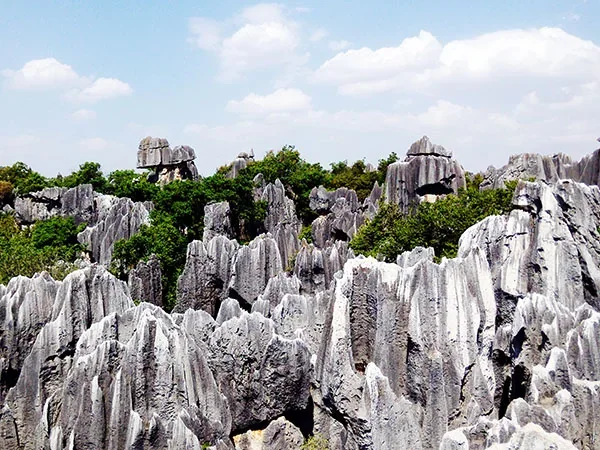
What to skip: Shangri-La, Yuanyang and a separate Lugu Lake stay. This version also leaves out the Stone Forest. If Stone Forest is a priority, move one Lijiang night to Kunming and accept less time for Lijiang excursions.
If your return flight leaves Kunming early on Day 7, plan to reach Kunming on Day 6 and use your last night there. The route then has one fewer Lijiang day; the return journey cannot be added without changing the plan.
Nine nights: Kunming 2, Dali 3, Lijiang 4. This is the stronger starting point if you want a full day in Kunming and a choice of outings without changing hotels more often.
If the highlands are a priority, use Kunming 1 night, Dali 3, Lijiang 3 and Shangri-La 2. Arrive on Day 1, move to Dali on Day 2, Lijiang on Day 5 and Shangri-La on Day 8, then depart on Day 10. This removes Kunming's full sightseeing day and some Lijiang flexibility.
Confirm the final connection before choosing this version. Two nights in Shangri-La leave one full day there. If that feels too compressed, extend the trip or remove a stop; do not fill the arrival afternoon with a demanding excursion.
For the highland extension, use the Shangri-La planning guide to choose your cultural and landscape visits before allocating the final nights.
Thirteen nights: Kunming 2, Dali 4, Lijiang 4, Shangri-La 3.

Build a southern branch around Kunming, Jianshui and Yuanyang, then decide how much of Dali and Lijiang still fits. One possible thirteen-night allocation is Kunming 2, Jianshui 2, Yuanyang 3, Dali 3 and Lijiang 3. That adds transfers and removes Shangri-La. Treat the return from the terraces toward the northwest as a travel commitment, with a possible overnight adjustment once connections are known.
For a relaxed photography trip, concentrating on Kunming, Jianshui and Yuanyang may be more rewarding than joining both branches. Terrace appearance, agricultural activity, fog and light influence the photographs you can make. Read the Yuanyang planning guide to understand the area, then confirm current access and conditions before booking.

Mark any fixed event, booked activity or weather-sensitive outing before filling the rest of the trip. If a priority can move, leave a second suitable local slot. If it cannot, avoid placing an uncertain long transfer immediately before it.
A spare day need not mean an empty day: it can hold a town walk or another flexible local interest that can swap places with an outdoor outing. A short trip may have no room for that flexibility, which is a reason to reduce the number of priorities.
Use Best Time to Visit Yunnan to choose the travel window. Here, the question is whether your available days allow the flexibility that choice needs.
Count packing and check-out, the journey to the station or airport, waiting and boarding, the main journey, and travel to the next hotel. Add meals and a realistic margin for collecting luggage or finding the meeting point. A short advertised ride describes only one part of the day.
Write the earliest sensible start for an activity at the destination. If the remaining time is uncertain, keep it for a short local walk rather than a timed excursion. A private road transfer can include selected stops, but each stop adds to the same daily time budget.
Confirm the exact connection using the Yunnan transport guide. If departure requires returning to Kunming, move a night there and remove it from another base; do not append an uncounted journey to the last morning.
A change between two nearby hotels still uses packing, check-out, luggage handling and check-in. For a short stay, visiting the second area as an outing may protect more of the day than sleeping there. Change properties when the new location has a clear purpose, such as repeated early starts near your main interest.
Keep the final night tied to the real departure connection. An early departure can make a gateway stay more useful than another evening far away. For luggage access, stairs and room details, use the practical hotel checklist once the nights are assigned.
Once the time plan works, use its exact nights and transfer days in Yunnan Travel Cost. A seven-day outline supplies six accommodation nights; a ten-day outline supplies nine. Record rooms separately from travelers and note any additional gateway night.
An extra day at an existing base and an extra day used for another region have different service requirements. Send the completed day-and-night plan for pricing so that the budget describes the trip you actually intend to take.
For families or travelers who prefer slower mornings, protect longer stays and fewer hotel moves before adding more destinations. If meals, rest or access arrangements require extra time, place them inside each day instead of expecting them to fit around a full excursion schedule.
For photography, repeat visits to the same setting may deserve the extra night. For an overnight hike, count the approach, walking days, luggage arrangements and onward transfer. A viewpoint visit and a trek use different amounts of time.
When there are more priorities than usable days, remove the least important base or extend the trip. Compressing every transfer and break does not create another full day.
The seven-day example here allocates one night to Kunming, two to Dali and three to Lijiang. Our separate 7-day Yunnan itinerary uses one, three and two nights respectively, giving more time to Dali. Both total six nights; choose according to whether lakeside time or a Lijiang excursion matters more.
The ten-day example here keeps Kunming, Dali and Lijiang, while the dedicated 10-day itinerary includes Shangri-La. These are alternative travel styles. Compare the higher overnight stay, departure gateway and number of transfers before choosing a version.
Yes, for a focused stay in one or two bases with suitable gateways. Four nights do not allow a relaxed province-wide circuit.
In the comparison above, it adds a second Kunming night and therefore a full Kunming day. You can instead place it at another base if that protects a higher priority.
Choose ten for the classic route with meaningful local stays. Twelve allows extra rest, flexible excursions or repeat viewing opportunities without requiring another base.
That is a compressed choice with little usable time at each stop. The seven-day example keeps three bases. If Shangri-La is essential, remove a different base or add days after checking the connections.
No. The fourteen-day example develops the northwest. A southern branch is a deliberate alternative allocation, with its own transfer commitments.
Reserve time to return and, where needed, the final night there. Remove that night from another stop and recheck the full days remaining.
Count from arrival in Yunnan to departure, including those travel days. Avoid counting the same interregional transfer as a full sightseeing day in both places.
Write down your month, available days, likely arrival and departure cities, group size, room needs and two or three priority experiences. Mark the places you are happy to leave out. That gives you a clear basis for comparing independent arrangements with classic Yunnan tours.
Send your total calendar days, the arrival and departure arrangements you already know, and the hotel-night allocation you prefer. Mark which stops are essential and where you can add or remove a night, then request a Yunnan itinerary that fits your available days. Use Yunnan Travel Cost to price the same number of nights and transfers after the time plan is agreed.
Planning basis and further reading
These itineraries are editorial suggestions based on regional geography and the allocation of travel days. Background reading includes our Yunnan destination overview, transport collection and seasonal guide, reviewed September 6, 2026. They are background guides; current fares, schedules, reservations and access conditions must be confirmed with the relevant provider for your travel dates.
Editorial accountability
Hu Lei, CEO. The named owner is responsible for travel-planning accuracy and escalation of time-sensitive checks.
Yuntian Travel (Yunnan) Group is identified in its corporate profile as a licensed professional inbound travel service provider based in Kunming, China. Registration and travel-service documents can be requested before booking.
Page-specific references where cited, official destination, transport and entry notices, YUNSKY route-planning records, and direct provider confirmation before a booking is finalized.
Content is reviewed when rules, transport, access, pricing or route conditions change. Final availability and operating details are reconfirmed for each traveler’s dates.
Quality review: Page updated: