Your China & Yunnan Travel Experts

Yuanyang rice terraces in Yunnan deserve a stay when the landscape and changing light are a main reason for your trip. Two nights provide more opportunities than a single viewpoint stop; three nights add another morning and greater flexibility. Count the road journeys separately, because arriving in the region is not the same as having a full terrace-viewing day.
The terraces are a working agricultural landscape associated with Hani communities and neighboring communities, not a static outdoor display. Water, planting, growth, harvest and weather change what you see. A widely shared reflection photograph is not a promise for your dates.
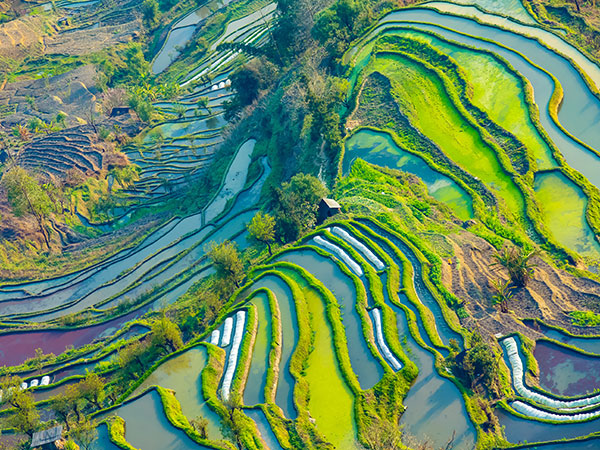
Choose the region for layered fields, village settings and time to observe changing conditions. It is particularly useful for photographers who value repeat opportunities at a selected viewpoint. It can also suit travelers interested in the relationship between cultivation, settlements and the surrounding hills.
It is a less natural addition if you have only a short Dali and Lijiang trip. Yuanyang belongs to a southern route from Kunming, with its own travel days. The Yunnan route map helps make that branch visible before hotels are booked.
Winter into early spring is a useful period to investigate for water-filled terrace scenes, but the agricultural calendar and conditions vary between fields. Later stages of the growing cycle produce a different landscape. Decide whether you want reflections, green fields or the experience of the region more generally.
Visibility depends on weather as well as the field state. Cloud can create layered views or obscure them; a planned sunrise may not produce visible sunlight. Staying longer improves the number of opportunities, but does not guarantee a particular photograph.
The best-time guide compares Yuanyang with other Yunnan regions. Check the current field and weather conditions locally when choosing your travel dates, rather than infer them from an image taken in an unknown month.
Duoyishu is widely associated with early-morning terrace views, while Bada is discussed for broad layered panoramas. These associations help with orientation, but the exact light, visibility and current access still determine the day's choices. Do not turn a familiar sunrise label into a guaranteed result.
A viewpoint such as Laohuzui may appear in older itineraries. Verify current visitor access and route conditions before including any named site; an old photograph or recommendation is not an operating notice. Choose an available alternative when required.
| Approach | Why choose it | Trade-off |
|---|---|---|
| Repeat one promising viewpoint | More familiarity with the scene and changes in light | Fewer named stops |
| Two contrasting viewpoints | Compare different field patterns and outlooks | More road movement and less time at each |
| Landscape plus a village visit | Add context about the lived and worked setting | Less emphasis on chasing every light window |
Ask your driver or guide to plan a workable order around your base and the actual conditions. A long circuit that revisits the same roads may be less useful than returning to a nearby viewpoint when the scene changes.
For two nights, treat arrival as a travel day with only a nearby view if the timing allows. Use the full middle day for an early outing, a real rest, a selected cultural or landscape visit and another light opportunity. On departure day, a short morning visit may fit only if it supports the onward journey.
Three nights add another full day and morning. That can be valuable when photography is central, when the group prefers slower starts or when weather makes the first day's view unproductive. It need not mean doubling the number of attractions.
Do not count an early-morning viewpoint as rest before a long drive. Discuss the complete day's duration, meal opportunities and your group's tolerance for repeated early starts. A non-photographer may prefer one sunrise and more daytime village context.
Choose accommodation in relation to your selected viewpoints, not simply the broad county name. Ask for the exact location, vehicle access, stairs, room conditions and meal arrangements. A room advertised with a view may show a different scene from the viewpoint you intend to visit.
For early photography, discuss departure and breakfast explicitly. For travelers with specific meal requirements, resolve the actual menu or packed-food arrangement before reaching a more limited rural setting. The Muslim travel guide offers route-specific questions where relevant.
Costs can include several vehicle movements in a day, guiding, accommodation, admissions and meals. Request a quote for the actual number of nights and outings. The budget guide helps compare a focused stay with a short excursion that includes less time in the region.
Kunming and Jianshui are useful places to investigate when building a southern Yunnan journey. The connection must be planned from the actual hotel to the next base, including any intermediate stop. Use the transport guide to avoid equating a rail arrival or town drop-off with arrival at a terrace hotel.
Combining Yuanyang with the northwest is possible when enough days are available, but it joins distinct branches. If the terraces are the priority, a shorter southern route may provide more meaningful time than a large loop through every famous Yunnan city.
The 7, 10 and 14-day planning guide provides a way to compare nights. Count the southern road days explicitly before adding Dali, Lijiang or Shangri-La.
Use public paths or places where visitor access is permitted. Fields, water channels, homes and working areas are not props. Do not step onto terrace edges or cultivated land for a better photograph without permission.
Ask before taking identifiable photographs of residents, especially in homes or private activities. If a visit involves a paid demonstration or arranged encounter, understand what was agreed. The guide to Yunnan communities explains why one staged activity cannot stand for everyday life.
It may provide one evening and one morning, depending on travel, but leaves little room for poor visibility or a rushed arrival. Two or three nights are a better starting comparison when the landscape is a priority.
No month guarantees a particular scene. Investigate the local field cycle and current conditions, and separate water-filled fields from the weather and light needed for a reflection photograph.
It is a well-known early-morning viewpoint, but actual conditions and access matter. Ask locally about the scene for your dates rather than follow one location regardless of weather.
No. Two contrasting views or repeat visits to one promising scene can be more rewarding than constant transfers. Choose the approach that fits your interests and pace.
Treat it as a separate southern regional stay, not a casual extension to a Lijiang day. Check the full route and allocate the necessary travel and overnight time.
List the hotel location, nights, early and late outings, vehicle availability, guiding and meal arrangements. Include the approach to weather changes without expecting a guarantee of light or visibility.
Compare the regional allocation in Yunnan tour ideas, then request a southern Yunnan itinerary with time at Yuanyang if the terraces deserve a longer focus. State whether photography, village context or a slower stay is your main interest.
Editorial accountability
Hu Lei, CEO. The named owner is responsible for travel-planning accuracy and escalation of time-sensitive checks.
Yuntian Travel (Yunnan) Group is identified in its corporate profile as a licensed professional inbound travel service provider based in Kunming, China. Registration and travel-service documents can be requested before booking.
Page-specific references where cited, official destination, transport and entry notices, YUNSKY route-planning records, and direct provider confirmation before a booking is finalized.
Content is reviewed when rules, transport, access, pricing or route conditions change. Final availability and operating details are reconfirmed for each traveler’s dates.
Quality review: Page updated: