Your China & Yunnan Travel Experts

A Yunnan map is most useful when it helps you choose a route branch and overnight bases. Locate Kunming first, then follow Dali and Lijiang toward the northwest. Place Shangri-La farther along that broad direction, and look separately at southern journeys toward Yuanyang or Xishuangbanna. This prevents a province map from becoming an unrealistic checklist.
The map below is an orientation image. It is not a live navigation map, a transport timetable or proof that a road or border crossing is open. Use the Yunnan geography guide alongside it to understand terrain and relative position.

Start with the province boundary and the main city names. Next mark where you intend to sleep. Finally add the excursions that belong to each base. Doing this in that order makes a distant attraction easier to recognize as a separate journey rather than a nearby sightseeing stop.
A line between two cities shows a relationship, not the full travel process. The hotel entrance, station or airport, waiting and the final transfer all affect the day. The transport guide explains how to convert map geography into a hotel-to-hotel plan.
Kunming is a practical starting location to investigate for many routes. Dali and Lijiang form a familiar northwest progression, with different lake, town and cultural interests. Shangri-La adds a higher regional setting and should be given a deliberate stay.
| Base on the map | Excursion or interest to investigate | Do not confuse it with |
|---|---|---|
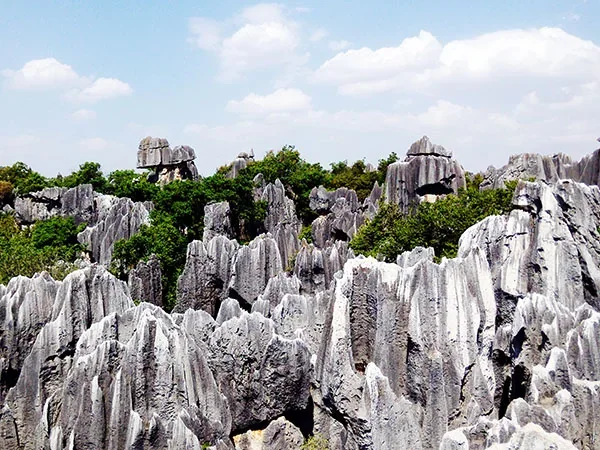
| Kunming | City time, Dianchi or a Stone Forest day | Immediate arrival at every outlying sight |
| Dali | Old Town, selected Erhai shore and Xizhou | One compact district covering the entire lake |
| Lijiang | Old towns, cultural visits or a mountain outing | A gorge trek included automatically in a city stay |
| Shangri-La | Town, monastery and selected landscapes | A quick stop covering the whole far northwest |
Use the Dali, Lijiang and Shangri-La planning guides to give each base a specific purpose. The map cannot tell you which experience your group will value most.
Yuanyang lies on a different regional branch from Dali and Lijiang. Its terrace viewpoints and rural accommodation need a road plan after you reach the relevant area. The Yuanyang guide explains why extra nights can matter more than adding viewpoints.
Xishuangbanna, with Jinghong as an important visitor base to investigate, belongs to the warmer south. A journey centered on that region has different climate and cultural priorities from a northwest circuit. See the Xishuangbanna destination guide before combining it with distant bases.
Pu'er may enter a southern journey for a focused tea or coffee interest. A production-region name does not identify a publicly accessible farm, so plot the exact visit only after it has been arranged.
For a seven-day illustration, six nights might be allocated as Kunming one, Dali two and Lijiang three. This leaves limited Kunming sightseeing and no separate southern branch. It is an allocation example, not a transport schedule.
For ten days, nine nights can be used to slow the same route down or to add another base by taking nights away elsewhere. For fourteen days, thirteen nights allow more depth or one considered extension. The full itinerary guide explains the daily sequence and the choices that those numbers imply.
If the final flight requires a return to another city, draw that return on the map and reserve its night or travel time. Do not silently treat the last destination as the departure airport.
First, a city label can cover a large administrative area. Use the hotel and attraction entrance pins, not the center of the name. Second, a lake is not one point; the chosen shore matters. Third, a mountain name does not identify the visitor route or its highest point.
Fourth, geographic closeness across a valley does not prove an easy connection. Fifth, an international boundary on the map is not a travel authorization. This article supports domestic route orientation and does not provide border-entry advice.
Read the altitude guide and climate guide before treating two nearby pins as similar environments. Terrain can change the experience even when the map scale makes the distance look small.
Keep a simple daily card showing the previous hotel, departure point, arrival point and next hotel. Add the Chinese names and exact pickup instructions using the language guide. A saved map image can help orientation, but the booking needs more precision.
Compare your airport choices after the route direction is clear. An arrival or departure closer to the main stay may avoid backtracking, but actual services and the full journey cost still determine whether it helps.
Locate Kunming and your intended first hotel, then separate the northwest and southern branches. Mark overnight bases before adding attractions.
No. It provides orientation. Determine the actual transport and both end transfers using current services and the exact addresses.
Treat it as a separate southern journey with travel days and nights, not a nearby Lijiang excursion. Compare whether that branch deserves its own focus.
No. Use current navigation and precise meeting points for local movement. The image is intended to explain the province at a broader scale.
A map label may refer to a large city or administrative area. Check the property's actual address and entrance rather than assuming the label represents the visitor district.
Only if the places and actual connections justify it. A route that arrives and departs through different cities may be more useful than a loop added solely for symmetry.
Compare your shortlist with Yunnan itinerary ideas, then request a route using the bases you have marked on the map. Include the places you would prefer to omit as well as the ones you want to see.
Editorial accountability
Hu Lei, CEO. The named owner is responsible for travel-planning accuracy and escalation of time-sensitive checks.
Yuntian Travel (Yunnan) Group is identified in its corporate profile as a licensed professional inbound travel service provider based in Kunming, China. Registration and travel-service documents can be requested before booking.
Page-specific references where cited, official destination, transport and entry notices, YUNSKY route-planning records, and direct provider confirmation before a booking is finalized.
Content is reviewed when rules, transport, access, pricing or route conditions change. Final availability and operating details are reconfirmed for each traveler’s dates.
Quality review: Page updated: