Your China & Yunnan Travel Experts



The Four Great Inventions of China—papermaking, printing, gunpowder and the compass—are a useful way to explore how knowledge, materials and techniques move through history. None appeared as a finished modern technology in one moment.
How historians decide what counts as an invention
An invention can refer to a material, a repeatable process, a practical device or a system that makes widespread use possible. Written records, dated objects, archaeological context and later technical descriptions do not always point to the same first moment. Surviving evidence is uneven: paper decays, wooden blocks burn, magnetic devices may be described without an excavated example, and military formulas can be copied centuries after their first use. Responsible history separates the earliest known evidence from a claim about absolute origin.
It also distinguishes invention from diffusion. A technique may be created in one setting, improved in another and transformed again when it reaches a new language, material or market. The Four Great Inventions matter because each became part of a larger knowledge network, not because history stopped at its earliest Chinese form.
Papermaking: material, process and scale
Early Chinese writing used bamboo slips, wood, silk and other surfaces. Fiber paper offered a different balance of weight, cost and storage. A papermaker breaks suitable plant or textile fibers into pulp, suspends them in water, lifts a thin layer on a screen, presses out moisture and dries the sheet. The exact materials and finishing methods vary. Improvements associated with the Eastern Han official Cai Lun belong within a longer development rather than a single-day invention story.
Paper changed administration because records could be copied, carried and archived more efficiently. It supported letters, religious texts, painting, packaging and eventually mass printing. The craft spread through Central Asia and the Islamic world before European production expanded. At museums, look for fiber samples, screens, pressing tools and the texture of handmade sheets; these reveal more than a portrait of one credited figure.
Printing: from carved blocks to movable type
Woodblock printing begins with a page prepared in reverse on a block. Ink is applied and paper is pressed or rubbed against the surface. One carved block can produce many impressions and combine text with illustration, but corrections require recutting. It suited repeated religious, administrative and literary works, especially where a large character set made reusable type management complex.
Bi Sheng is associated with movable type in the Northern Song period. Individual characters could be arranged, inked, printed and reused. Later printers experimented with wood, metal and different systems for organizing type. Movable type did not immediately replace woodblocks everywhere; labor, edition size, script and local workshop practice determined which method was efficient. When viewing a printed work, check whether the label identifies the date of the copy, the date of the original text and the printing technique—three separate facts.
Gunpowder: formula, weapon and historical context
Gunpowder developed from experiments with ingredients including saltpeter, sulfur and carbon-rich material. Early descriptions are connected with alchemical practice, while military texts later recorded formulas and uses. Fire arrows, bombs, incendiary devices and eventually guns represent stages of adaptation rather than one finished weapon. Composition, confinement and ignition determine the effect, and historical formulas were not identical to modern propellants.
Knowledge moved across Eurasia through warfare, trade and translation. In different regions it contributed to artillery, fortification changes, mining and ceremonial fireworks. Museum interpretation should distinguish a reconstruction from an original object and explain the source used for dating. Visitors should never treat historic formulas as a home experiment; production and use of explosives are dangerous and regulated.
The compass: magnetism, direction and navigation
Chinese observers knew that lodestone and magnetized iron align with the earth's magnetic field. Early directional devices were linked to divination and orientation as well as practical navigation. Written evidence later describes magnetized needles and maritime use. A compass provides a direction reference, but safe navigation also requires knowledge of coastlines, stars, currents, depth, weather and the difference between magnetic and geographic north.
As compass knowledge spread, mariners combined it with regional sailing experience and improved charts and instruments. The result supported longer and more repeatable voyages, yet it did not remove risk. A museum model may illustrate a “south-pointing” tradition without being the same mechanism as a modern liquid-filled compass; read the label carefully.
Why the four are grouped together
The familiar grouping became influential because papermaking and printing changed the preservation and distribution of knowledge, the compass supported navigation, and gunpowder changed warfare and state power. The category is a teaching framework, not a complete list of Chinese innovation. Agriculture, metallurgy, ceramics, silk, hydraulic engineering, medicine, astronomy and mechanical devices also have long histories that deserve attention.
The framework should not be used as a competition between civilizations. Paper, print, explosives and navigation advanced through contact among craftspeople, merchants, soldiers, scholars and states. Asking how knowledge moved, who could use it and what institutions supported it produces a stronger account than asking only who was first.
Planning an invention-focused visit
Major history, science and printing museums can provide dated objects and clear provenance, while living workshops may demonstrate papermaking, block carving or binding. Confirm opening days and whether an English label, audio guide or specialist tour is available. Working heritage sites may protect fragile tools and documents by limiting light, touch or photography.
Choose demonstrations that explain materials and safety rather than turning history into a staged claim. Paper or printing workshops can be suitable for families, but hot surfaces, sharp carving tools and chemicals require supervision. Fireworks or weapons displays should be viewed only through lawful, professionally managed events. For a deeper comparison, record the object name, approximate date, findspot and evidence type instead of relying on an attraction caption remembered from a photograph.
Understanding the modern “new four” label
High-speed rail, mobile payment, e-commerce and bike sharing show how infrastructure, smartphones, logistics and dense urban markets can change behavior at scale. Their components have international histories, and the phrase does not establish origin. The useful question is why adoption became rapid: large user bases, coordinated networks, investment, platform integration and everyday convenience all played roles.
Visitors should also notice the trade-offs. Rail depends on stations, maintenance and identity-based booking; mobile payment depends on account access and connectivity; e-commerce depends on delivery labor and packaging; shared bicycles require safe lanes, orderly parking and responsible data management. Scale makes the systems visible, but service quality, access and regulation continue to evolve.
Questions to carry through a museum
For each display, ask what survives, how it was dated and whether the object is an original, later copy or reconstruction. Identify the material and the skill required to make it. Then ask who used the technology, how expensive it was and what network allowed it to spread. A court record, a workshop tool and a mass-produced object reveal different stages of adoption.
Translate broad labels into evidence. “Ancient paper” should have an approximate date and findspot; a printed sutra should identify the edition; a compass model should cite the description it reconstructs; and a gunpowder display should distinguish a formula from a later weapon. If the label is unclear, photograph it where permitted and verify the claim through the museum catalogue rather than repeating an attractive but unsupported caption. Each developed through experimentation, improvement and exchange, then changed further as it spread to other regions. Understanding that process is more informative than assigning every achievement to a single inventor or date.
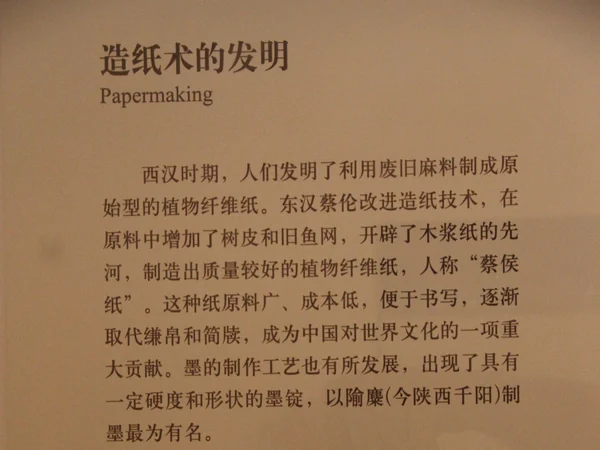
Papermaking
Paper existed in China before the official Cai Lun's report to the Han court in 105 CE, but later histories credit him with improving and documenting a practical process using plant fibers and recycled materials. Paper was lighter and easier to store than bamboo slips and helped expand administration, literature, art and education. The history of Chinese papermaking explains the craft and its movement along exchange routes.
Printing
Woodblock printing transfers ink from a carved block onto paper, allowing a prepared page to be reproduced many times. It was well established by the Tang period. The dated 868 copy of the Diamond Sutra is the earliest complete dated printed book known, not necessarily the first book ever printed. Movable-type systems later appeared in China, including ceramic type associated with Bi Sheng in the eleventh century, while woodblocks remained practical for Chinese text and illustration. These technologies belong within the wider story of Chinese history.
Gunpowder
Chinese alchemical experimentation produced mixtures containing saltpeter, sulfur and carbon-rich material. Written formulas appear by the Tang period, and Song-era sources describe incendiary and explosive military uses. Over time, gunpowder technology spread across Eurasia and was adapted for weapons, mining, signaling and fireworks. The Silk Road guide adds context for the wider networks through which technologies, materials and ideas circulated. The history involves changing recipes and devices, not one modern explosive invented at a single sitting.
The Compass
Chinese knowledge of lodestone and magnetic direction developed over centuries. Early devices were used in divination and orientation; later written evidence describes magnetized needles used for navigation. Mariners in China and elsewhere refined compass practice as it spread. A compass did not remove the need for astronomy, coastal knowledge or charts, but it made reliable direction-finding possible when landmarks or stars were unavailable.
The expression “new four great inventions” commonly refers to high-speed rail, mobile payment, e-commerce and shared bicycles. It is a popular media label, not a claim that all four technologies were first invented in modern China. Their significance lies in rapid, large-scale adoption and the way integrated digital and transport systems changed daily routines.
Shared bicycles
Dockless bike sharing expanded quickly through app-based unlocking, location services and dense urban deployment. The market has since changed, with operators and city parking rules varying over time. International visitors should check whether a current app accepts their identification and payment method, inspect the bicycle, use marked lanes and park only in a permitted zone.

High-speed rail
China adapted international rail technology while developing its own trains, standards, stations and network at exceptional scale. 
High-speed rail now links many major city clusters and can replace a flight on medium-distance routes. It should be understood as a complex system of civil engineering, rolling stock, signaling, operations and booking—not as one object invented by one country. Station names, passport-ticket matching and current timetables matter to travelers.

Mobile payment
QR-code payment through platforms such as Alipay and WeChat Pay became deeply embedded in shops, transport and online services. Cash remains legal tender, but some small merchants may be more accustomed to mobile transactions. Overseas-card support and identity checks can change, so visitors should set up more than one payment option and confirm current platform instructions before departure.
E-commerce
Online marketplaces combined digital payment, nationwide logistics, mobile apps and dense delivery networks. The result changed purchasing habits and gave many smaller businesses access to wider markets. Travelers encounter the same infrastructure through food delivery, ticketing and local services, although registration, language and hotel-delivery rules can limit access.
The ancient inventions and the modern label answer different questions. The first traces long-term technological development and global diffusion; the second describes the social impact of widespread systems. Both make more sense when placed within the broader Chinese culture guide rather than treated as a list of national slogans.
Editorial accountability
Hu Lei, CEO. The named owner is responsible for travel-planning accuracy and escalation of time-sensitive checks.
Yuntian Travel (Yunnan) Group is identified in its corporate profile as a licensed professional inbound travel service provider based in Kunming, China. Registration and travel-service documents can be requested before booking.
Page-specific references where cited, official destination, transport and entry notices, YUNSKY route-planning records, and direct provider confirmation before a booking is finalized.
Content is reviewed when rules, transport, access, pricing or route conditions change. Final availability and operating details are reconfirmed for each traveler’s dates.
Quality review: Page updated: