Your China & Yunnan Travel Experts


Dashanbao National Nature Reserve is in Zhaoyang District of Zhaotong, Yunnan, and protects a high-elevation wetland landscape used by wintering black-necked cranes and other wildlife. It is also a Ramsar wetland of international importance. Use the Yunnan travel guide for regional planning, but treat reserve regulations, seasonal zoning and staff instructions as the authority on where visitors may go. This photography guide was reviewed August 28, 2026; exact bird counts, arrival dates, roads and open observation areas must be checked for the specific season rather than copied from an old article.
Dashanbao combines marshes, shallow water, grassland and farmland at roughly 3,000 metres. The conservation story is not only a close portrait of one crane: it is the relationship among secure roosting water, feeding ground, winter weather and community land use. Current official monitoring reports show that numbers vary by date and season, so the inherited fixed total and “one-sixth of the world” claim should not be used as a permanent fact. Record the observation date, location category, weather, approximate group size and whether a count came from reserve staff or your own non-expert estimate. For a wider subject choice, compare the China bird photography guide.
Black-necked cranes migrate between plateau breeding and wintering areas, but a travel page should not compress complex populations into three exact routes or claim one universal 800-kilometre journey. Birds using the eastern Qinghai–Tibet Plateau and southwest China can follow different corridors, stopovers and wintering sites. Weather, food and disturbance affect their movements. Caption what was observed at Dashanbao, and use a current scientific or reserve source before describing origin, route or population trend.
The useful field question is therefore not “Which historic route did this bird fly?” but “What behaviour is happening without disturbance?” Build a sequence of habitat, family or flock spacing, feeding, vigilance, take-off and return to water. Do not bait, call, herd or approach birds to manufacture action. Repeated head-up vigilance, walking away or alarm movement is a signal to stop and increase distance, even if a barrier or lens still allows a picture.
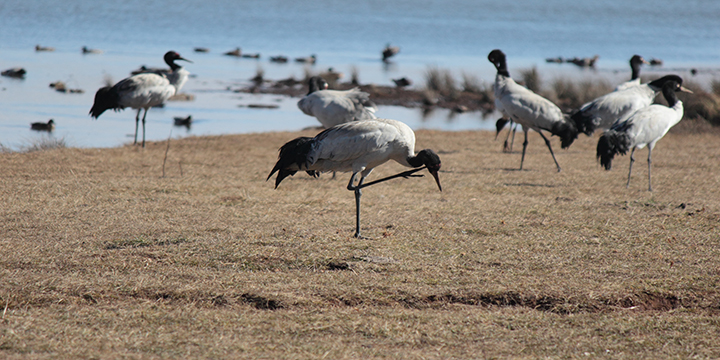
Black-necked cranes using protected wetland habitat at Dashanbao
The black-necked crane, Grus nigricollis, is a large plateau crane with a grey body, black head and upper neck, and a red crown patch visible under suitable conditions. Size, plumage and behaviour change with age and light; do not identify a distant bird from one dark neck alone. Keep the original file and note the observation conditions so a knowledgeable birder can review an uncertain record. Avoid overstating sex or family relationship when those details were not established in the field.
The species breeds and winters in high-altitude wetlands across the Tibetan Plateau and adjoining regions. At Dashanbao, cranes use wetlands and surrounding feeding areas during the cold season, but food descriptions should remain broad rather than repeating the old mistranslated list that included “hydrangeas” and “sand.” Photograph feeding without implying that one frame proves the whole diet. The reserve's purpose is conservation, so habitat protection outranks focal length, rarity or social-media reach.
Late October or November through March can be a practical planning window, with departure commonly occurring as spring advances, but migration is not a timetable. Ask the reserve or a current local operator whether cranes are present, which observation area is open, and whether snow, fog, fire prevention, maintenance or wildlife management affects access. Recheck 48 hours before arrival. A cold clear day can give clean flight backgrounds; overcast can preserve feather detail; snow can create exposure and road hazards. Any of those conditions can be photographically useful.
Plan at least two mornings rather than one guaranteed encounter. Use the first session to learn direction, distance, roost-to-feeding movement and visitor rules; use the second for a specific behaviour or environmental frame. High-elevation cold drains batteries and can affect people quickly. Carry layered wind protection, warm gloves that preserve camera control, water, food, spare batteries inside an insulated pocket and a plan to descend or seek help if headache, dizziness, breathlessness at rest or confusion develops.
Dahaizi is a principal Dashanbao wetland observation area associated with wintering cranes. Use only the currently designated route, hide or platform; an old map or a distant flock does not authorize walking onto grassland or marsh edge. A hide works only when photographers remain quiet, keep openings controlled and follow staff direction. Arrive before the intended movement if the reserve allows, settle equipment once, and avoid repeated entry and exit while birds are nearby. A 400–600 mm equivalent lens can create useful portraits from an authorized position, but longer glass does not justify filling every frame with a bird. Include wetland and flock spacing, keep support inside your footprint, and use a shutter speed appropriate to behaviour. Begin around 1/1000 second for a standing crane if light allows and go faster for flight; treat these as starting points, review sharpness, and raise ISO before compromising animal distance.
Tiaodunhe is part of the wider reserve landscape and has been described as a roosting or feeding area, but reservoir statistics and public access can change. Ask reserve staff whether the area is open to visitors and what activity is present before travelling there. Do not cross a barrier, drive onto a track, approach the waterline or use a boat because an older guide called it a photography spot. Use a wide or short-telephoto frame to explain water, shore and plateau scale, then stop if weather or management activity requires the area to remain quiet.
Nianhu Lake is commonly associated with black-necked crane viewing in Huize County, Qujing, not an observation zone inside Dashanbao. The old page merged the two places and even used an incorrect town name. Keep them as separate assignments with separate transport, reserve rules and captions. A photograph made at Nianhu must never be labelled Dashanbao, and its published morning or afternoon times should not be imported as Dashanbao operating hours. If combining both, allow independent travel days and confirm the current status of each reserve.
From $ 1568
From $ 850
From $ 2583
Editorial accountability
Hu Lei, CEO. The named owner is responsible for travel-planning accuracy and escalation of time-sensitive checks.
Yuntian Travel (Yunnan) Group is identified in its corporate profile as a licensed professional inbound travel service provider based in Kunming, China. Registration and travel-service documents can be requested before booking.
Page-specific references where cited, official destination, transport and entry notices, YUNSKY route-planning records, and direct provider confirmation before a booking is finalized.
Content is reviewed when rules, transport, access, pricing or route conditions change. Final availability and operating details are reconfirmed for each traveler’s dates.
Quality review: Page updated: