Your China & Yunnan Travel Experts


Yandunjiao whooper swan photography guide—reviewed August 28, 2026. Yandunjiao is a coastal village in Rongcheng, at the eastern end of the Shandong Peninsula on the Yellow Sea. Its sheltered bay, winter food resources and long-standing community stewardship attract migratory whooper swans, but the birds, water level, ice and access are never fixed props. Start with the Shandong travel guide, then confirm the current reserve notice, weather, public viewing position and swan distribution before leaving Rongcheng. The old description incorrectly placed the village beside three seas and promised a permanent close encounter; this guide uses observable conditions and protected-area boundaries instead.
The photographic story is larger than a white bird portrait. A complete sequence can show the Yellow Sea bay, fishing-village context, family groups resting or feeding, changing light, wind and the distance maintained by visitors. Use signed platforms, paths or locally authorized public ground; a bird walking toward a quiet photographer is not permission to advance. Do not bait, call, surround, touch or chase swans, and do not fly a drone without every current aviation and reserve authorization. For broader field ethics and species assignments, compare the China bird photography guide.
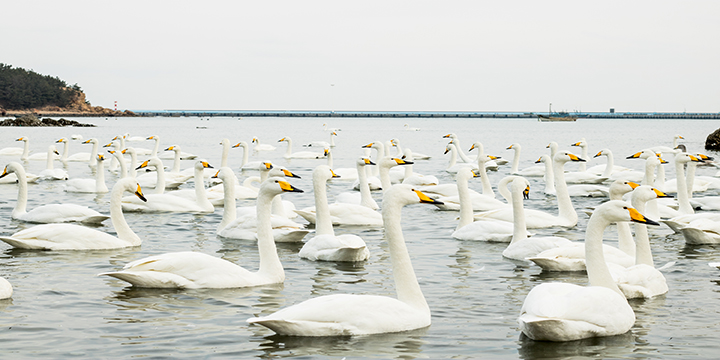
The whooper swan (Cygnus cygnus) is a large migratory waterbird. Adults have white plumage and a yellow-and-black bill in which the yellow normally forms a pointed wedge toward the tip; juveniles are grey-brown with a duller bill. Bill pattern, head shape, voice and body proportions are more reliable together than apparent size in one telephoto frame. Tundra swans can show less yellow on the bill, but distance, angle and mud can mislead, so label a close species identification only when the evidence is visible or a knowledgeable local observer confirms it.
Family groups often travel and feed together. Head-up scanning, relaxed preening and steady feeding suggest a different state from repeated alarm calls, neck stretching, rapid swimming away or interrupted rest. If several birds react to the photographer, the ethical response is to stop, lower the camera and increase distance. A clean frame made without changing behavior has more documentary value than a closer image created by pressure. Keep dogs, food and loud playback away from the shore.
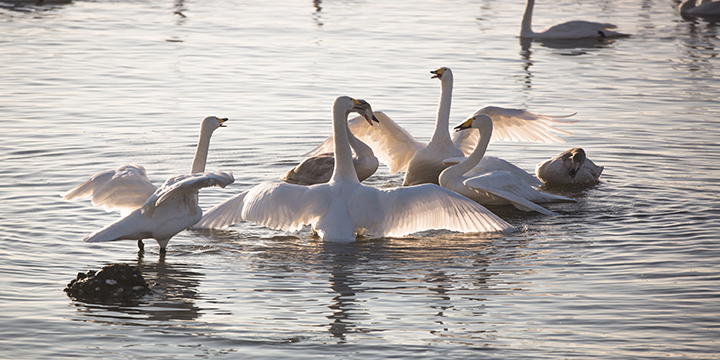
Whooper swans use shallow water, coastal wetlands and nearby feeding areas, taking aquatic vegetation and other available food. Their migration connects northern breeding areas with winter sites in East Asia, but weather and food can change arrival, departure and daily location. Avoid repeating unsupported claims about exact flight height, a guaranteed flock size or one universal route. Record date, time, weather, tide or water state, location and observed behavior with the image; those notes turn a decorative photograph into evidence.
Rongcheng's whooper swan season usually builds from late October or November and runs into March, with northward departure often visible in March and sometimes into early April. That is a planning window, not a promise that one bay will hold the same number every day. Recheck recent local observations within 24–48 hours, then reassess at dawn: strong wind can move birds to shelter, ice can change open-water positions and a warm spell can accelerate migration. Never book a specific close formation or snow scene as a guaranteed deliverable.
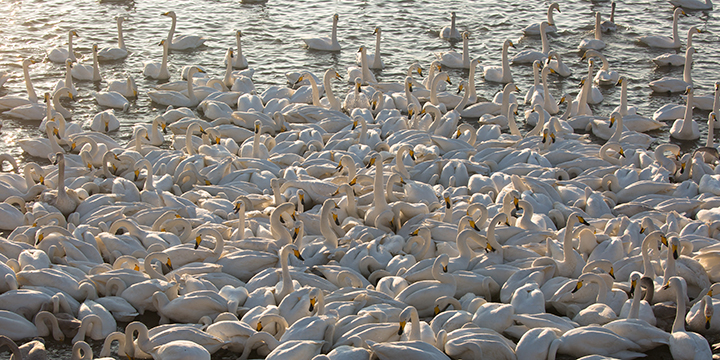
Plan at least two dawn or late-afternoon sessions so one difficult sky, crowd or empty shoreline does not force unsafe decisions. Low winter sun can edge-light breath and feathers; overcast light can reveal subtle white detail; falling snow may add context but also hides slippery edges and reduces autofocus contrast. Midday remains useful for scouting, village context and behavior notes. Set a hard departure time before roads or shore paths ice over, and protect hands well enough to operate controls without losing dexterity.
Yandunjiao Bay and other Rongcheng swan sites are separate assignments even when English names online overlap. Save the Chinese destination, pin the legal entrance and ask where the birds are currently resting before driving. A Yandunjiao image should not be captioned as Rongcheng Swan Lake merely because both are in Rongcheng. Use an establishing frame—shoreline, village, headland or lagoon shape—before tight portraits, and retain that location evidence with the files. Seaweed-roof houses and working courtyards are cultural subjects only from public space or with permission.
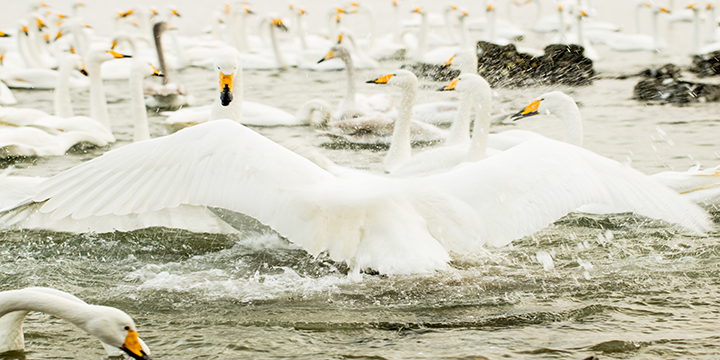
The small Yellow Sea bay can support low, intimate-looking perspectives from authorized shore positions without entering the birds' space. Begin with a normal zoom to show water, settlement and weather, then use a long lens for family interactions, preening or flight. Check wind direction: birds often face into the wind before takeoff, so a position that keeps the sun and likely flight path compatible is more useful than simply standing closest. Stay behind barriers, leave a clear passage for residents and avoid the waterline when ice, waves or reserve staff make it unsafe.
Rongcheng's larger lagoon and reserve-managed viewpoints may offer a broader habitat composition, but current entry, seasonal transport, opening and buffer-zone rules can change. Confirm the exact site rather than relying on the generic English name “Swan Lake.” Use public hides or platforms, follow staff instructions and do not cross a rail when birds are distant. A longer focal length, patient observation and a wider environmental frame are the correct tools for distance; feeding, calling or moving into a restricted buffer is not.
Use equipment that can be carried safely in winter and operated quietly. A practical kit is one body with a stabilized telephoto for behavior, a second body with a normal or wide zoom for habitat, spare batteries kept warm, weather protection and a support that fits inside the public viewing footprint. Clean salt spray only after moving away from the exposed edge. Long lenses magnify heat shimmer, vibration and operator error, so more reach is useful only when technique and air quality support it.
Meter from the actual scene and protect meaningful highlights on the swan's neck and back. In front light or snow, start near the camera meter and inspect the right side of the histogram plus individual color channels; in backlight, expose for the rim and decide whether the body should retain detail or become a deliberate silhouette. Cloud, dark water and bright snow can all fool an automatic meter. Use raw capture and a neutral reference, but do not recover a white bird by inventing texture or replacing the sky.
A responsible winter assignment works best as a four-day Yandunjiao and Rongcheng photography plan with two wildlife sessions, one weather buffer and a separate community or coastal subject. The sequence below is deliberately conditional: reconfirm rail or flight arrival, legal transfers, reserve notices and sunrise before locking each morning. Keep accommodation close enough to avoid fatigue, but do not promise a 35-kilometre transfer will always take 40 minutes.
Day 1 — arrival, daylight scout and first ethical session: Reach Rongcheng with enough daylight to check the road and signed Yandunjiao viewing area. Meet the local driver or guide, confirm the next two days' weather and bird report, then make an orientation series from public ground. Identify ice, tide, wind, toilets, warm shelter and the last safe return time. A short late-light session is optional; travel recovery and a two-copy backup are mandatory.
Day 2 — Yandunjiao dawn and behavior coverage: Arrive at the confirmed public position before useful light without using calls or food. Begin wide, observe the flock's direction and make short telephoto sequences only after behavior settles. Midday is for rest, battery charging, caption notes and a public village walk; request consent before identifiable portraits or courtyard photographs. Return only if light, access and bird behavior justify a second session.
Day 3 — a distinct Rongcheng habitat assignment: Use the latest report to choose a reserve-managed lagoon or another authorized Rongcheng viewpoint rather than repeating the same close portrait. Build a habitat story, compare open water with the village bay and keep transfer time realistic. If snow, wind or a closure changes the plan, switch to safe coastal landscape, seaweed-house exterior details from public space or an indoor cultural subject—never pressure staff to open a buffer.
Day 4 — weather reserve, review and departure: Use the final morning only if it does not jeopardize the confirmed rail or flight connection. Fill a specific gap such as flight, environmental context or an establishing frame, then verify two backups and species/location captions before leaving. Photographers continuing south for a different wetland subject can compare the Wuyuan mandarin duck photography guide, but should schedule it as a separate ecology and access plan rather than reuse the Rongcheng assumptions.
From $ 1568
From $ 850
From $ 2583
Editorial accountability
Hu Lei, CEO. The named owner is responsible for travel-planning accuracy and escalation of time-sensitive checks.
Yuntian Travel (Yunnan) Group is identified in its corporate profile as a licensed professional inbound travel service provider based in Kunming, China. Registration and travel-service documents can be requested before booking.
Page-specific references where cited, official destination, transport and entry notices, YUNSKY route-planning records, and direct provider confirmation before a booking is finalized.
Content is reviewed when rules, transport, access, pricing or route conditions change. Final availability and operating details are reconfirmed for each traveler’s dates.
Quality review: Page updated: