Your China & Yunnan Travel Experts



Dragons on flags do not share one universal meaning. In late Qing China, a blue dragon on yellow represented the imperial state; in Wales, Y Ddraig Goch is a national emblem rooted in legend and later political use; in Bhutan, the white Druk expresses the “Thunder Dragon” identity and constitutional symbolism. The three designs emerged in different centuries and institutions. Comparing their colors, posture, legal status and historical sources is more reliable than assuming that every flag dragon means power in the same way.
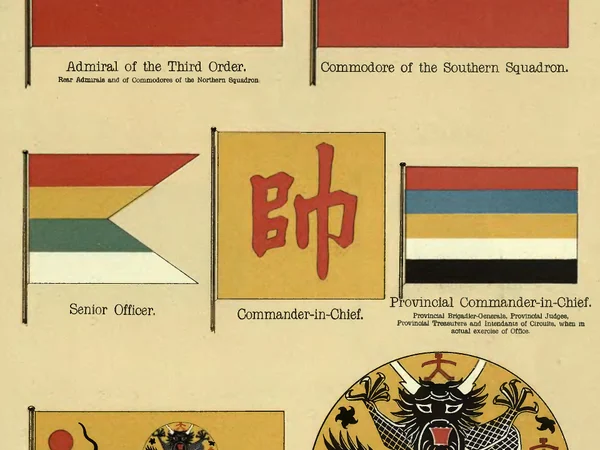
The Qing state adopted yellow flags with a blue dragon during the nineteenth century as it needed recognizable maritime and diplomatic emblems. Designs did not appear in one final form immediately: triangular and rectangular versions, proportions and details varied before late-imperial standardization. Calling it simply “China's first flag” hides that gradual development and the earlier use of banners for military, court and maritime identification.
Its yellow field referred to the Qing imperial house, while the blue dragon and red flaming pearl drew on established court imagery. The design was connected with, but not identical to, the Eight Banners system. Surviving photographs, printed charts and museum textiles should be dated carefully because modern reproductions often regularize details that differed historically.
After the 1911 Revolution and the end of the Qing dynasty, republican governments adopted other national flags. The yellow dragon flag is therefore historical, not a current flag of China. Display it in museums, education or historical reenactment with a clear date and label. For the deeper development of the motif itself, see Chinese dragon history.
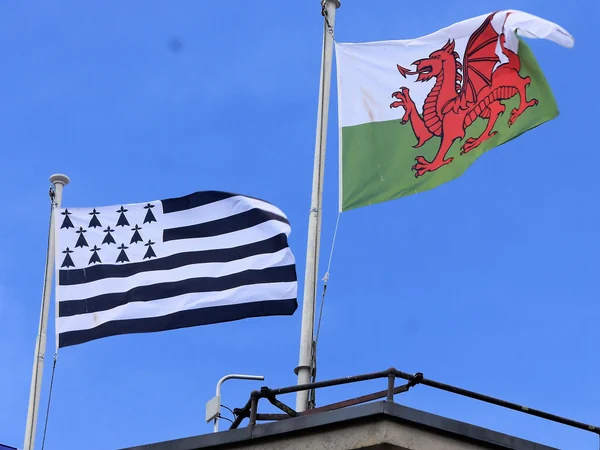
The Welsh flag shows a red dragon, Y Ddraig Goch, on horizontal white and green fields. It received its present official form in 1959, although the red dragon had represented Wales in stories, badges and standards for centuries. Modern status and ancient-looking legend should be kept separate: the current layout is twentieth-century, while the emblem draws authority from a much longer cultural memory.
A famous medieval tradition tells of a red dragon battling a white dragon beneath the ground; the red dragon's victory becomes a sign for the Britons. Later writers connected dragons with rulers and Welsh resistance, and Tudor use strengthened the emblem's public profile. These are layered literary and political traditions rather than a single uninterrupted flag design from antiquity.
Today the flag appears at government, sporting and community events as an affirmative Welsh symbol. The dragon is not an “evil Western monster.” It is a useful reminder that European traditions include protective, dynastic and national dragons as well as hostile creatures. Our Chinese and Western dragon comparison examines that wider range.
When photographing or reproducing the flag, preserve the official red-dragon-on-green-and-white composition and do not substitute a fantasy dragon. Government and heritage sources are better references than commercial clip art.
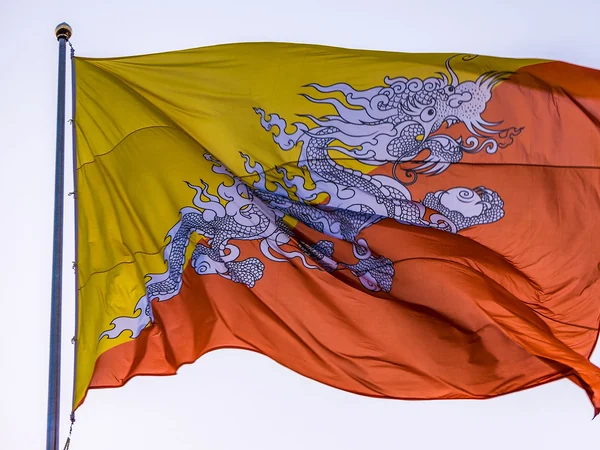
Bhutan's flag is divided diagonally into yellow and orange, with a white dragon across the center. The dragon is Druk, the Thunder Dragon, whose name is embedded in the country's own name, Druk Yul. Bhutan's constitutional description explains the colors and emblem: yellow signifies the civil tradition and temporal authority of the king, orange the Buddhist spiritual tradition, and white the loyalty and unity of the people.
The dragon holds jewels, which official descriptions connect with the country's wealth and security. Its placement across the color division visually joins civil and spiritual traditions. Earlier twentieth-century flag designs differed in color, orientation and detail, so undated reconstructions should not be presented as the current legal flag.
Druk also appears in Bhutanese institutions and national identity, but that does not mean every Bhutanese person “worships dragons.” The flag's symbolism is constitutional and cultural; individual religious practice is more diverse and specific. Similar caution applies when discussing Chinese dragon traditions—see the broader culture and festival guide.
These three flags demonstrate why context matters. The Qing dragon was an imperial-state emblem that is now historical; the Welsh red dragon is a current national flag built on layered legend; Bhutan's current flag encodes Druk within constitutional symbolism. A precise caption should always name the country or dynasty, date and current/historical status.
Editorial accountability
Hu Lei, CEO. The named owner is responsible for travel-planning accuracy and escalation of time-sensitive checks.
Yuntian Travel (Yunnan) Group is identified in its corporate profile as a licensed professional inbound travel service provider based in Kunming, China. Registration and travel-service documents can be requested before booking.
Page-specific references where cited, official destination, transport and entry notices, YUNSKY route-planning records, and direct provider confirmation before a booking is finalized.
Content is reviewed when rules, transport, access, pricing or route conditions change. Final availability and operating details are reconfirmed for each traveler’s dates.
Quality review: Page updated: