Your China & Yunnan Travel Experts


Reviewed August 28, 2026. Pingyao rewards a deliberate photography plan more than a long equipment list. The UNESCO property is not only the walled city: it also includes Shuanglin Temple and Zhenguo Temple outside the walls, while the old town itself remains a living place of streets, shops, courtyards and homes. This guide concentrates on photographable public viewpoints in and near the city, explains what each location can communicate, and separates a realistic walking route from two out-of-town compounds. Start with the Pingyao travel hub for transport and destination context, then check the official scenic-area notice for the date of your visit because wall access, ticketed interiors and closing times can change.
Pingyao has hosted an international photography festival since 2001, but a festival reputation does not guarantee empty streets or unrestricted access. Before choosing a frame, decide whether the story is urban form, merchant history, domestic architecture or present-day life. The strongest Pingyao photography locations are connected by subject and light: the wall gives scale, Rishengchang explains finance, and courtyards reveal how architecture organized work and family life. Photograph residents and shopkeepers only with consent, keep doors and emergency routes clear, and never move objects for a cleaner composition.
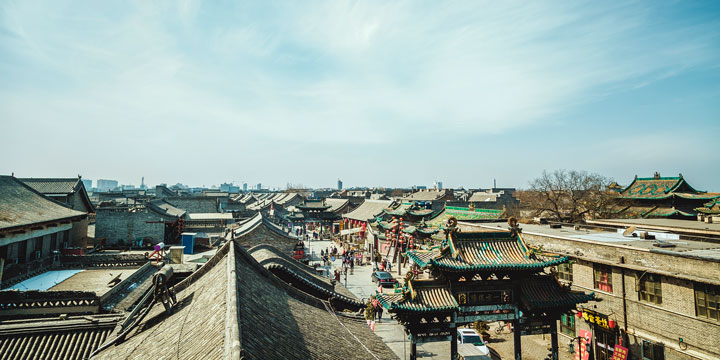
Overview of tiled roofs and the north–south street axis inside Pingyao Ancient City
Pingyao City Wall is the most efficient place to understand the city's orthogonal street pattern. For a wide establishing frame, use a normal or short telephoto lens to layer roofs, gates and distant hills; an ultra-wide lens can make the near parapet dominate and distort towers. Scout in daylight, note the permitted entry and exit points, and leave enough time to descend before the current closing time. The best wall segment depends on open access, crowd direction and sun angle, not a fixed online pin.
Treat sunset as a sequence rather than one exposure: make a neutral-color frame before the sun drops, a silhouette only when the sky carries detail, and a blue-hour frame if the wall remains legally open. Stone and brick surfaces can be uneven, polished or icy; use the strap on steps, keep tripod legs inside your own standing space and do not block narrow passages. Drones are not a substitute for a wall viewpoint. China requires lawful registration and airspace compliance, and a heritage site may impose stricter local rules, so fly only with explicit site and regulatory permission.
Wang Family Compound lies outside Pingyao Ancient City and needs a separate vehicle block; do not present it as a doorway encountered on an old-town walk. Its nested courtyards and elevation changes are better photographed as sequences: first an orientation frame showing gate-to-courtyard relationships, then a medium frame of an arch or screen wall, and finally one detail of brick, stone or wood carving. Use converging lines carefully and keep verticals intentional rather than correcting every historic irregularity into false symmetry.

Wang Family Compound gate and layered courtyard architecture
Qiao Family Compound is another separate excursion, in the direction of Taiyuan rather than Wang's Lingshi location. Choose between the two compounds according to route, available time and the architectural story you want; forcing both into one rushed day usually produces repetitive courtyard images. At Qiao, arrive near opening when permitted, wait for natural gaps instead of asking strangers to leave, and use doorways as frames without stepping into roped or private areas.

Red lanterns and brick courtyards inside Qiao Family Compound
Rishengchang Draft Bank helps explain why UNESCO highlights Pingyao's role as a financial centre in the nineteenth and early twentieth centuries. Build a short visual essay: facade and street context, the progression of counters and courtyards, then one permitted object or interpretive panel. Interiors can be dim and crowded, so use a fast lens or higher ISO before considering a tripod or flash; comply with the museum's current photography rules and never photograph documents or displays marked as restricted.
Begin at a currently open city-wall gate for orientation, descend before the lanes become busiest, then work toward Rishengchang and the main commercial axis. Reserve late afternoon for side streets where oblique light reveals brick texture, but distinguish public lanes from residential thresholds. The Pingyao attractions guide can help identify nearby stops; choose two or three, not every ticketed building. Keep a rain cover, spare battery, lens cloth and a second memory card in a small bag, and back up files before the next day.

Plan a focused Pingyao photography visit
From $ 1568
From $ 850
From $ 2583
Editorial accountability
Hu Lei, CEO. The named owner is responsible for travel-planning accuracy and escalation of time-sensitive checks.
Yuntian Travel (Yunnan) Group is identified in its corporate profile as a licensed professional inbound travel service provider based in Kunming, China. Registration and travel-service documents can be requested before booking.
Page-specific references where cited, official destination, transport and entry notices, YUNSKY route-planning records, and direct provider confirmation before a booking is finalized.
Content is reviewed when rules, transport, access, pricing or route conditions change. Final availability and operating details are reconfirmed for each traveler’s dates.
Quality review: Page updated: