Your China & Yunnan Travel Experts


In Jiashan County near the Shanghai–Jiangsu–Zhejiang border, Xitang Ancient Town is a living canal settlement whose roofed corridors, lanes, bridges, homes and working storefronts create several distinct photography assignments. This Xitang photography guide was reviewed August 28, 2026. Use the Zhejiang destination map to place the town within a coherent route, then verify the current ticket boundary, opening hours, night program, pedestrian controls and transport for the exact date. The town is on China's UNESCO World Heritage Tentative List as part of the Ancient Waterfront Towns south of the Yangtze River; it is not an inscribed World Heritage property.
The settlement developed over many centuries at the junction of waterways and regional trade routes, with substantial Ming- and Qing-period urban fabric recorded in the UNESCO tentative-list dossier. Heritage value is not a license to treat every building as an untouched ancient set: Xitang remains inhabited and commercially active. Read plaques and current local interpretation before assigning a date or function, distinguish restoration from original material, and keep residents, shop workers and boat operators in captions as people with agency. It combines naturally with Hangzhou, but each destination needs its own light, access and story plan.
The most useful Xitang Ancient Town photography strategy is to plan by water level, light direction, pedestrian flow and subject permission rather than mechanically copy a “top viewpoint” list. The roofed waterside corridors are measured in the scale of a long connected town feature, not the nearly 1,000 kilometres claimed in the old text. Rain may give reflections and shelter, but it also creates slick stone; festivals and evening programs may add activity, but also crowds. Build a morning, daytime-detail and blue-hour sequence with a rain and crowd fallback. Spring humidity can soften distant rooflines, summer requires heat and storm breaks, autumn may give clearer low light, and winter can simplify color while shortening useful daylight; none guarantees mist or an empty canal. Check the local forecast rather than choosing by a stock seasonal image. Stone bridges, steps and narrow lanes can be difficult for travelers with limited mobility or heavy equipment, so ask about the least-stepped route, a realistic rest point and whether a support can be used without obstruction. Respect current controls on electric bicycles and delivery traffic inside the protected core, and never ask a resident to move a vehicle for a cleaner composition.
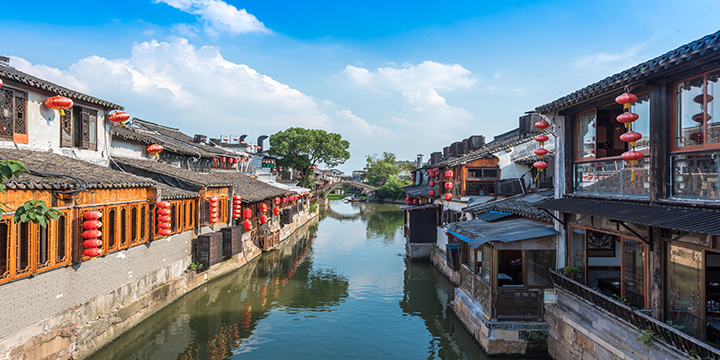
Xitang canal, roofed corridor and residential waterfront context
Start with three frames before concentrating on details: a waterway orientation showing bridge and roofline, a mid-range frame connecting people with the corridor, and a close study of material or daily activity. Then decide whether the assignment is architecture, canal life, resident-approved portraiture, night atmosphere or documentary change. The China ancient towns photography guide helps compare Xitang with other water towns without recycling the same caption or image. Black-awning boats, shops and mist are possible subjects, not guaranteed daily conditions.
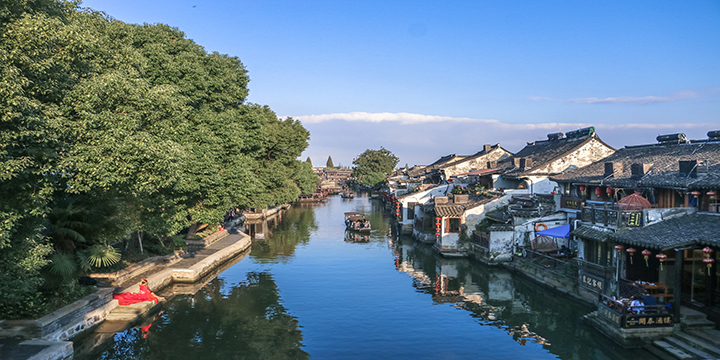
Xitang waterfront and bridge view in its living-town setting
Xitang's long covered passages shelter pedestrians and link homes, shops and the waterfront. Photograph them as circulation spaces, not empty stage scenery. Early oblique light can reveal columns, benches and repeated roof lines; soft rain can add reflections; midday can work for layered activity beneath the shade. Keep a tripod tight to the edge only where permitted, leave a clear route for residents, wheelchairs, deliveries and emergency access, and never move a stool, sign or household item for symmetry. If the corridor is congested, use a handheld normal lens, a higher ISO and a shorter session instead of claiming the walkway.
Shipi Lane is known as a narrow stone-paved passage between traditional residences. Exact slab counts and measurements circulate online, but the photographic decision is simpler: a very wide lens exaggerates width, while a normal lens better records proportion and compression. Photograph from public circulation space, avoid bracing equipment against private walls or thresholds and do not block the lane for an empty frame. Side light or wet stone can reveal texture; include one consenting person for scale only when passage remains open. Never enter a doorway or aim into a home because the lane feels public.
Yongning Bridge is a useful elevated position for linking canal, roofed corridor, tiled roofs and crossing traffic, but it is not a private panorama platform. First observe which side carries the cleaner light and how pedestrians move, then make one wide establishing frame and a few tighter layers. Keep tripod legs out of the walking line, yield immediately and do not stand on parapets. Morning can bring quieter movement and softer contrast; blue hour can balance illuminated storefronts with the remaining sky. Mist and lantern reflections depend on weather and operations and must not be promised.
At dawn, expose for pale sky and water while retaining shadow texture under the eaves; a graduated filter is less useful when roofs and bridges break the horizon, so bracket a static scene carefully if dynamic range exceeds one frame. During the day, use side light for brick, timber and stone, or open shade for color-accurate details. In rain, protect the camera, watch slippery steps and use reflections only from a place that leaves the path clear. Record the direction, weather and time so later captions explain why the same corridor looks different.
Scout the composition in daylight, confirm when the public area closes and return before blue hour rather than setting up after dark. Use manual exposure, a low starting ISO and a stable support only where tripods are allowed; make a separate faster frame if boats or people must remain sharp. Protect illuminated signs and lanterns from clipping, keep white balance believable and watch for mixed LED color. Do not clone a crowded bridge into an empty one or intensify reflections beyond the observed scene. When the sky becomes fully black and highlights dominate, the strongest architectural window may already have passed.
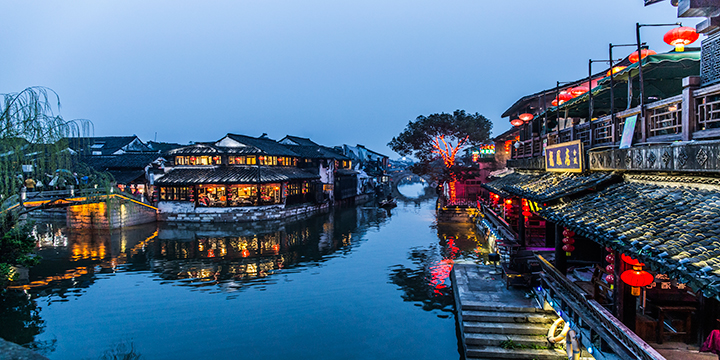
Blue-hour reflections along Xitang's inhabited canal waterfront
A panorama is useful when one legal viewpoint cannot contain both corridor and canal, but more frames do not automatically create a better result. Level the tripod or shoot a controlled handheld sequence, lock exposure, focus and white balance, overlap each frame by roughly one-third and rotate around the lens as consistently as practical. Make two passes in case boats or pedestrians cross a seam, then inspect railings and roof lines for parallax. Never gain height by climbing a bridge, wall, roof or private staircase. A well-corrected two- or three-frame panorama is more credible than an impossible composite from several positions.
Use the existing tailor-made China trip planning service to match Xitang with realistic rail, road and hotel logistics, while keeping all current tickets, opening hours and local controls subject to final confirmation. Jiashan South is a common high-speed rail gateway, but the onward vehicle, pickup point, luggage handling and late return need to be arranged rather than assumed. One overnight stay usually gives a better dawn and blue-hour sequence than a rushed midday stop.
A strong two-session plan begins with an afternoon scout of bridge direction, corridor traffic and legal tripod space, continues through blue hour, and resumes before the busiest morning period for canal and daily-life context. Choose one weather backup such as covered architectural details, a museum or an approved craft encounter. Contact us with travel dates, walking needs, camera-support requirements and the type of story you want to make. We will confirm what is currently accessible; no itinerary should guarantee mist, an empty bridge, a specific boat position or unrestricted resident photography.
From $ 1568
From $ 850
From $ 2583
Editorial accountability
Hu Lei, CEO. The named owner is responsible for travel-planning accuracy and escalation of time-sensitive checks.
Yuntian Travel (Yunnan) Group is identified in its corporate profile as a licensed professional inbound travel service provider based in Kunming, China. Registration and travel-service documents can be requested before booking.
Page-specific references where cited, official destination, transport and entry notices, YUNSKY route-planning records, and direct provider confirmation before a booking is finalized.
Content is reviewed when rules, transport, access, pricing or route conditions change. Final availability and operating details are reconfirmed for each traveler’s dates.
Quality review: Page updated: