Your China & Yunnan Travel Experts


Zhouzhuang is a compact canal town in Kunshan, Suzhou, where lanes, bridges, waterside homes and working boat routes occupy the same narrow public space. Reviewed August 28, 2026, this guide treats it as a living town rather than a decorative set. The current official ticket page lists a broad scenic-area operating window but says individual buildings can change hours, so check the day notice before planning interiors. Use the Suzhou travel hub to decide whether Zhouzhuang should be a day trip or an overnight stop.
The useful photographic question is not ‘which bridge is famous?' but ‘what relationship am I showing?' A bridge can connect street and water, frame a boat, reveal reflections or show how residents move. Work with one wide environmental image, one human-scale scene and one architectural detail at each theme. Early morning reduces tour-group pressure; evening adds artificial light but also higher contrast, wet surfaces and tripod conflicts. Ask permission before making an identifiable portrait, and do not lean equipment against historic fabric.
This field guide covers bridge sightlines, Shen and Zhang mansions, rain and night exposure, a two-day route, crowd etiquette and weather alternatives. For current ticket inclusions and nearby heritage stops, consult the Suzhou attractions guide as well as the Zhouzhuang official notice.
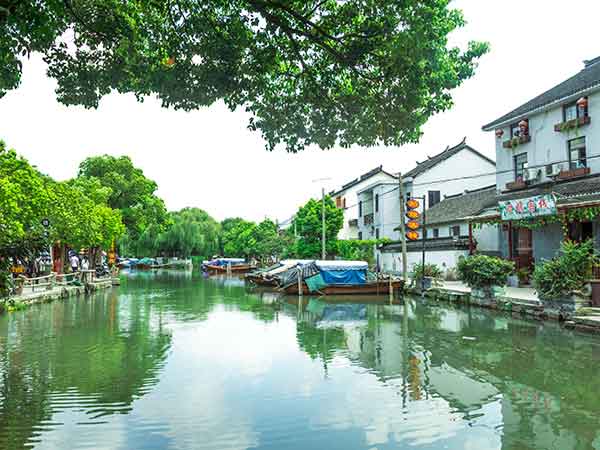
Water, stone, whitewashed walls and dark roofs create a restrained palette. Look for a boat or pedestrian only when the subject clarifies scale and movement; a random person in the centre is not automatically ‘local life.' Use a polarizer cautiously because removing every reflection can erase the very relationship that makes a water-town frame legible. From a bridge, keep both feet and the tripod within the safe walkway and yield immediately to residents and staff.
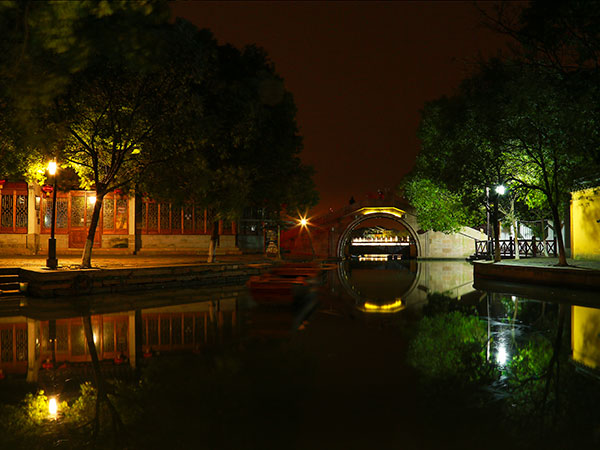
Fu'an Bridge combines a stone bridge with bridge-side buildings, so an effective frame needs breathing room around both structures. Scout from each bank and record which direction receives side light; the west-side view often links water, houses and another crossing, but boats, temporary works and crowd control can alter the cleanest angle. A 35–70 mm equivalent helps compress layers without including excessive blank sky. Do not repeat folklore about crossing the bridge as a factual guarantee; use interpretation panels for verified history.
The Double Bridge refers to Shide and Yongan bridges arranged at right angles. Before raising the camera, identify both openings; otherwise the picture becomes a generic single arch. A slightly elevated viewpoint can clarify the key-like geometry, while a lower bank view emphasizes reflection. Avoid stepping into doorways or boarding points to centre the composition.
Chen Yifei's painting helped make the Double Bridge internationally recognizable. That art-historical association is useful context, not a reason to reproduce the same composition. Change season, focal length or human scale while preserving the bridge relationship, and caption the work accurately rather than calling every nearby crossing ‘Double Bridge.'
Architectural photography: from public facade to lived interior
3. Shen House: merchant scale and circulation
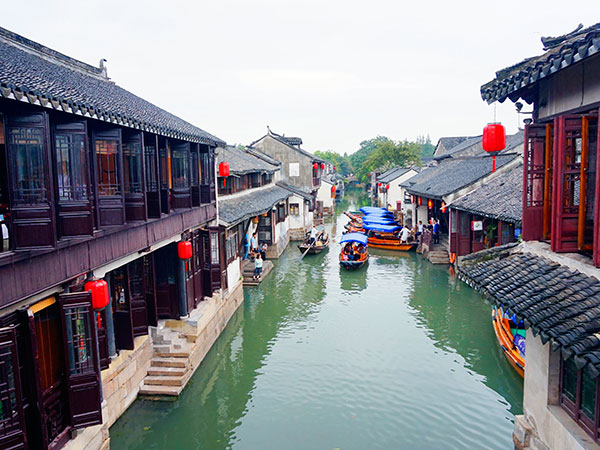
Shen House is best approached as a sequence of functions and thresholds. Begin with the entrance in street context, then show how halls, courtyards and service spaces progress inward. Indoors, stabilize your stance, raise ISO and use quiet shutter where permitted; flash can disturb visitors and flatten carving. Confirm the day's final entry time instead of assuming the scenic-area closing time applies to the mansion. 4. Zhang House: water access, hall and rear garden
Zhang House communicates most clearly when the frame connects stone columns, timber structure and the waterway passing the residence. Look for a view that explains circulation rather than collecting disconnected carvings. Keep bags and tripod feet away from thresholds, do not touch painted or wooden surfaces, and follow any room-specific photography restriction. Field settings and responsible technique
Time of day changes access, light and the story
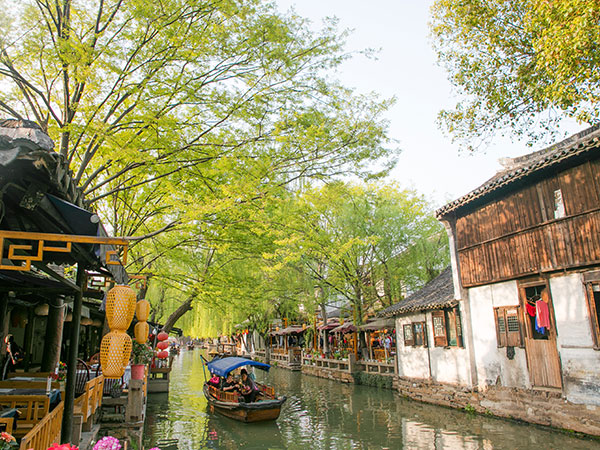
Stay overnight only if dawn and blue-hour images justify the extra logistics. Confirm whether your accommodation lies inside the controlled area, how repeat entry works for your ticket, and where luggage can be handled without blocking stone lanes.
Season and weather: plan a fallback, not a promise
When the weather closes outdoor options, move to an open mansion, museum or covered waterside subject and make a detail series. Check the official notice after typhoons, heavy rain or maintenance; do not enter a closed waterfront for a dramatic image.
Build a Zhouzhuang photography itinerary

Use the official notice and the Zhouzhuang attraction guide to define a realistic route. If access, a private guide or commercial permission remains unclear, contact the planning team with the exact date, hotel location, tripod size and intended use of the images. Ask for ticket validity, individual-building hours, boat rules and weather cancellation in writing rather than accepting a generic ‘everything is open' answer.
A credible brief should also state mobility limits: stone bridges and narrow thresholds make step-free access inconsistent, and a wheelchair or pushchair route needs current advice from the scenic area. List the images you need—bridge geometry, resident-approved street life, interiors, rain or blue hour—so the visit becomes a safe, coherent visual assignment instead of a repeated postcard loop.
From $ 1568
From $ 850
From $ 2583
Editorial accountability
Hu Lei, CEO. The named owner is responsible for travel-planning accuracy and escalation of time-sensitive checks.
Yuntian Travel (Yunnan) Group is identified in its corporate profile as a licensed professional inbound travel service provider based in Kunming, China. Registration and travel-service documents can be requested before booking.
Page-specific references where cited, official destination, transport and entry notices, YUNSKY route-planning records, and direct provider confirmation before a booking is finalized.
Content is reviewed when rules, transport, access, pricing or route conditions change. Final availability and operating details are reconfirmed for each traveler’s dates.
Quality review: Page updated: