Your China & Yunnan Travel Experts


Fujian Tulou photography guide , reviewed August 28, 2026. ‘Fujian Tulou' names a broad regional building tradition, while the UNESCO property is a specific serial site of 46 buildings in six clusters and four individual houses across Yongding, Nanjing and Hua'an. They were built and adapted over centuries as large communal residences, and many remain homes rather than empty monuments. This guide separates the World Heritage components from the many non-inscribed tulou and treats architecture, residents, farmland and access as one photographic context.
Choose a cluster before choosing a lens. Yongding supports a deeper study of different layouts; Nanjing is often more practical from Xiamen and provides the famous Tianluokeng overview; Hua'an offers another architectural lineage and should not be labelled ‘more authentic' merely because fewer tours visit. The Fujian travel guide provides provincial context. Confirm tickets, internal shuttles, open buildings, last entry and any commercial-shoot rule with the relevant scenic area for your date.
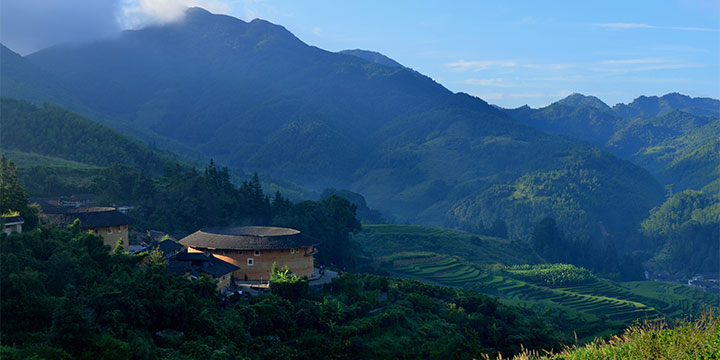
Round and square Fujian Tulou set among mountain farms and villages
The inscribed components are Yongding's Chuxi, Hongkeng and Gaobei clusters plus Yanxiang and Zhenfu buildings; Nanjing's Tianluokeng and Hekeng clusters plus Hegui and Huaiyuan buildings; and Hua'an's Dadi cluster. This list matters: an attractive earthen building elsewhere is not automatically a UNESCO component. For a first visit, choose one geographical area per day. Mountain roads, shuttles, village walking and interior queues make a same-day sweep of all three counties unrealistic. Choose Nanjing for an efficient iconic overview, Yongding for architectural comparison, or Hua'an for a focused Dadi study; none is a universal ‘best.'
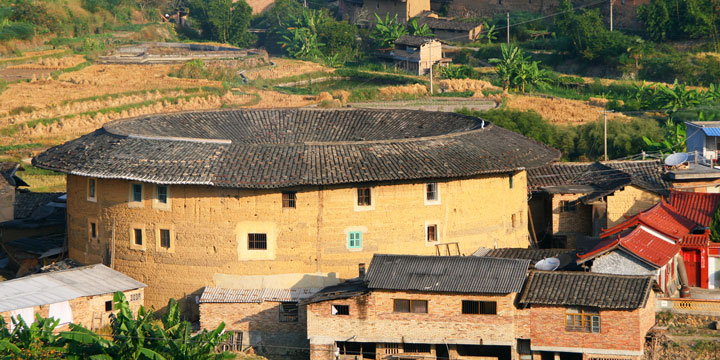
Fujian Tulou courtyard with timber galleries and an open central space
Yongding Tulou is useful when the assignment needs several building types rather than one iconic overview. Hongkeng shows different residential forms, Gaobei centres attention on Chengqi Lou, and Chuxi links varied buildings to a mountain village. Nanxi contains additional tulou scenery, but not every building marketed within a scenic route is one of the 46 UNESCO components. Build captions from on-site names and interpretation instead of copying nicknames as formal titles.
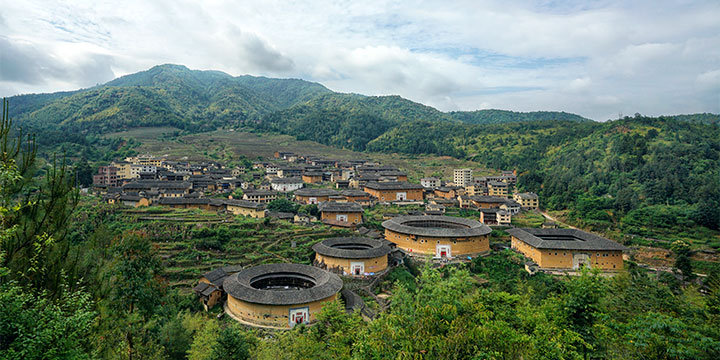
Inside a multi-storey Fujian Tulou communal courtyard
At Hongkeng, make a three-image sequence: an exterior in village context, an interior showing the relationship between central space and galleries, and a detail that explains timber, rammed earth or drainage. Zhencheng, Kuiju and Fuyu differ in layout, but promotional names such as ‘Tulou Prince' or ‘Potala Palace of Tulou' are labels, not architectural evidence. Keep verticals intentional, avoid blocking doors and ask before photographing within a family's threshold.
Chengqi Lou's concentric plan is easier to understand with a wide environmental frame followed by a tighter photograph of circulation. Do not repeat historical population numbers as current occupancy. Interior galleries, stairs and upper levels may be restricted, private or changed from older accounts; follow barriers and current staff instructions. A high ISO and stabilized stance are safer than opening a tripod across a narrow passage.
Chuxi rewards a slower landscape approach because the cluster, slopes, streams and agriculture explain why the buildings sit where they do. Begin from an authorized overview, then descend for human-scale frames. Rain can improve colour but makes stone and timber slippery. Keep working lanes clear, buy or photograph local products only with permission, and do not use residents as scale figures without consent.
Nanxi can show circular, square and other plans distributed through a valley. It should be captioned carefully: some buildings may be protected at another level or promoted as part of a tourism route without being a named UNESCO component. Ask the guide to identify the exact building in each frame. Long-lens compression can show the relationship among roofs, fields and road without implying that all visible structures share one date or status.
Nanjing is often selected from Xiamen, but the published driving distance is not a travel-time promise. Tianluokeng suits a high overview plus a village-level study; Hekeng supports a quieter cluster narrative; Hegui and Huaiyuan are separate individual World Heritage components. Yuchang Lou is commonly combined with Tianluokeng but is not part of Hekeng and should not be confused with Xiaochun Lou. Film-location claims, military-base anecdotes and building nicknames need primary evidence before publication.
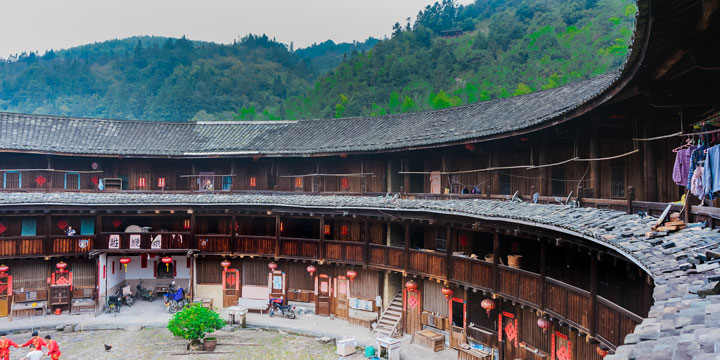
Tianluokeng Tulou cluster seen from the authorized hillside viewpoint
The five-building composition—one square, one oval and three round buildings—is most legible from the official upper viewpoint. Use a normal or short telephoto lens to control empty sky and preserve the surrounding terraces. Then photograph at ground level to show doors, materials and everyday scale. Night lighting and viewpoint hours can change; verify rather than promising that it is the only illuminated cluster or that a tripod will be accepted.
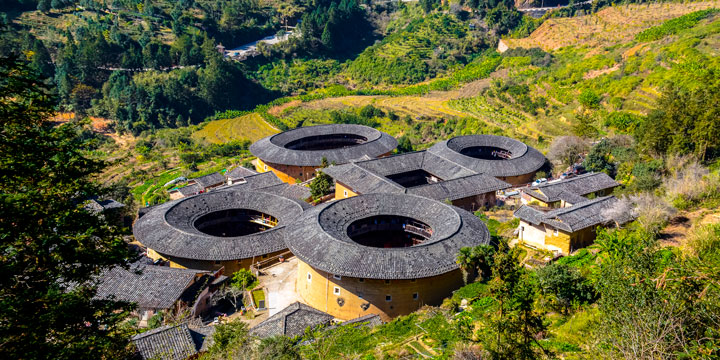
Five earthen buildings in the Tianluokeng cluster among green terraces
Hekeng is valuable for studying how multiple earthen buildings relate to settlement and terrain. A broad frame should retain paths and fields instead of cropping every building into an isolated shape. Do not misidentify Yuchang Lou as part of this cluster or present a commercial film set as heritage proof. Use signed names, record voice notes on site and check the frame list before leaving.
A drone is not the default or automatically the best method. China requires registration and compliance with current airspace and operating rules, while heritage authorities, scenic areas, villages and residents may impose tighter limits. Verify UOM airspace, obtain explicit site permission, avoid people and homes, and keep the aircraft grounded if any condition is unclear. An authorized hillside platform, elevated road or longer lens can often explain the plan with less disturbance.
More than 2,000 people still live in the 46 inscribed buildings according to a 2025 Fujian government response. Treat laundry, kitchens, worship, family rooms and portraits as private life, not free cultural material. Ask before entering or making an identifiable photograph, accept refusal without negotiation, avoid photographing children alone, and agree on intended commercial use. A purchased ticket is access to designated visitor areas, not blanket model consent.
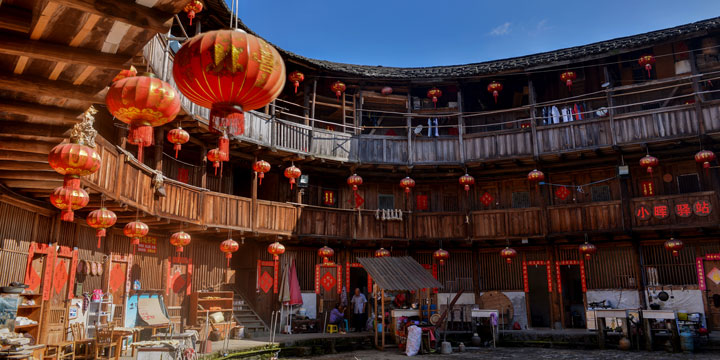
Resident-approved daily activity inside a living Fujian Tulou
A 16–35 mm equivalent can fit an interior courtyard, but the widest setting can stretch people and bend the circular rim. Keep the camera level, step back where permitted and make one normal-lens frame for truthful scale. In dark interiors, raise ISO before using flash; flash, lighting stands and tripods may be restricted and can interrupt narrow circulation.
Symmetry works when it clarifies load-bearing earth walls, timber galleries and communal organization. It becomes empty decoration when every building is forced into the same centred frame. Pair one symmetrical image with a detail of rammed-earth layers, drainage, fire equipment or repaired timber, but never touch, climb or reposition historic material. Fujian's protection rules require fire safety and original-form conservation, which makes clear passages and local instructions part of the photographic method.
For one day, select one Nanjing or Yongding cluster, one individual building if access permits, and one landscape session. For two days, add a second cluster with a genuinely different plan rather than racing between counties. Day 1 should establish exterior, approach, courtyard and one construction detail; Day 2 should test a contrasting plan and include resident-approved daily-life context. Check rainfall, shuttle operations, stairs, food, toilets and return transport; step-free access is inconsistent and needs current confirmation. Carry names in Chinese, save tickets and location notes offline, and back up files before changing county. Build a written brief : connect this study with the China architecture tour and specify the exact clusters, required interiors, tripod and drone equipment, mobility needs and intended image use. Request current access and commercial permissions in writing. Add a shot list—landscape, exterior structure, courtyard circulation, material detail and consented human scale—plus one weather fallback. A credible portfolio identifies the building, cluster and heritage status precisely and shows that these are protected living communities, not interchangeable circular backdrops. Before delivery, cross-check every caption against the field notes rather than relying on visual similarity.
From $ 1568
From $ 850
From $ 2583
Editorial accountability
Hu Lei, CEO. The named owner is responsible for travel-planning accuracy and escalation of time-sensitive checks.
Yuntian Travel (Yunnan) Group is identified in its corporate profile as a licensed professional inbound travel service provider based in Kunming, China. Registration and travel-service documents can be requested before booking.
Page-specific references where cited, official destination, transport and entry notices, YUNSKY route-planning records, and direct provider confirmation before a booking is finalized.
Content is reviewed when rules, transport, access, pricing or route conditions change. Final availability and operating details are reconfirmed for each traveler’s dates.
Quality review: Page updated: