Your China & Yunnan Travel Experts


Xijiang Qianhu Miao Village photography guide—reviewed August 28, 2026. Xijiang in Leishan County, Guizhou, is a living Miao community and a heavily visited scenic destination, not an open-air studio. The strongest photographs connect the valley settlement, timber houses, ridgelines, river, public performance spaces and present-day livelihoods without pretending that every scene is untouched or ceremonial. Start with the Guizhou travel guide, then confirm the current gate, shuttle, performance, viewpoint and tripod rules for the actual date. Avoid inherited household counts and permanent “largest village” claims unless a current official source supports the exact wording. Xijiang Miao Village photography should document place, light and consent rather than simply collect costumes and illuminated roofs. This guide preserves the original architecture, festival, viewpoint and night subjects while adding route logic, exposure decisions, cultural accuracy, mobility, fire safety and a practical two-night workflow.
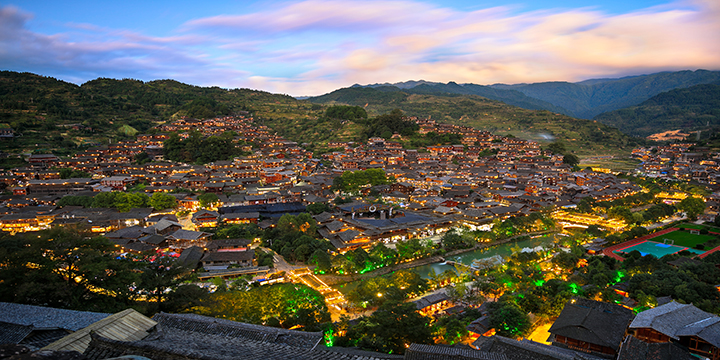
Xijiang Miao Village across the valley at dusk
From a signed public overlook, begin with one orientation frame that shows how the village follows the valley and slopes. Make a second frame at street level to explain scale, water and pedestrian movement. The night lighting is visually strong, but it is an operated visitor environment rather than evidence that every household follows one traditional lighting practice. Record the viewpoint, direction, date and whether the frame was made before or after the main evening visitor peak. Visitor flow can be concentrated around shuttles, performance times and sunset, so select a backup lane or lower public view before committing to one crowded platform. Never stand on a wall, roof or landscaped edge to see over another camera.
Many buildings use timber post-and-beam construction adapted to steep, humid terrain. Do not repeat the old three-floor formula as a rule for every house: floor use, age, renovation and commercial conversion vary. Identify a specific building only from current interpretation or a knowledgeable resident. Public admission does not authorize entry into a home, balcony or working courtyard; ask before crossing a threshold and do not lean equipment against timber walls.
Use a normal or short telephoto lens to keep verticals natural and separate repeating roof layers. An extreme wide lens can exaggerate the valley and make nearby facades lean; a very long lens can falsely compress distinct neighbourhoods into one wall of roofs. Make a neutral reference frame before increasing contrast, and retain modern fire lanes, signs, cables and safety systems when they are part of the scene.
Timber villages require strict fire discipline. Obey smoking, open-flame and restricted-access signs; keep batteries protected, do not charge equipment from an improvised socket, and never place a hot light against wood or fabric. A tripod must leave a passing lane. In rain, stone steps and timber decks become slippery, so trade the “best angle” for a stable public position and a safe exit.
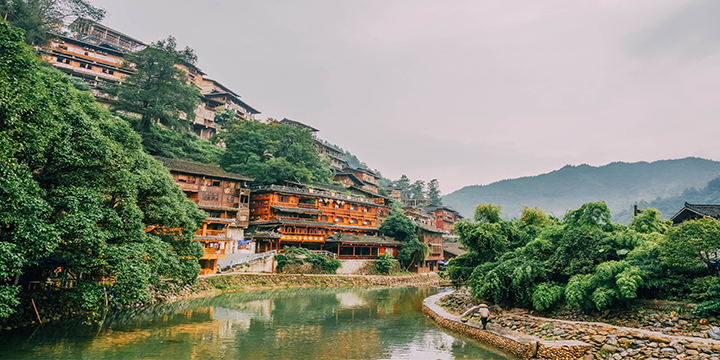
Timber houses and riverfront landscape in Xijiang
Festivals and public performances can add cultural context, but a calendar entry does not guarantee unrestricted photography. Confirm the event name, lunar or solar date, venue, ticket and camera policy from a current organizer. Distinguish a community observance from a scheduled visitor show in the caption. Do not call every silver headdress “festival dress,” and do not infer a person's identity, marital status or village from clothing alone.
For an identifiable portrait, ask before raising the camera, explain whether the image is personal, editorial or commercial, and accept refusal without negotiation. Children require guardian consent. Do not direct a ceremony, interrupt singing, touch jewellery or pay one person to recreate an event without labeling it as a posed portrait. If consent cannot be established, photograph public movement anonymously from a respectful distance or focus on hands, tools and architectural context.
Use mountain contours, river, bridges, trees, lanes and weather to explain why the settlement looks as it does. A foreground should come from a legal public position, not from moving a basket, opening a gate or stepping into a planted slope. In mist, expose for important pale sky and keep enough shadow detail to distinguish timber layers. In rain, use a hood and cloth rather than sheltering in a doorway that residents need. Make horizontal and vertical versions, then check that roof edges remain sharp and that mist has not condensed on the front element. A small umbrella can become a collision hazard on stairs; a fitted rain cover is safer in moving crowds.
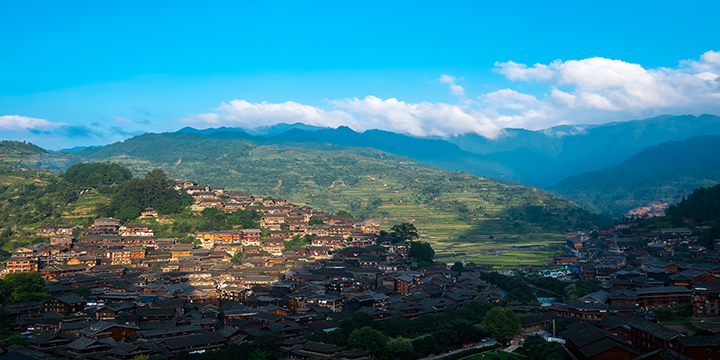
Village, mountain and sky layers in Xijiang
A high public viewpoint shows settlement pattern; a mid-level lane connects roofs with daily movement; a low river or bridge position reveals reflected light and street scale. These angles tell different stories, so do not rush between them during the same ten minutes of light. Scout in daylight, save the signed route offline and set a turnaround time. For limited stair tolerance, ask for the exact shuttle drop, remaining step count, handrails, platform seating and toilet access; “panoramic view” does not mean step-free. Drones require national compliance plus explicit scenic-area and privacy permission; dense timber buildings and crowds make ground photography the responsible default.
Soft overcast light preserves carved detail and reduces harsh facial contrast. Low side light reveals roof and wall texture, while backlight can separate smoke, rain or costume edges only when the activity is safe and consented. Meter the brightest meaningful highlight, check individual colour channels and avoid pushing orange lamps or saturated clothing until texture disappears. Flash may be disruptive or prohibited during performances; verify first.
For portraits, position the subject only after consent and let the person choose a comfortable public place. Open shade often produces more faithful skin and textile colour than direct midday sun. Keep one wider frame showing location and one closer frame with agreed context. Do not use aggressive skin smoothing, change clothing colours, remove cultural objects or manufacture a “timeless tribe” in post-production.
Scout the overlook and exit before dusk. Start when ambient blue still separates the ridge from the roofs, then bracket only static scenes if necessary; people, smoke and flags can create false HDR edges. A small stable support is useful only where permitted and where it does not block circulation. Protect lamp highlights, set white balance from a neutral reference, and stop when haze or darkness removes geographic context rather than producing dozens of interchangeable light patterns. Begin at base ISO when support and rules allow, but raise ISO rather than risking camera shake or blocking a platform with a large tripod. Review the red channel because warm lamps can clip before the overall histogram appears problematic.
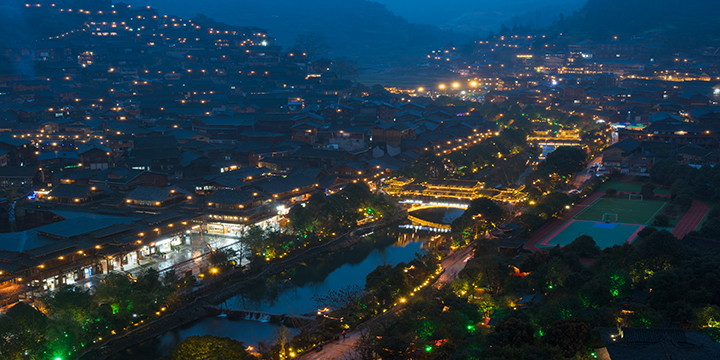
Xijiang village lights after dusk from a public overlook
Night one should be reconnaissance: arrive in daylight, confirm the map and rules, walk one public lane and make a safe blue-hour overview. On the full day, photograph early settlement context, rest and back up files at midday, then choose either one consented craft or performance subject and one late landscape. Reserve the final morning for weather, market or architectural details. Carry a normal zoom, short telephoto, lens cloth, fitted rain cover, headlamp, spare battery and two cards. Store portrait consent notes separately from public landscape files, and make two backups each night. A wider Guizhou minority journey should allow time to distinguish Xijiang from other communities rather than applying one generic caption to every village. plan a responsible Xijiang visit by sharing dates, walking ability, equipment, intended image use and any portrait request with the planner. Compare this page with the Zhaoxing Dong Village photography guide, but keep Miao and Dong architecture, language, performance and dress clearly separated. Verify current transport, ticket, shuttle, event and commercial-use rules before paying non-refundable costs.
From $ 1568
From $ 850
From $ 2583
Editorial accountability
Hu Lei, CEO. The named owner is responsible for travel-planning accuracy and escalation of time-sensitive checks.
Yuntian Travel (Yunnan) Group is identified in its corporate profile as a licensed professional inbound travel service provider based in Kunming, China. Registration and travel-service documents can be requested before booking.
Page-specific references where cited, official destination, transport and entry notices, YUNSKY route-planning records, and direct provider confirmation before a booking is finalized.
Content is reviewed when rules, transport, access, pricing or route conditions change. Final availability and operating details are reconfirmed for each traveler’s dates.
Quality review: Page updated: