Your China & Yunnan Travel Experts


Reviewed August 28, 2026. Jinshanling is a steep, exposed Great Wall section in Luanping County, Hebei, not a guaranteed sunrise platform with a fixed Beijing shuttle. The scenic area extends across ridges with restored and less-restored surfaces, dense watchtowers and major elevation change. A successful photography plan starts with current gate, cableway, weather and access notices, then matches one sunrise or sunset objective to a route you can walk safely in darkness. The Jinshanling attraction guide provides destination context; the official scenic-area notice remains the source for same-day operations.
The Great Wall is a UNESCO World Heritage property and a protected cultural landscape. Strong images show how defensive architecture follows terrain without climbing on parapets, moving stones or entering closed towers. This guide explains the main tower areas as orientation points rather than GPS promises, then covers light, cloud, composition, transport, overnight decisions, drones and an equipment checklist. There is no responsible forecast that can guarantee sunrise, sunset or a sea of clouds at Jinshanling .

Jinshanling Great Wall ridge at sunrise with layered mountains
Small Jinshan Tower, Flower Tower, Eastern Five-window Tower and the General Tower area are commonly used orientation names, but the usable point depends on the gate open for your ticket, closure barriers and the direction of that day's light. Scout the route in daylight. Record the stair gradient, safe stopping bays and time needed from lodging or entrance; in darkness, walk with a headlamp aimed down, keep hands free and never set a tripod across a narrow stair.

Early light across Jinshanling's towers and mountain ridges
General Tower, Western Five-window Tower, Yaogou Tower and Gaojian Tower can offer west-facing layers, but reaching one does not guarantee an unobstructed sun. Choose the nearest legal viewpoint that gives a safe descent buffer. Stop shooting before darkness removes depth perception, carry a backup light and do not rely on a phone battery that has been depleted by cold or navigation.
Small Jinshan Tower is useful for compressed ridge layers and repeating towers. A short telephoto lens can isolate the wall's rhythm, while a wider frame needs a foreground that does not tempt you beyond the path. Treat tower names and heights from older guides as orientation only; match signage on site because transliterations and accessible areas can differ.
Flower Tower is associated with carved stone detail as well as the surrounding ridge. Make one context frame before switching to close details, and verify that the detail is actually part of the named tower. Do not touch carvings, rest lenses on masonry or step over a barrier to remove foreground visitors.
The Eastern Five-window Tower can create strong window silhouettes, but high-contrast openings easily lose masonry detail. Expose for the highlight, bracket a static scene if permitted and keep other visitors' exit route clear. Never climb a window or upper surface for symmetry.
The General Tower area reveals multiple defense elements and connecting walls, making it better for an explanatory sequence than a single sunset icon. Photograph the overall system, a junction or barrier-wall relationship, and one signed detail. If haze removes distant layers, pivot to architecture instead of overprocessing the sky into a false scene.
Spring and autumn often provide comfortable light windows, but season alone does not predict visibility, cloud or wind. Check official severe-weather warnings and the scenic area's closure notice on the evening before and again before departure. Use a sun-position app only as planning support; ridges and towers can block the geometric sunrise shown on a flat map.
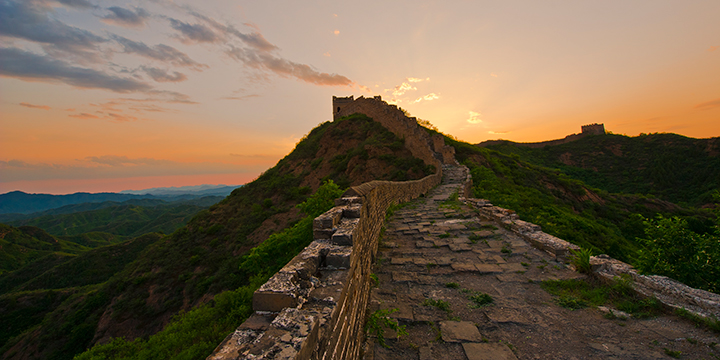
Cloud and light over the Jinshanling ridge
Cloud can reflect warm light and create separation between ridges. Meter highlights around the sun, review the histogram and bracket only when the wall and camera are stable. A graduated filter can help at a clear horizon, but irregular towers often make a bracketed exposure blend more natural. Record a neutral frame so later editing does not erase the weather you actually encountered.
A sea of clouds forms only under suitable moisture, temperature and wind conditions; it cannot be booked. Fog also reduces path visibility and makes stone damp. If the wall edge or next stair is unclear, stop moving, retreat to a signed safe area and make close architectural studies rather than chasing a viewpoint.
The rule of thirds is one option, not a requirement. Place a tower or sun off-centre when it balances the wall's direction; centre the frame when symmetry supports the subject. Keep the horizon level, check edge intrusions and leave enough sky only when cloud contributes information. A 24–70 mm zoom covers most context views; a 70–200 mm lens can compress distant towers but amplifies shake and heat shimmer.
Jinshanling is roughly 130 kilometres from central Beijing, but travel time varies with pickup point, traffic, weather and the operating gate. Sunrise normally requires nearby lodging or a prearranged vehicle because ordinary public transport may not reach an open entrance before first light. Compare it with other Great Wall sections if the group cannot manage long stairs or a pre-dawn start.
Do not use old West Wangjing shuttle times as a current timetable. Routes, minimum-passenger rules and return departures have changed across seasons. Ask the scenic area or a current transport operator for the exact Beijing departure point, operating dates, booking method, final return and which gate is served; save the answer offline in Chinese and English.
Decision point : public transport can suit a daylight visit when the return is confirmed, but it is a poor basis for a sunrise assignment unless the operator explicitly serves that access window.
For dawn or sunset, book a licensed vehicle with a written pickup time, named gate, waiting arrangement, driver rest plan, price and cancellation terms. An English-speaking guide can help with route decisions, but no guide can override closures or guarantee weather. Seat belts, child restraints and legal parking matter more than proximity to an unofficial trail.
A robust plan uses nearby lodging, a daylight scout, one sunset session, rest, then one sunrise attempt with a weather fallback. It does not hike an unknown ridge for the first time in darkness. Tell someone the route, carry water and a small first-aid kit, download the map, and turn the plan into
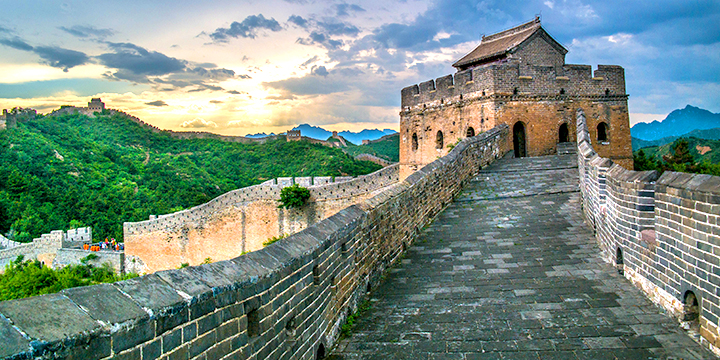
a written Jinshanling photography brief
From $ 1568
From $ 850
From $ 2583
Editorial accountability
Hu Lei, CEO. The named owner is responsible for travel-planning accuracy and escalation of time-sensitive checks.
Yuntian Travel (Yunnan) Group is identified in its corporate profile as a licensed professional inbound travel service provider based in Kunming, China. Registration and travel-service documents can be requested before booking.
Page-specific references where cited, official destination, transport and entry notices, YUNSKY route-planning records, and direct provider confirmation before a booking is finalized.
Content is reviewed when rules, transport, access, pricing or route conditions change. Final availability and operating details are reconfirmed for each traveler’s dates.
Quality review: Page updated: